










Johnson® Faces Unhedged Metal Costs With Limited Long-Term Contracts
Key highlights
- Cost of goods sold was 83.21% of revenue from operations in the period ended August 31, 2026, down from 90.50% in FY 2023-24.
- Johnson® does not use derivatives to hedge aluminium, copper or other raw-material price volatility.
- Johnson®’s top 10 customers accounted for 66.24% of revenue from operations in FY 2025-26 and 55.44% in the period ended August 31, 2026.
- Johnson® says it has not experienced material disputes with major raw-material suppliers despite relying largely on purchase orders and short-term arrangements.
powered by IRIS
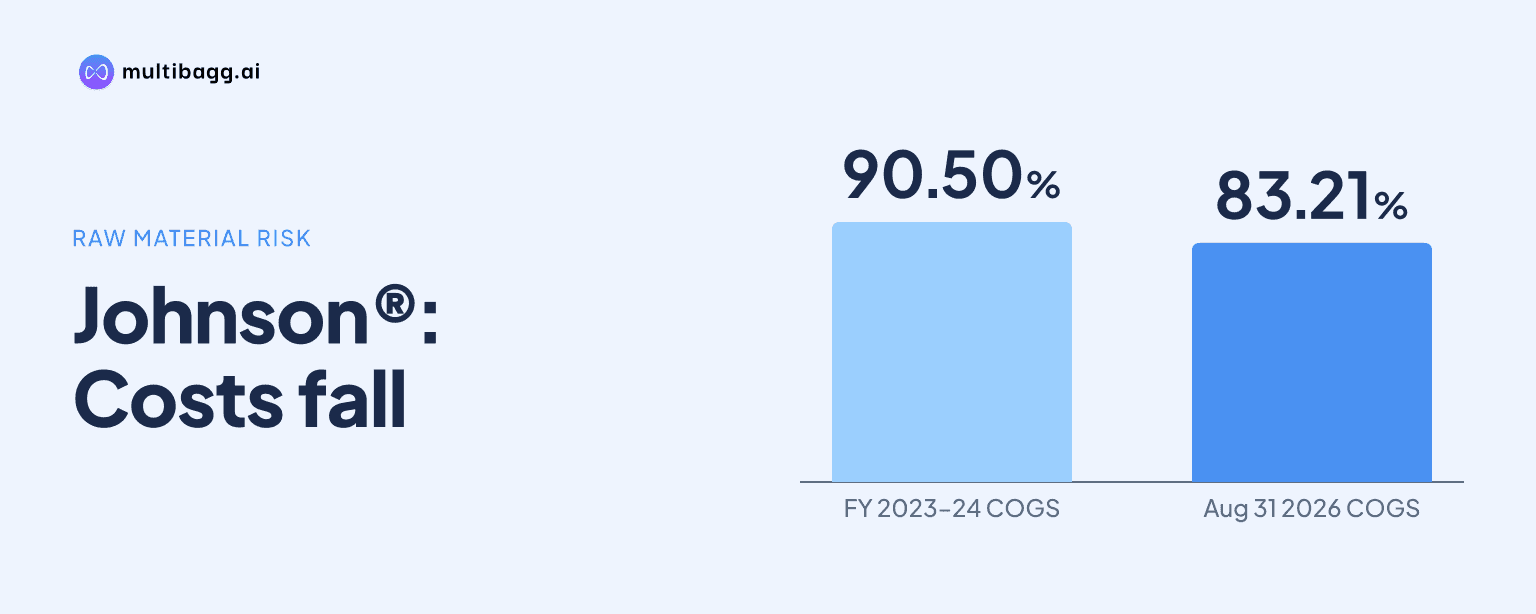
Johnson® faces unhedged metal-cost exposure because it does not use derivatives to mitigate raw-material price volatility and has no long-term contracts with most suppliers. Cost of goods sold was 83.21% of revenue from operations in the period ended August 31, 2026, after reaching 90.50% in FY 2023-24.
Why does Johnson® face unhedged metal-cost exposure?
Johnson® faces this exposure because aluminium and copper wire and rods are inputs for its cable and wire manufacturing, and it does not currently undertake hedging activities or enter into derivative contracts to mitigate raw-material price volatility. Hedging in this disclosure refers to activities or derivative contracts intended to mitigate the effect of price volatility.
Johnson® also identifies polyvinyl chloride, or PVC, cross-linked polyethylene, or XLPE, GI strips or wires, and packing wooden drums as materials prone to price fluctuations. The prospectus attributes possible price volatility and supply disruptions to domestic and foreign trade policies, shifts in supply and demand, competition and other factors outside Johnson®’s control.
Johnson® states that it generally passes cost increases to customers, but may not be able to pass on every increase and may need internal cost-control measures. If customer-price recovery and internal controls do not compensate for higher input costs, Johnson® says its results of operations, financial condition and cash flows could be materially affected.
How much of Johnson® revenue is tied to cost of goods sold?
Johnson® reported cost of goods sold of 83.21% to 90.50% of revenue from operations across the disclosed periods. Cost of goods sold is the reported cost of products sold, and its high share of revenue makes changes in raw-material procurement costs consequential to operating results.
Johnson®’s cost-of-goods-sold ratio declined from 90.50% in FY 2023-24 to 88.25% in FY 2024-25, 85.12% in FY 2025-26 and 83.21% in the period ended August 31, 2026. The reported decline does not change the disclosed absence of hedging or the absence of long-term contracts with most suppliers; continued cost protection would depend on procurement prices, customer pass-through and cost controls remaining aligned.
Why do limited long-term contracts matter for Johnson®?
Limited long-term contracts matter because Johnson® usually procures from major suppliers either under formal agreements or on a short-term basis through purchase orders, rather than under long-term contracts. Johnson® says it cannot assure adequate, continuous or timely raw-material supply at competitive prices in future periods.
Johnson®’s top 10 suppliers accounted for 20.05% of raw-material purchases in the period ended August 31, 2026, compared with 49.30% in FY 2025-26, 64.05% in FY 2024-25 and 36.38% in FY 2023-24. The latest partial-period figure indicates less concentration among the top 10 suppliers than in FY 2024-25, but the prospectus still identifies reductions, discontinuations and delays in supply as risks.
Johnson®’s top supplier represented 10.21% of raw-material purchases in the period ended August 31, 2026, compared with 8.96% in FY 2025-26 and 13.00% in FY 2024-25. Its top five suppliers represented 16.21% in the latest period, versus 31.11% in FY 2025-26 and 27.80% in FY 2024-25; lower concentration does not itself establish long-term commitments on supply volumes or prices.
Got a follow-up? Ask IRIS
What has Johnson® said about supplier performance and disputes?
Johnson® says it has not experienced material disputes with major raw-material suppliers arising from the absence of formal long-term supply agreements. Its supplier arrangements are generally governed by purchase orders and supporting documents, while disputes are addressed through applicable terms, records and discussions with the supplier concerned.
Johnson® maintains transaction records to establish the rights, obligations and responsibilities of each party. This process provides a basis for resolving an individual supplier matter, but it does not mitigate market-wide movements in copper, aluminium or other input prices, and it does not secure long-term material availability.
Johnson® reported Rs 179.1593 crore of cost of goods sold in FY 2025-26, equal to 85.12% of revenue from operations. At that reported scale, a delay or reduction in input availability could affect the pricing and supply of finished cables and wires, as described in the risk factor.
What conditions determine whether Johnson® can preserve margins?
Johnson® can preserve margins only if it obtains required materials in adequate quantities and at competitive prices, while recovering increases from customers or offsetting them through internal controls. The prospectus does not quantify the speed, extent or contractual basis of customer price pass-through, and expressly says that every cost increase may not be recoverable.
Customer concentration can affect that recovery process. Johnson®’s top 10 customers generated 66.24% of revenue from operations in FY 2025-26, compared with 51.87% in FY 2024-25 and 28.18% in FY 2023-24; Johnson® also has no long-term or exclusive arrangements with customers.
In the period ended August 31, 2026, Johnson®’s top 10 customers accounted for 55.44% of revenue from operations and its top three customers accounted for 33.56%, below FY 2025-26 shares of 66.24% and 45.41%, respectively. Johnson®’s disclosed customer-retention plan is to implement projects cost-effectively and efficiently, which it says is intended to provide better value and increase engagement with new and existing customers.
Conclusion
Johnson®’s disclosed operating risk combines volatile copper, aluminium and other inputs with no current hedging activity and no long-term contracts with most suppliers. Cost of goods sold declined as a share of revenue from 90.50% in FY 2023-24 to 83.21% in the period ended August 31, 2026, but the procurement and hedging practices described in the prospectus remain unchanged.
The next issue is whether Johnson® can continue to recover higher input costs from customers while procuring adequate materials at competitive prices. Johnson® has disclosed a plan to retain customers through cost-effective and time-efficient project implementation, but it has not disclosed a plan to begin hedging raw materials or to move most supplier purchases to long-term contracts.