










Johnson plans 17.8-fold Unit-II wire-and-cable capacity rise
Key highlights
- Johnson plans to add 167,580 km of annual wires-and-cables capacity at Unit-II, increasing installed capacity from 9,950 km to 177,530 km.
- The Unit-II wires-and-cables expansion is estimated to cost Rs 18.37 crore, including Rs 9.90 crore for plant and machinery.
- Government-tender revenue rose from Rs 4.92 crore in Fiscal 2024 to Rs 39.75 crore in Fiscal 2026.
- Johnson is also adding a separate PICC line with annual installed capacity of 47.25 metric tonnes.
powered by IRIS
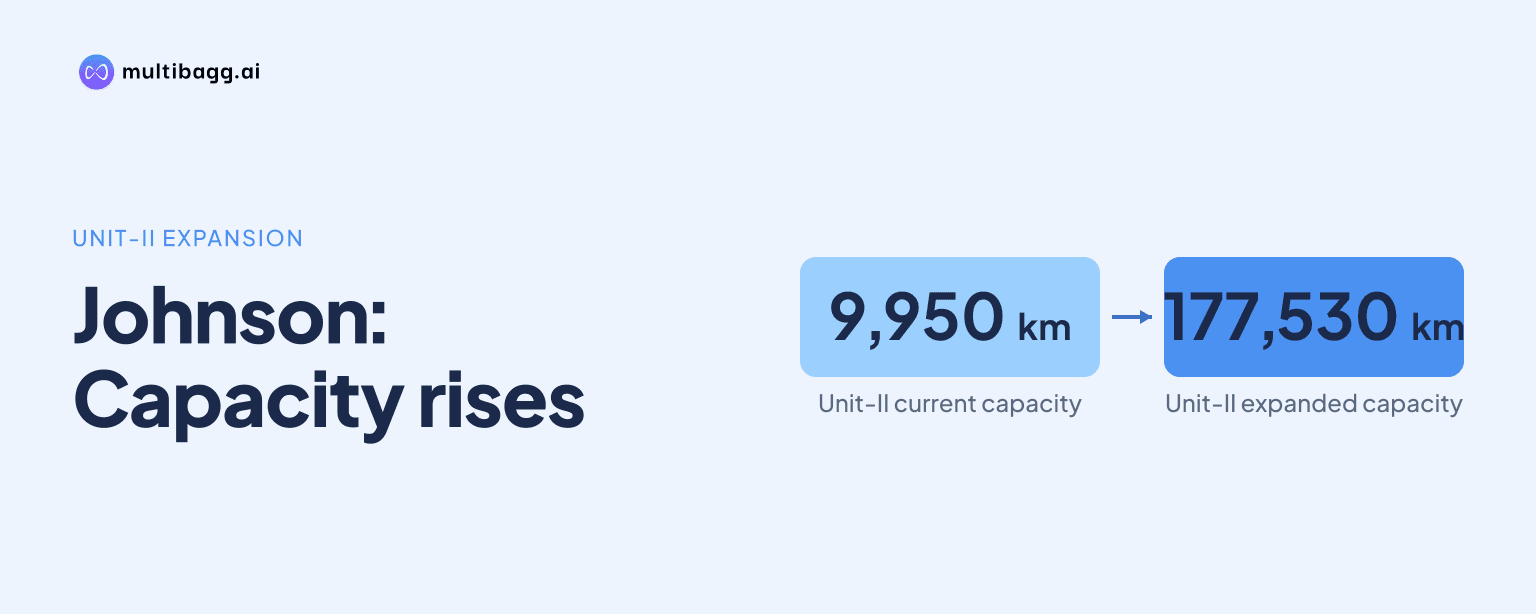
Johnson plans to raise Unit-II wires-and-cables installed capacity from 9,950 kilometres a year to 177,530 kilometres, a 17.8-fold increase based on two proposed production lines. The plan carries an estimated Rs 18.37 crore cost for the shed and machinery, while commercial production is targeted for April 2027 and approvals remain pending.
How will Johnson expand Unit-II wire-and-cable capacity?
Johnson will add 167,580 km of annual wires-and-cables capacity at Unit-II, taking installed capacity to 177,530 km from 9,950 km. Vishvakarma Consulting Services Private Limited, an independent chartered engineer, assessed the proposed capacity in its August 6, 2026 technical evaluation report.
The calculation assumes two machine lines, one production shift and 315 working days a year. The proposed machinery is designed for wire sizes of 0.75 square millimetres, 1 square millimetre, 1.5 square millimetres, 2.5 square millimetres, 4 square millimetres and 6 square millimetres. On that basis, each proposed machine line has average annual capacity of 83,790 km.
Johnson proposes to install the equipment in Shed-3 at Unit-II in Linch, Mehsana, Gujarat. Unit-II has built-up area of 9,999.45 square metres, with 3,930.47 square metres in Shed-1 used for the existing setup and 6,068.98 square metres identified as free area. The planned machinery installation requires 341.89 square metres.
The additional capacity is intended for housing and building wires, industrial single-core cables, and solar or photovoltaic cables. The disclosed end uses are residential and commercial construction, manufacturing, oil and gas, chemical and infrastructure activity, and solar-power infrastructure. Installed capacity measures the facility's potential output, so actual production will depend on commissioning, operating conditions and customer demand.
What will Johnson spend on the Unit-II expansion?
Johnson estimates that the Unit-II wires-and-cables expansion will cost Rs 18.37 crore, comprising Rs 8.46 crore for civil work and a factory shed and Rs 9.90 crore for plant and machinery. The company had deployed Rs 52.60 lakh for machinery as of the Red Herring Prospectus date and proposes to fund Rs 17.84 crore of the total from net issue proceeds.
The proposed factory shed will cover about 3,294.43 square metres on Unit-II's 21,796-square-metre plot. Johnson holds the site under a lease agreement originally dated June 6, 2023 and amended on December 31, 2025, for 10 years commencing January 1, 2026. Lease payments are to be funded through internal accruals, while the proposed shed cost is to be funded from net issue proceeds.
The civil-work estimate includes Rs 7.03 crore of vendor-quoted work, Rs 1.27 crore of taxes and Rs 16.70 lakh of contingency, resulting in the rounded Rs 8.46 crore cost. The contingency is 2% of the underlying cost estimate for unforeseen circumstances or costs. Johnson states that it had not placed firm civil-work orders or entered definitive agreements with the quoted suppliers.
The machinery plan includes two high-speed insulation lines, automatic coiling machines, cranes, a compressor, an air dryer, a heater-cooler mixer, material-conveying equipment, laboratory instruments and a 2,600 kilovolt-ampere transformer. Purchase orders had been placed for equipment with a total rounded cost of Rs 7.03 crore, including taxes and other costs, while machinery quotations totalled Rs 2.88 crore. The Rs 52.60 lakh advance was paid for the two insulation lines.
Why is Johnson planning the larger Unit-II capacity?
Johnson links the Unit-II wire-and-cable capacity expansion to higher government-tender revenue and expected demand from power, infrastructure, renewable-energy, construction and distribution customers. Revenue from government tenders increased from Rs 4.92 crore in Fiscal 2024 to Rs 39.75 crore in Fiscal 2026, an increase of Rs 34.83 crore over two fiscal years.
Johnson says its registrations with Railways, Uttar Gujarat Vij Company Limited and Jaipur Vidyut Vitran Nigam Limited provide access to procurement opportunities. The company also discloses ongoing efforts to obtain additional registrations and participate in further government tenders. Those registrations may support tender participation, but tender revenue does not itself establish future production volumes or capacity utilisation.
Johnson manufactures low-voltage wires and cables rated up to 1.1 kilovolts for power transmission and distribution, renewable-energy integration, railways and industrial applications. Its existing range includes power cables, control cables, industrial single- and multicore control cables, housing and building wires, welding cable, solar or photovoltaic cables, and submersible flat cables.
The expansion follows a higher level of capital expenditure in Fiscal 2026. Total capital expenditure was Rs 16.91 crore in Fiscal 2026, compared with Rs 1.65 crore in Fiscal 2025 and Rs 9.84 crore in Fiscal 2024. Plant, machinery and equipment accounted for Rs 14.25 crore in Fiscal 2026, while factory building and shed expenditure was Rs 2.65 crore.
Got a follow-up? Ask IRIS
What else is Johnson adding at Unit-II?
Johnson is adding a separate Paper Insulated Copper or Aluminium Conductors, or PICC, line at Unit-II with annual installed capacity of 47.25 metric tonnes. PICC is a new product line and is not included in the planned 177,530-km wires-and-cables capacity figure.
The PICC capacity calculation assumes daily production of 150 kilograms over 315 working days, equalling 47,250 kilograms, or 47.25 metric tonnes, a year. Johnson proposes to use Rs 7.33 crore of net issue proceeds for PICC machinery against a total estimated machinery cost of Rs 8.50 crore. The company says PICC civil construction has commenced using term loans and is not an object of the offer.
Johnson states that PICC can be used in oil-filled power and distribution transformers, dry-type transformers, high-tension motors and windmill generators. The PICC machinery is planned for Shed-2 and requires 770.35 square metres, within the 6,068.98 square metres of stated free area at Unit-II.
Separately, Johnson proposes rooftop solar power plants at Units I and II, allocating Rs 3.23 crore from net issue proceeds. The stated purpose is to reduce power costs through captive solar generation. The solar project does not form part of the 167,580-km proposed addition to Unit-II wires-and-cables capacity.
What must happen before the added capacity can operate?
Johnson must complete civil works, machinery delivery, installation, trial runs and commissioning before the expanded Unit-II capacity can operate. The disclosed implementation schedule marks civil works as pending for November to December 2026, machinery delivery and installation for January to February 2027, and trial runs and commissioning for March to April 2027.
Johnson targets commencement of operations and commercial production in April 2027. Basic and detailed engineering and finalisation of civil and structural drawings were marked in process through September 2026, while ordering of plant and machinery was marked in process through December 2026. Purchase orders had been placed for specified machinery listed in the prospectus.
Three approvals remained pending: factory-plan approval under the Factories Act, 1948; consent to operate from the Gujarat Pollution Control Board after plant completion; and approval for load release and extension of electricity supply from Uttar Gujarat Vij Company Limited. Johnson had received consent to establish from the pollution board and factory layout and building-plan approval from Mehsana's Town Planning and Valuation department dated December 31, 2025.
The company states that its funding requirements are management estimates based on prevailing market rates and vendor quotations and have not been appraised by a bank, financial institution or independent agency. If net issue proceeds are insufficient or actual costs rise, Johnson may use internal accruals or additional debt facilities. It also states that no bridge financing had been availed as of the prospectus date.
Conclusion
Johnson's Unit-II wire-and-cable capacity plan would add 167,580 km of annual installed capacity to a 9,950-km base, alongside a separate 47.25-metric-tonne PICC line. The proposed scale reflects the company's tender-revenue increase between Fiscal 2024 and Fiscal 2026 and its stated demand expectations across construction, infrastructure, power and renewable-energy applications.
The next milestones are the scheduled civil works, machinery delivery, installation, trial runs and April 2027 commercial-production target. The timing and cost of the project will depend on receipt of the pending factory-plan, pollution-control and electricity approvals, as well as final vendor arrangements and availability of the planned financing.