










Johnsoncab housing wires become its largest revenue line
Key highlights
- Housing/building wires generated Rs 50.8051 crore, or 44.95% of Johnsoncab’s revenue, in the five months ended August 31, 2026.
- Power-cable revenue fell to Rs 10.3204 crore, or 9.13% of revenue, in the five months ended August 2026, from a 32.58% share in fiscal 2026.
- Gujarat accounted for Rs 86.3313 crore, or 76.37% of revenue, in the five months ended August 2026.
- Johnsoncab’s distributor revenue was Rs 27.4732 crore, or 24.31% of revenue, and its ultimate industry allocation was not recorded.
powered by IRIS
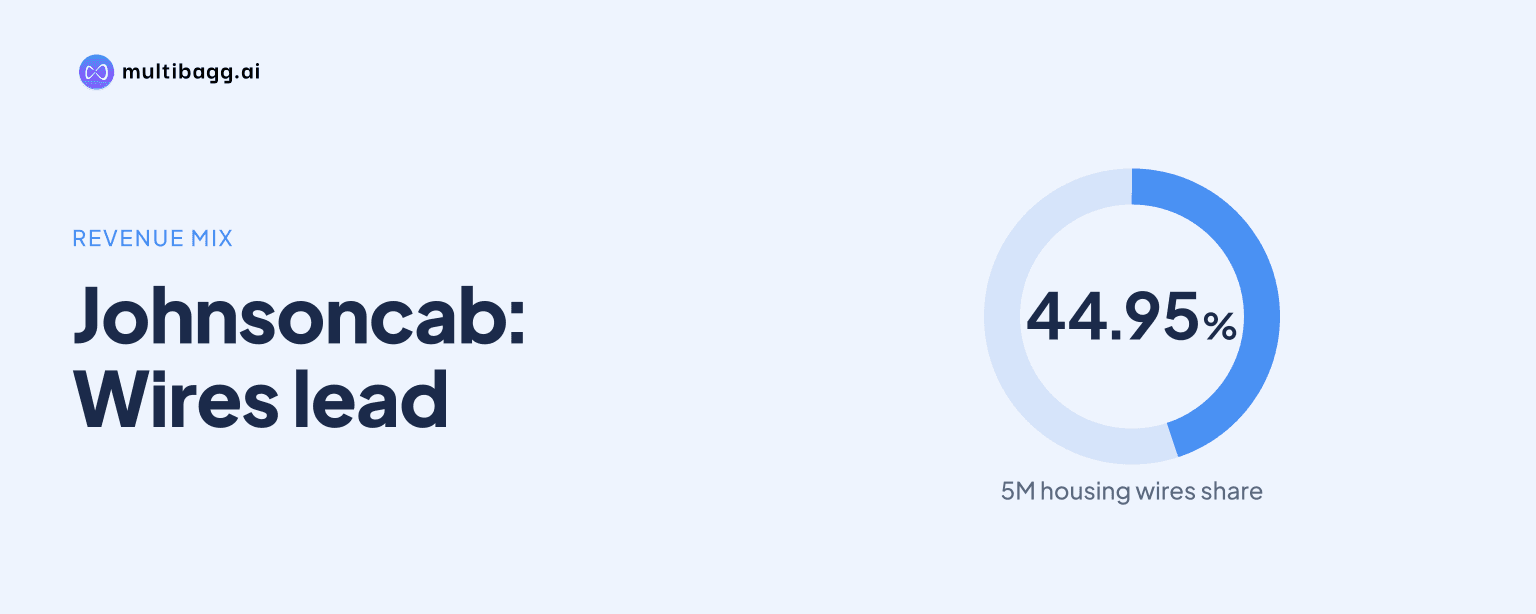
Johnsoncab’s housing/building wires became its largest named product line in the five months ended August 31, 2026, generating Rs 50.8051 crore, or 44.95% of revenue from operations. The category exceeded submersible flat cables at 14.76% and power cables at 9.13%, reversing the product ranking seen in fiscal 2026.
Why did Johnsoncab housing wires become its largest revenue line?
Johnsoncab housing wires became the largest named revenue line because their share rose to 44.95% in the five months ended August 31, 2026, from 30.04% in fiscal 2026 and 17.31% in fiscal 2025. The category generated Rs 50.8051 crore in five months, compared with Rs 63.219 crore for the full year ended March 31, 2026 and Rs 24.1963 crore in fiscal 2025.
The ranking changed primarily because power cables, the largest product line in fiscal 2026, accounted for Rs 68.5719 crore and 32.58% of that year’s revenue. In the five months ended August 2026, power-cable revenue was Rs 10.3204 crore, or 9.13%, placing it below housing wires and submersible flat cables.
The reported sequence shows that the mix had already changed before the latest five-month period. Housing/building wires represented 17.63% of revenue in fiscal 2024, 17.31% in fiscal 2025, 30.04% in fiscal 2026 and 44.95% in the five months ended August 2026. Submersible flat cables moved from 35.28% in fiscal 2024 to 21.95% in fiscal 2025, 13.75% in fiscal 2026 and 14.76% in the latest period.
What do Johnsoncab’s housing-wire sales volumes show?
Johnsoncab’s volume disclosure shows that housing/building wires are sold using two separate measures. The company reported 158,009 housing/building-wire units and 7,475.56 kilometres of housing/building wires in the five months ended August 31, 2026. Johnsoncab states that wires sold on a numbers basis are segregated from kilometre-based volumes, so the two measures cannot be combined.
The kilometre-based measure increased before the latest period. Housing/building-wire volume rose 51.75% to 12,944.9 kilometres in fiscal 2025 from 8,530.5 kilometres in fiscal 2024, then rose 4.22% to 13,490.9 kilometres in fiscal 2026. The unit-based disclosure recorded zero in fiscal 2024 and fiscal 2025, with year-on-year changes marked as not applicable.
Submersible flat-cable volumes followed a different path. Volume declined 21.50% to 2,151.2 kilometres in fiscal 2025 from 2,740.4 kilometres in fiscal 2024, then rose 5.29% to 2,264.9 kilometres in fiscal 2026. In the five months ended August 2026, submersible flat-cable volume was 1,383.48 kilometres and revenue was Rs 16.6879 crore, less than one-third of housing-wire revenue.
Which markets are linked to Johnsoncab’s housing-wire revenue mix?
Johnsoncab identifies housing wires as products for low-voltage residential requirements, including power distribution for lighting, appliances and utilities in residential and commercial construction. Its house/building-wire portfolio includes heat-resistant flame-retardant, flame-retardant low-smoke-halogen and HRFR Gold products, each rated up to 1,100 volts and described as compliant with IS 694:2010.
Construction, covering residential and commercial activity, generated Rs 29.8067 crore, or 26.37% of revenue, in the five months ended August 2026. That share rose from 17.27% in fiscal 2026 and 2.95% in fiscal 2025, while renewable energy accounted for 22.74% in the latest period. The industry disclosure is directionally consistent with housing-wire exposure but does not allocate every product sale to an end-use market.
The incomplete allocation matters because distributor revenue was Rs 27.4732 crore, or 24.31% of five-month revenue. Johnsoncab says it does not maintain records of the ultimate industry served by products sold through distributors, and therefore presents those sales separately. Construction revenue is consequently not a complete measure of housing-wire demand.
Got a follow-up? Ask IRIS
How concentrated is Johnsoncab’s revenue as housing wires lead?
Johnsoncab’s sales remained concentrated in Gujarat while housing wires became the largest named product category. Gujarat contributed Rs 86.3313 crore, or 76.37% of revenue from operations, in the five months ended August 31, 2026, compared with 70.91% in fiscal 2026. Andhra Pradesh contributed 8.11% and Karnataka contributed 6.08% in the latest period.
Housing/building wires were the largest named product category, but the residual “Others” line was Rs 20.924 crore, or 18.50% of five-month revenue. Johnsoncab defines Others as sales of scrap, raw materials and other residual products, compared with a 7.06% share in fiscal 2026. This distinction separates the company’s principal identified manufactured product from a broader residual sales category.
Johnsoncab operates two manufacturing units in Mahesana, Gujarat, with aggregate land area of 27,793 square metres and built-up area of 10,031.06 square metres, according to a June 1, 2026 engineer’s certificate. The facilities manufacture low-voltage wires and cables designed for voltages of up to 1.1 kilovolts, using copper or aluminium conductors and polyvinyl chloride or cross-linked polyethylene insulation.
What would need to hold for the shift to persist?
The housing-wire-led mix would need to continue beyond a five-month reporting period. Johnsoncab reported total revenue from operations of Rs 113.0362 crore for the five months ended August 2026, versus Rs 210.4741 crore for fiscal 2026, making the two periods different in duration. Housing wires would need to retain a large share while power, solar and submersible categories remain below their fiscal 2026 proportions.
The company’s latest sales base was entirely domestic, with domestic revenue of Rs 113.0362 crore and no export revenue in the five months ended August 2026. In fiscal 2026, exports were Rs 0.6298 crore, or 0.30% of revenue. The continued mix will therefore depend on domestic sales, particularly in Gujarat, and on distributor revenue whose end use Johnsoncab does not record.
Conclusion
Johnsoncab’s product disclosures show a clear change in sales composition: housing/building wires rose from about 17% of revenue in fiscal 2024 and fiscal 2025 to 44.95% in the five months ended August 2026. At the same time, power cables fell from 32.58% of fiscal 2026 revenue to 9.13%, while submersible flat cables remained well below their fiscal 2024 share.
The next full-year product breakdown will indicate whether the five-month pattern continues. Johnsoncab has not disclosed a separate housing-wire capacity plan or product-sales target in the supplied material, while 24.31% of latest-period revenue came through distributors without recorded final end use; those are the main unresolved factors in assessing the mix shift.