










Johnsoncab lacks order book as top 10 drive FY2025-26 revenue
Key highlights
- Johnsoncab has no formal long-term order book and generally manufactures and dispatches products within one to two months of receiving purchase orders.
- The top 10 customers contributed Rs 139.41 crore, or 66.24%, of FY2025-26 revenue of Rs 210.47 crore.
- Johnsoncab’s customer count fell to 460 at March 31, 2026, from 524 a year earlier, despite adding 199 new customers during FY2025-26.
- The company operated its two Mehsana plants at 79.62% capacity utilisation in FY2025-26, producing 63,659 kilometres against installed capacity of 79,950 kilometres.
powered by IRIS
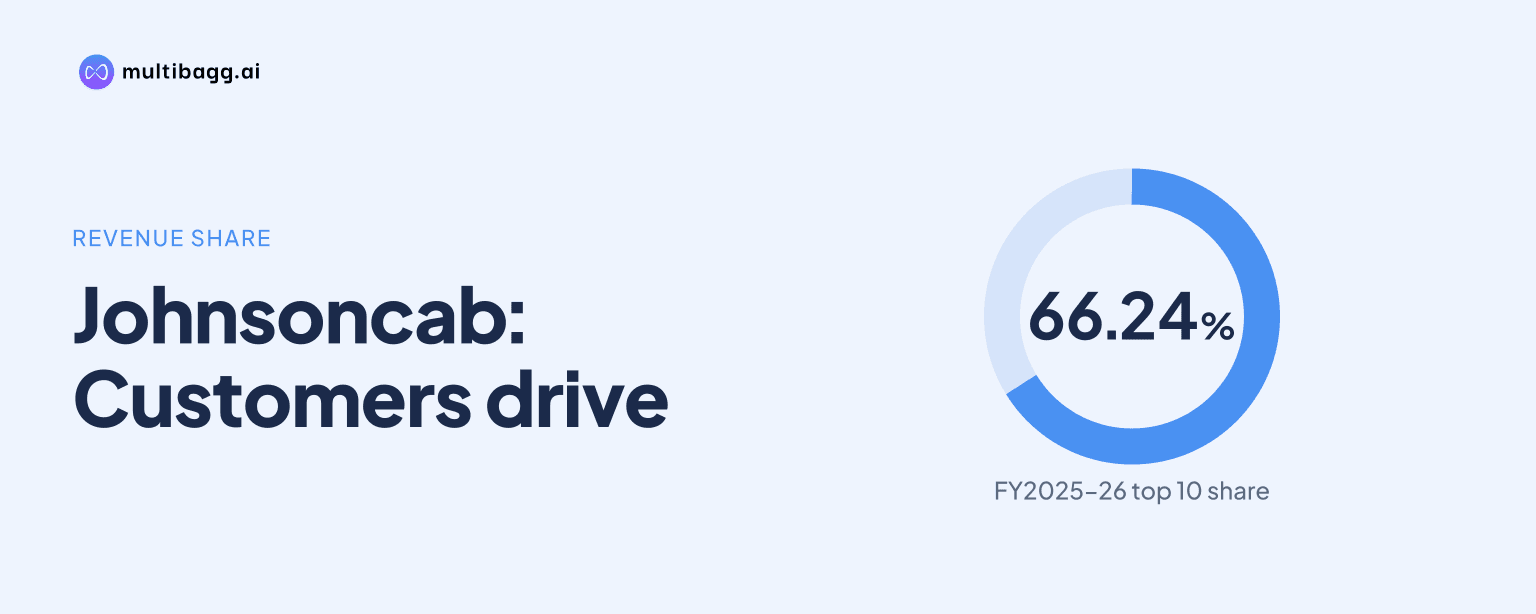
Johnsoncab does not maintain a formal order book of long-term or unexecuted contracts, although its 10 largest customers generated Rs 139.41 crore, or 66.24%, of FY2025-26 revenue. Production starts after regular purchase orders, and products are generally manufactured and dispatched within one to two months.
What does Johnsoncab’s lack of a formal order book mean?
Johnsoncab’s reported sales are not supported by a disclosed backlog of signed, unexecuted long-term contracts. The company says its business model primarily relies on regular purchase orders from established customers, after which it plans production and procures raw materials. It reports that no significant long-term unexecuted orders are generally pending.
Johnsoncab’s order process runs from customer inquiry and technical evaluation to quotation, order confirmation, production planning, manufacturing, sample-based quality testing, packing and dispatch. Its main inputs include copper and aluminium rods, polyvinyl chloride, or PVC, and cross-linked polyethylene, or XLPE. PVC and XLPE are insulation and sheathing materials used in wires and cables.
The one-to-two-month manufacturing and dispatch cycle means future production depends on new customer purchase orders being received on an ongoing basis. For railway supplies, Johnsoncab participates in relevant tenders and receives purchase orders after successful awards; tender participation itself is not treated as an order book. Its distribution network supports recurring demand, but the company does not disclose contracted future sales through that network.
How concentrated was Johnsoncab revenue among its largest customers?
Johnsoncab’s top 10 customers supplied Rs 139.41 crore, or 66.24%, of FY2025-26 revenue from operations of Rs 210.47 crore. Their share rose from 51.87% in FY2024-25 and 28.18% in FY2023-24, increasing the importance of continued purchases by a limited set of accounts.
Johnsoncab’s largest customer in FY2025-26 was in the railway vertical and supplied Rs 38.63 crore, or 18.35% of revenue. The second-largest customer, in residential and commercial construction, supplied Rs 30.71 crore, or 14.59%, and the third-largest, in renewable energy, supplied Rs 26.23 crore, or 12.46%. The top three therefore accounted for 45.40% of FY2025-26 revenue.
Johnsoncab does not disclose customer names because it says it did not receive consent to do so. The statutory-auditor-certified customer table shows that the top five customers contributed 54.25% of FY2025-26 revenue across railway, construction, renewable energy and power-transmission categories.
Has Johnsoncab’s customer base changed alongside concentration?
Johnsoncab’s closing number of customers fell to 460 at March 31, 2026 from 524 at March 31, 2025, despite 199 new customers being added in FY2025-26. The company recorded 263 customers that had sales in FY2024-25 but no sales in FY2025-26, exceeding the 199 additions.
In FY2024-25, Johnsoncab began with 493 customers, added 255 and reported 224 prior-year customers without current-year sales, closing with 524 customers. The disclosed movement measures customers with sales, rather than contract cancellations or the reasons individual customers ceased buying, so it does not establish the cause of the lower FY2025-26 closing count.
The top-10 share declined to 55.44% in the five months ended August 31, 2026, from 66.24% in FY2025-26. However, the partial-period figure represents Rs 62.67 crore of Rs 113.04 crore in revenue and cannot alone establish an annual change in customer concentration.
Got a follow-up? Ask IRIS
How does the purchase-order model affect production and procurement?
Johnsoncab schedules production and sources materials after receiving customer purchase orders, making the continuity of ordering central to factory activity. Cost of goods sold was Rs 179.16 crore in FY2025-26, equal to 85.12% of revenue from operations, reflecting the scale of materials and manufacturing costs required to fulfil sales.
The cost-of-goods-sold ratio was 90.50% in FY2023-24 and 88.25% in FY2024-25 before falling to 85.12% in FY2025-26. It was 83.21% in the period ended August 31, 2026. Johnsoncab identifies copper, aluminium and PVC price dependence as a weakness and states that cost increases can affect profitability if they cannot be passed on to customers.
Johnsoncab’s two Mehsana, Gujarat manufacturing units had aggregate installed capacity of 79,950 kilometres and actual production of 63,659 kilometres in FY2025-26. Total capacity utilisation, defined by the company as actual production divided by aggregate available capacity, was 79.62% in FY2025-26.
For the five months ended August 31, 2026, Johnsoncab reported pro-rata installed capacity of 33,400 kilometres, production of 21,590 kilometres and utilisation of 64.64%. It stated that annualised installed capacity at August 31, 2026 was 79,950 kilometres, with no fresh plant-and-machinery capital expenditure or material change in shifts and unplanned maintenance during the period.
Does Johnsoncab have customer-type and sector diversification?
Johnsoncab derived Rs 170.72 crore, or 81.11%, of FY2025-26 revenue from private entities, while public-sector units and state government agencies supplied Rs 39.75 crore, or 18.89%. The private-sector majority means the reported customer concentration was primarily within private-entity revenue.
For the period ended August 31, 2026, private entities accounted for Rs 112.41 crore, or 99.44%, of revenue, while public-sector units and state agencies supplied Rs 63.10 lakh, or 0.56%. Johnsoncab categorises top customers across railway, construction, renewable energy, power transmission, chemicals, distribution and agriculture, but this sector spread does not change the 66.24% top-10 share reported for FY2025-26.
Revenue at the FY2025-26 level would require repeat orders from major accounts, continued activity in relevant end markets, available manufacturing capacity and timely procurement of materials. Johnsoncab’s procurement process uses an internally maintained vendor list and includes supplier evaluation, requests for quotation, commercial negotiation and purchase-order placement.
Conclusion
Johnsoncab’s disclosed operating model relies on repeat purchase orders rather than a formal backlog, while its top 10 customers provided 66.24% of FY2025-26 revenue. This makes customer concentration relevant to annual revenue composition as well as near-term procurement, production planning and dispatches under the one-to-two-month fulfilment cycle.
The disclosed indicators to watch next are the customer count after 460 at March 31, 2026, the top-10 customer share after 55.44% in the five months ended August 31, 2026, and the government-private revenue mix. Johnsoncab’s stated railway tender participation and annualised 79,950-kilometre capacity provide context for future execution, but neither represents a disclosed long-term order book.