










Johnsoncab’s working capital more than doubled in two years
Key highlights
- Johnsoncab’s net working capital rose 191% from Rs 26.7282 crore in FY24 to Rs 77.7381 crore in FY26.
- Inventory increased by Rs 30.5851 crore and trade receivables by Rs 25.7509 crore between FY24 and FY26.
- Johnsoncab reported negative operating cash flow in each of FY24, FY25 and FY26, including an outflow of Rs 19.7006 crore in FY26.
- Net working capital days reached 122 for the five months ended August 31, 2026, up from 111 days in FY26.
powered by IRIS
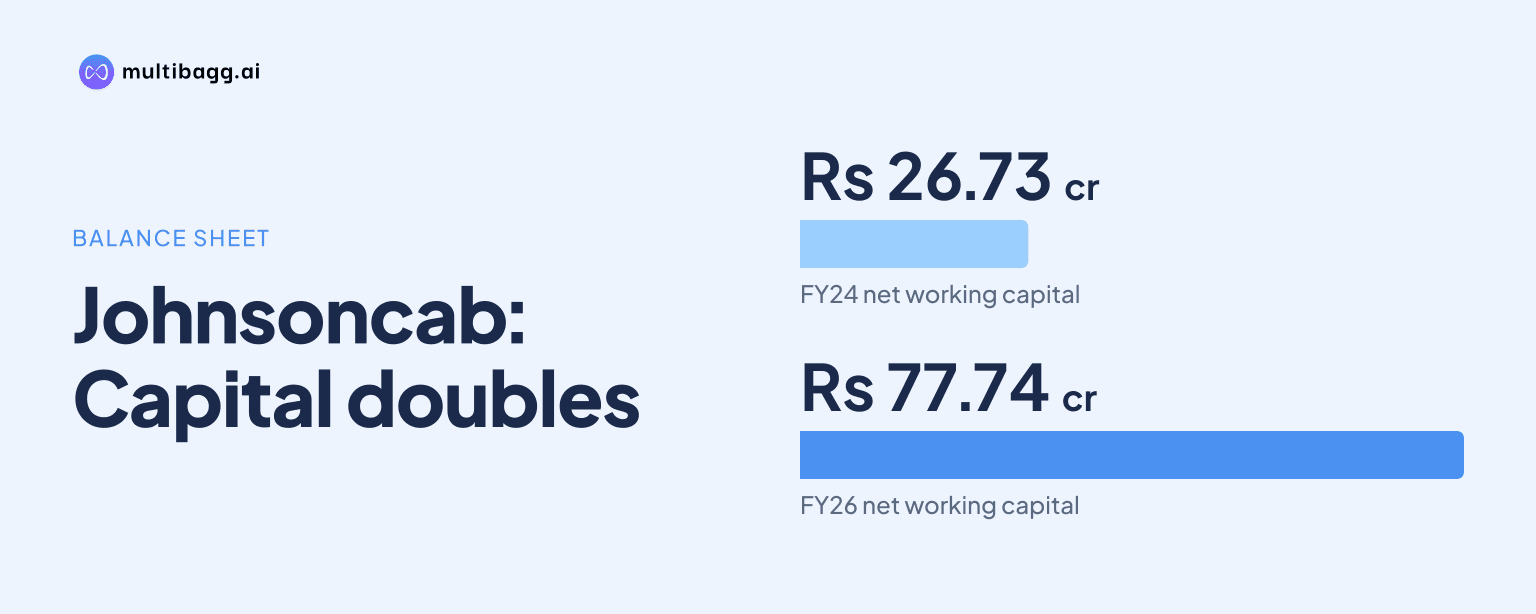
Johnsoncab’s net working capital more than doubled from Rs 26.7282 crore in FY 2023-24 to Rs 77.7381 crore in FY 2025-26, driven chiefly by higher inventory and trade receivables. The company recorded negative operating cash flow in each of the three fiscal years through FY26, including Rs 19.7006 crore in FY26.
How far did Johnsoncab’s net working capital increase?
Johnsoncab’s net working capital increased by Rs 51.0099 crore between FY24 and FY26, a rise of about 191%. Net working capital is current assets less current liabilities. At March 31, 2026, Johnsoncab reported restated current assets of Rs 92.4005 crore and current liabilities of Rs 14.6624 crore, resulting in net working capital of Rs 77.7381 crore.
The increase accelerated in FY26. Net working capital rose from Rs 26.7282 crore in FY24 to Rs 38.8501 crore in FY25, then nearly doubled in the following year. It reached Rs 82.2977 crore for the five-month period ended August 31, 2026, although that partial-period balance is not directly comparable with full-year figures.
Johnsoncab defines net working capital days as the sundry debtors holding period plus the inventory holding period, minus the sundry creditor holding period. The measure declined from 111 days in FY24 to 97 days in FY25, returned to 111 days in FY26 and rose to 122 days at August 31, 2026. The latest reading indicates that receivables and inventory, after allowing for supplier credit, represented a larger funding requirement than at FY26 year-end.
Which balances drove Johnsoncab’s working-capital increase?
Inventory and trade receivables accounted for most of Johnsoncab’s expansion in current assets between FY24 and FY26. Inventory rose by Rs 30.5851 crore, to Rs 51.1534 crore from Rs 20.5683 crore, while trade receivables increased by Rs 25.7509 crore, to Rs 37.3574 crore from Rs 11.6065 crore. Together, the two categories increased by Rs 56.3360 crore over the two fiscal years.
At August 31, 2026, inventory stood at Rs 65.4595 crore and trade receivables at Rs 26.8095 crore. Inventory represented about 68% of total current assets of Rs 95.8867 crore at that date. Short-term loans and advances were Rs 3.8488 crore in FY26, compared with Rs 89.23 lakh in FY24, while other current assets were Rs 4.09 lakh in FY26.
Current liabilities increased but did not offset the growth in operating assets. Trade payables rose from Rs 2.5490 crore in FY24 to Rs 10.8430 crore in FY26, an increase of Rs 8.2940 crore. Other current liabilities declined from Rs 3.7517 crore to Rs 3.4189 crore, while short-term provisions increased from Rs 10.47 lakh to Rs 40.05 lakh.
Got a follow-up? Ask IRIS
Why does Johnsoncab need this working-capital funding?
Johnsoncab requires working capital because it purchases raw materials, manufactures products and incurs related expenses before receiving payment from customers. It says it funds these requirements through a mix of internal accruals and bank working-capital facilities. This operating cycle commits funds to materials and production before receivables are collected.
The company identifies delayed billing and settlement, defaults or delays in trade receivables, increased inventory and work in progress, accelerated supplier payments, and limited advances on government contracts as factors that could increase funding needs. It also lists cost overruns, unanticipated expenses, regulatory changes, economic conditions and changes in customer or supplier terms as factors affecting the amount and timing of future working-capital requirements.
Johnsoncab stated that it had not failed to arrange adequate working capital for operations or failed to furnish performance bank guarantees in the disclosed periods. However, continued funding depends on the company securing sufficient working capital in a timely manner through internal accruals and bank facilities. The company says an inability to obtain funding on favourable terms, or at all, could affect cash flows, operating results and financial condition.
What do Johnsoncab’s operating cash flows show?
Johnsoncab reported negative net cash flow from operating activities in FY24, FY25 and FY26. The operating cash outflow was Rs 4.2657 crore in FY24, Rs 1.7307 crore in FY25 and Rs 19.7006 crore in FY26. Johnsoncab attributed the FY26 outflow primarily to higher working-capital requirements arising from the expansion of business operations, while it attributed the FY24 outflow primarily to an early stage of business expansion.
For the five months ended August 31, 2026, Johnsoncab reported positive operating cash flow of Rs 7.6519 crore. That period also included investing cash outflow of Rs 2.5979 crore and financing cash outflow of Rs 5.0520 crore. The positive partial-period operating result does not establish a full-year outcome, particularly because net working capital days were 122 at August 31, 2026.
Johnsoncab says operating earnings in the past three financial years were primarily deployed toward capital expenditure supporting expansion initiatives, while short-term working-capital requirements were funded through bank cash-credit facilities. Net investing cash flow was negative in all three fiscal years, and financing cash inflow was Rs 36.6539 crore in FY26. The reported cash-flow pattern shows that funding requirements extended beyond operating cash generation during FY24 to FY26.
Conclusion
Johnsoncab’s working-capital build-up between FY24 and FY26 was principally associated with a Rs 30.5851 crore increase in inventory and a Rs 25.7509 crore increase in trade receivables. Trade payables increased by Rs 8.2940 crore, but that rise was smaller than the expansion in those two current-asset categories, leaving net working capital at Rs 77.7381 crore at March 31, 2026 and coinciding with the FY26 operating cash outflow.
The next disclosed indicator is whether Johnsoncab can manage inventory, collections and supplier-credit timing while funding operations through internal accruals and bank facilities. Johnsoncab has not disclosed a target for inventory, receivables or net working-capital days, and says future requirements may change with customer and supplier terms, costs, regulation, market developments and unforeseen events.