










Maxwell’s straight-line switch lifted FY26 pre-tax profit
Key highlights
- Maxwell’s FY 2025-26 pre-tax profit was Rs 14.3965 crore under straight-line depreciation, versus Rs 12.5968 crore under the previous method.
- The depreciation-method change reduced FY 2025-26 depreciation by Rs 1.7997 crore, increasing pre-tax profit by the same amount.
- Maxwell reported FY 2025-26 profit after tax of Rs 11.8617 crore, up from Rs 9.1757 crore in FY 2024-25.
- Maxwell purchased property, plant and equipment worth Rs 18.9553 crore in FY 2025-26, compared with Rs 7.3701 crore a year earlier.
powered by IRIS
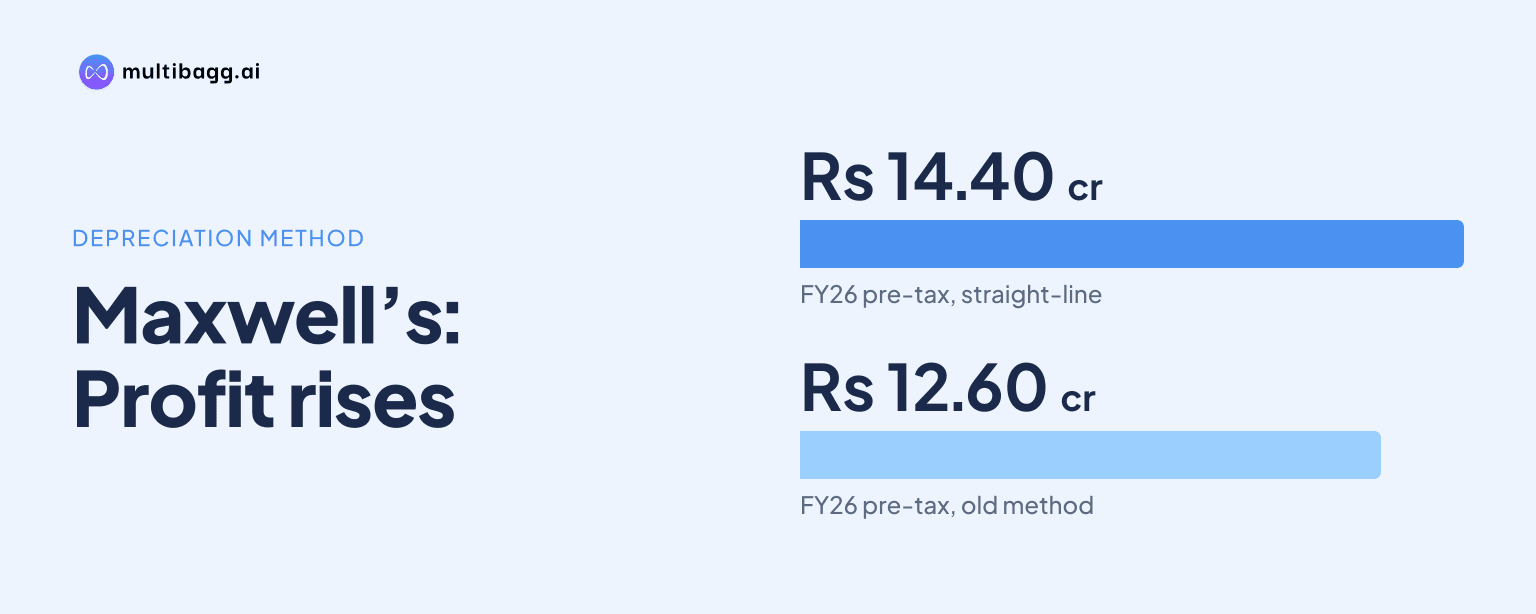
Maxwell Engineering Solutions Limited changed fixed-asset depreciation from the written-down value method to the straight-line method in FY 2025-26, lowering depreciation by Rs 1.7997 crore and increasing profit before tax by the same amount. Maxwell reported FY 2025-26 pre-tax profit of Rs 14.3965 crore under straight-line depreciation, compared with Rs 12.5968 crore under the previous method.
Why did Maxwell’s straight-line switch lift FY26 pre-tax profit?
Maxwell’s straight-line switch lifted FY26 pre-tax profit because the new method produced a lower annual depreciation charge than the written-down value method. Depreciation allocates an asset’s cost over its useful life, while the written-down value method applies depreciation to an asset’s declining carrying amount. For FY 2025-26, Maxwell recorded depreciation of Rs 1.0317 crore under the straight-line method, compared with Rs 2.8314 crore calculated under the written-down value method.
The Rs 1.7997 crore reduction in depreciation flowed into profit before tax because depreciation is reported as an expense in the statement of profit and loss. Maxwell’s disclosed profit before tax was Rs 14.3965 crore using straight-line depreciation, rather than Rs 12.5968 crore under the written-down value calculation. The FY 2025-26 disclosure identifies this as the effect of the depreciation-method change, rather than additional revenue, lower material costs or lower finance costs.
What changed in Maxwell’s depreciation charge?
Maxwell changed the depreciation method for fixed assets during FY 2025-26 and continued to charge depreciation on property, plant and equipment on a pro-rata basis from the addition or deletion date. The restated financial statements report depreciation and amortisation expense of Rs 1.0317 crore for the year ended 31 March 2026, compared with Rs 78.53 lakh for the year ended 31 March 2025 and Rs 52.93 lakh for the year ended 31 March 2024.
The reported charge increased by Rs 25.36 lakh from FY 2024-25 to FY 2025-26, but Maxwell’s comparative calculation says it would have been Rs 2.8314 crore had the written-down value method continued. This distinction affects year-on-year profit comparisons: FY 2025-26 pre-tax profit of Rs 14.3965 crore was Rs 3.3405 crore above FY 2024-25 pre-tax profit of Rs 11.056 crore, of which Rs 1.7997 crore was the disclosed effect of the revised depreciation estimate.
Why were earlier Maxwell financial statements not restated?
Maxwell did not restate earlier periods because it treats the depreciation-method change as a change in accounting estimate rather than a change in accounting policy. Maxwell cites Accounting Standard 5, Net Profit or Loss for the Period, Prior Period Items and Changes in Accounting Policies, together with Accounting Standard 10, Accounting for Fixed Assets. This treatment requires prospective recognition in FY 2025-26 instead of revisions to FY 2024-25 or FY 2023-24 financial results.
The prospective approach applies to the net book value of assets acquired before 1 April 2025 that retained useful life at that date. Net book value is an asset’s recorded cost after accumulated depreciation. Maxwell says those assets will be depreciated using the straight-line method going forward, while useful lives, residual values and depreciation methods will be reviewed at the end of each reporting period and any estimate changes will be accounted for prospectively.
Got a follow-up? Ask IRIS
How does the change affect Maxwell’s reported earnings and cash flow?
Maxwell reported FY 2025-26 profit after tax of Rs 11.8617 crore, compared with Rs 9.1757 crore in FY 2024-25, while current tax was Rs 2.2039 crore and deferred tax was Rs 33.09 lakh. Maxwell quantifies only the pre-tax impact of the method change at Rs 1.7997 crore. The company does not separately disclose an after-tax impact, so the full Rs 2.686 crore increase in profit after tax cannot be attributed to the accounting estimate.
The change affects reported profit because depreciation is a non-cash expense, but the cash-flow statement adds depreciation and amortisation back under the indirect method. Maxwell reported net cash generated from operating activities of Rs 7.4795 crore in FY 2025-26, compared with Rs 7.3719 crore in FY 2024-25. Under the indirect method, profit after tax is adjusted for depreciation, working-capital movements, tax paid and finance costs, separating operating cash generation from the accounting depreciation charge.
What will determine Maxwell’s future depreciation expense?
Maxwell’s future depreciation expense will depend on the straight-line allocation of asset values across its disclosed useful lives and on subsequent estimate reviews. Maxwell lists useful lives of 30 years for buildings, 15 years for plant and equipment, 10 years for furniture and fixtures, eight years for vehicles, five years for office equipment and four years for computers. Maxwell also states that Schedule II of the Companies Act, 2013 specifies a three-year useful life for computers, compared with the four-year life it uses.
Asset additions can also change subsequent charges. Maxwell purchased property, plant and equipment worth Rs 18.9553 crore in FY 2025-26, compared with Rs 7.3701 crore in FY 2024-25, and capitalised Rs 1.5169 crore of eligible research and development expenditure on high-precision die plates in FY 2025-26. Maxwell amortises computer software over six years and assesses finite-life intangible assets for impairment when an indication of impairment exists.
Conclusion
Maxwell’s FY 2025-26 straight-line depreciation switch increased reported pre-tax profit by Rs 1.7997 crore because the method reduced the depreciation charge from a calculated Rs 2.8314 crore under written-down value to Rs 1.0317 crore. The company’s prospective treatment means FY 2024-25 pre-tax profit remains reported at Rs 11.056 crore rather than being revised.
The next reporting periods will show how the straight-line method operates alongside Maxwell’s FY 2025-26 property, plant and equipment purchases of Rs 18.9553 crore and its estimate reviews at each reporting date. The continuing difference from a written-down value comparison will depend on the remaining net book value of assets acquired before 1 April 2025, subsequent additions or disposals, and revisions to useful-life or residual-value estimates.