










Maxwell Engineering’s FY26 capex outstripped operating cash flow
Key highlights
- Maxwell Engineering spent Rs 18.9553 crore on PPE in FY26, compared with Rs 7.4795 crore of net operating cash flow.
- FY26 net investing cash outflow was Rs 13.5781 crore, while net financing cash inflow was Rs 7.0559 crore.
- Maxwell Engineering’s PPE carrying amount rose to Rs 25.5335 crore at March 31, 2026, from Rs 2.8435 crore a year earlier.
- Inventory and trade receivables absorbed Rs 4.6242 crore and Rs 2.7858 crore of cash, respectively, in FY26.
powered by IRIS
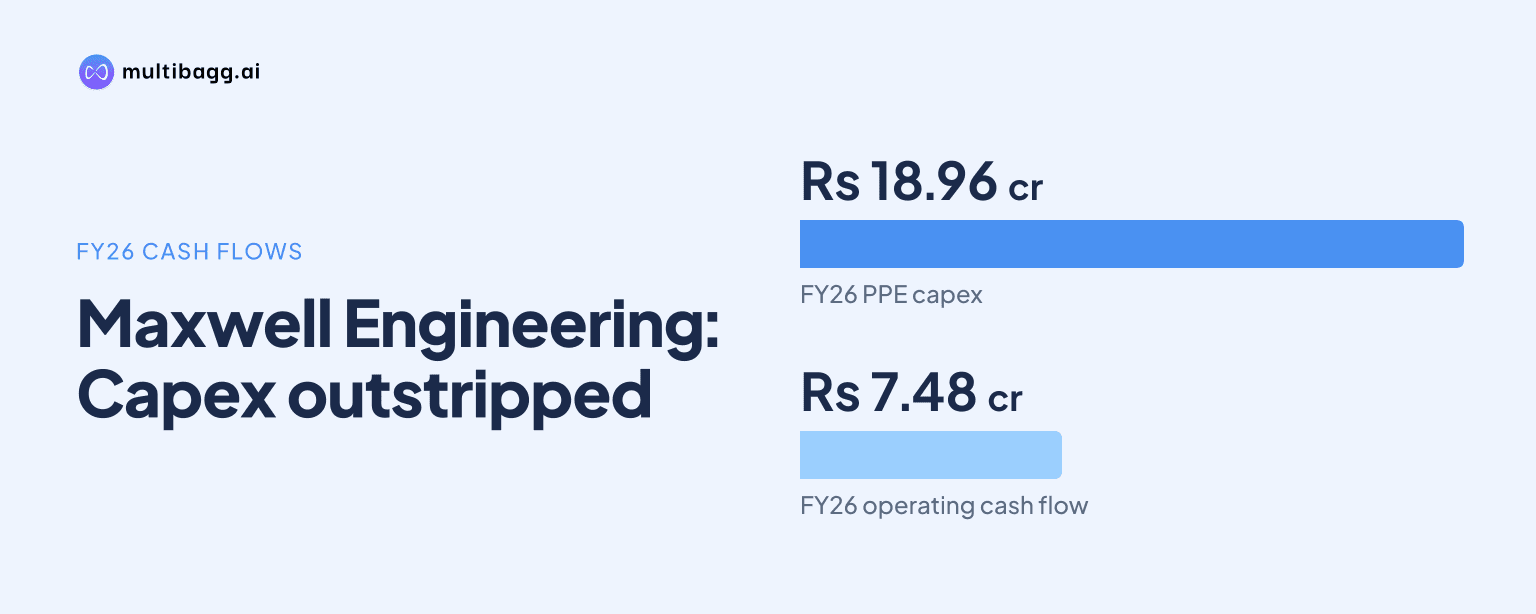
Maxwell Engineering Solutions Limited’s FY26 capital expenditure outstripped operating cash flow, with Rs 18.9553 crore spent on property, plant and equipment against Rs 7.4795 crore generated from operations. The funding gap coincided with Rs 6.2275 crore of additional long-term borrowings and a Rs 7.0559 crore net financing cash inflow in the year ended March 31, 2026.
Why did Maxwell Engineering’s FY26 capex outstrip operating cash flow?
Maxwell Engineering spent Rs 18.9553 crore on property, plant and equipment, or PPE, in FY26, about 2.5 times its Rs 7.4795 crore of net operating cash flow. PPE comprises physical long-term assets, including plant, equipment and buildings. Operating cash flow was marginally above Rs 7.3719 crore in FY25, while PPE purchases rose by Rs 11.5852 crore from Rs 7.3701 crore.
The FY26 position differed from FY25, when operating cash flow of Rs 7.3719 crore was close to PPE purchases of Rs 7.3701 crore. Maxwell Engineering prepares its cash-flow statement under the indirect method prescribed by Accounting Standard 3, which starts with profit and adjusts for non-cash items, working-capital movements and tax. FY26 operating profit before working-capital changes was Rs 16.4003 crore, but subsequent cash absorption reduced cash generated from operations to Rs 9.6834 crore before tax.
How was Maxwell Engineering’s FY26 investment cycle financed?
Maxwell Engineering funded part of the FY26 investment cycle through Rs 6.2275 crore of cash inflow from increased long-term borrowings and Rs 1.8984 crore from increased short-term borrowings. After Rs 1.0699 crore of finance costs, financing activities provided net cash of Rs 7.0559 crore. That amount was below the Rs 13.5781 crore net investing outflow, meaning operating cash and existing cash balances also contributed to the overall cash movement.
An advance-for-fixed-assets movement partly offset gross capital expenditure in FY26. The cash-flow statement records Rs 6.7653 crore generated from advances for fixed assets, compared with Rs 5.1090 crore used for that purpose in FY25. Maxwell Engineering also spent Rs 1.5169 crore on intangible assets under development in FY26, so the Rs 18.9553 crore PPE purchase figure did not equal the net investing outflow.
The pattern changed in the stub period ended July 31, 2026. Maxwell Engineering generated Rs 3.9080 crore from operating activities, spent Rs 56.80 lakh on PPE and Rs 65.62 lakh on intangible assets under development, and recorded a Rs 1.4153 crore net financing outflow. Long-term borrowings declined by Rs 1.9755 crore during the period, while short-term borrowings increased by Rs 1.0166 crore.
Got a follow-up? Ask IRIS
What did the FY26 expansion do to Maxwell Engineering’s balance sheet?
Maxwell Engineering’s PPE carrying amount rose to Rs 25.5335 crore at March 31, 2026 from Rs 2.8435 crore at March 31, 2025. Capital work-in-progress, meaning assets not yet ready for their intended use, fell to Rs 1.8232 crore from Rs 6.5921 crore over the same dates. The two movements show a substantial change in the scale and composition of non-current operating assets during FY26.
Long-term borrowings rose to Rs 12.8694 crore at March 31, 2026 from Rs 6.6419 crore a year earlier, matching the Rs 6.2275 crore increase recorded in the cash-flow statement. Short-term borrowings increased to Rs 3.8605 crore from Rs 1.9621 crore. Shareholders’ funds rose to Rs 24.8690 crore from Rs 13.0073 crore, including share capital of Rs 10.0503 crore and reserves and surplus of Rs 14.8187 crore at March 31, 2026.
Working capital also consumed cash in FY26. Inventory absorbed Rs 4.6242 crore, trade receivables absorbed Rs 2.7858 crore and loans and advances absorbed Rs 1.0592 crore. At March 31, 2026, inventories were Rs 6.1318 crore, receivables were Rs 5.8692 crore and short-term loans and advances were Rs 2.8480 crore, compared with Rs 1.5076 crore, Rs 3.0834 crore and Rs 8.5836 crore respectively a year earlier.
What affects how Maxwell Engineering’s FY26 cash generation and profit are read?
Maxwell Engineering reported profit after tax of Rs 11.8617 crore in FY26, compared with Rs 9.1757 crore in FY25, but accounting profit and operating cash flow measure different items. Net cash from operations was Rs 7.4795 crore after working-capital movements and Rs 2.2039 crore of net tax paid. Inventory, receivables and loans and advances together accounted for Rs 8.4692 crore of FY26 cash absorption.
A depreciation-method change also affected reported FY26 profit before tax. Maxwell Engineering changed from the written-down value method to the straight-line method for fixed assets in FY26. The company states that the change reduced depreciation expense by Rs 1.7997 crore: depreciation was Rs 1.0317 crore under the straight-line method, while profit before tax was Rs 14.3965 crore rather than Rs 12.5968 crore under the written-down value method.
Maxwell Engineering capitalised Rs 1.5169 crore of eligible research and development expenditure as intangible assets under development in FY26. The expenditure relates to high-precision die plates, including the D-500 die plate with 3,045 micro-holes and an oil-heating system. Capitalisation records qualifying development expenditure as an asset initially; subsequent amortisation and any impairment assessment will affect later reported profit.
Conclusion
Maxwell Engineering’s FY26 cash-flow profile reflects an investment cycle in which Rs 18.9553 crore of PPE purchases exceeded Rs 7.4795 crore of operating cash generation. Higher borrowings supplied part of the funding, while increased inventory and receivables limited the conversion of operating profit into cash during the year ended March 31, 2026.
The next disclosed development to watch is the company’s intended future commercial production from the high-precision die-plate programme, for which it capitalised Rs 1.5169 crore in FY26. The stub-period figures through July 31, 2026 showed long-term borrowing repayment of Rs 1.9755 crore, PPE of Rs 26.5200 crore and intangible assets under development of Rs 2.1731 crore, leaving future operating cash generation and the treatment of those assets as unresolved measures of the investment cycle.