










Maxwell Engineering Solutions leaves 85% of revenue unhedged
Key highlights
- Maxwell Engineering Solutions generated 84.73% of revenue from operations outside India in Fiscal 2026, up from 80.38% in Fiscal 2024.
- The company does not use forward contracts, options or swaps to hedge its foreign-currency exposure.
- Imported raw-material purchases were Rs 1.1785 crore, or 34.03% of total raw-material purchases, for the period ended July 31, 2026.
- Maxwell Engineering Solutions plans to deploy Rs 14 crore from the issue for working-capital requirements in Fiscal 2027 and Fiscal 2028.
powered by IRIS
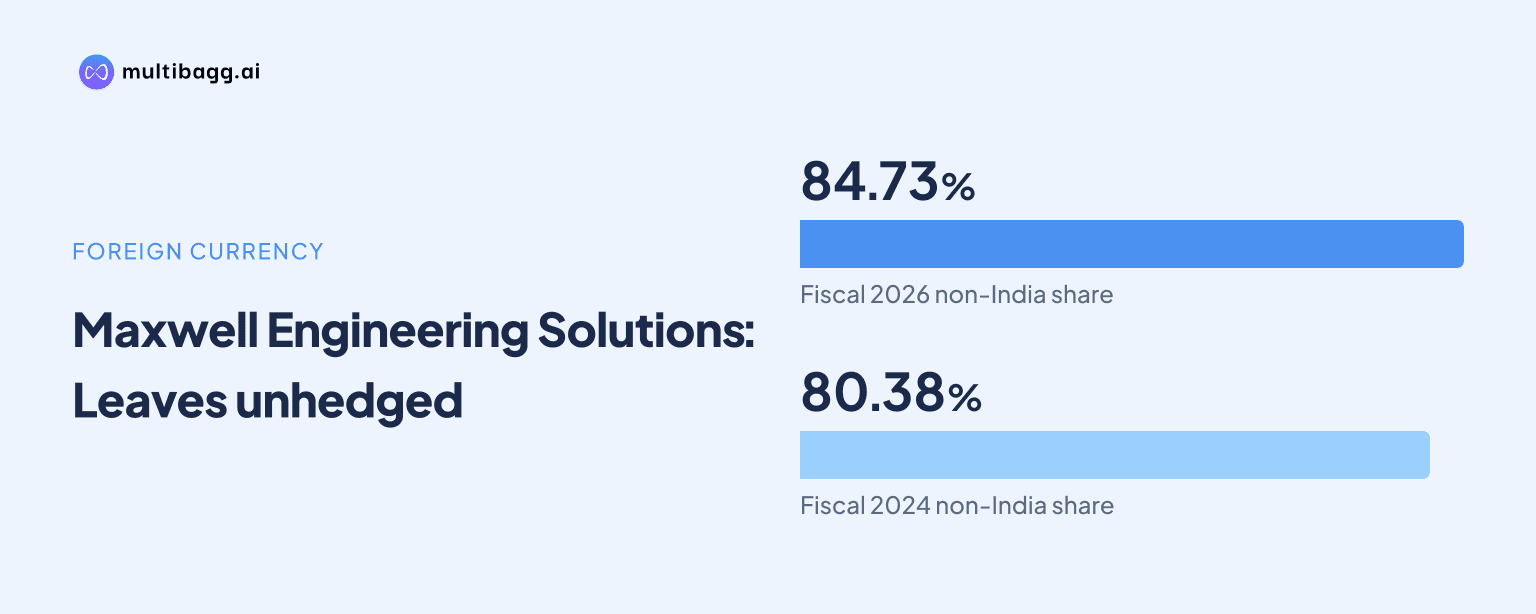
Maxwell Engineering Solutions Limited generated 84.73% of revenue from operations outside India in Fiscal 2026, while Maxwell Engineering Solutions does not use forward contracts, options or swaps to hedge foreign-currency exposure. The export share was 84.34% for the period ended July 31, 2026, leaving a large part of sales realisations exposed to exchange-rate movements.
How dependent is Maxwell Engineering Solutions on export revenue?
Maxwell Engineering Solutions is dependent on export revenue because overseas sales accounted for more than 80% of revenue from operations in every reported period from Fiscal 2024 through the period ended July 31, 2026. The overseas share increased from 80.38% in Fiscal 2024 to 84.73% in Fiscal 2026, an increase of 4.35 percentage points, before easing to 84.34% in the period ended July 31, 2026.
Maxwell Engineering Solutions manufactures precision-engineered wear components and spare parts used in underwater pelletizing systems. Its stated products include pelletizing die plates, pelletizing blades or knives, blade holders or cutter hubs, tapped driving bushes and other spare components, which it supplies to customers in international markets.
Maxwell Engineering Solutions says export sales are primarily denominated in euros and US dollars, while its financial statements are prepared and presented in Indian rupees. That currency mismatch means the rupee value of a foreign-currency export receipt can change between the sale and the conversion of proceeds into Indian rupees.
Why is Maxwell Engineering Solutions' export revenue unhedged?
Maxwell Engineering Solutions' export revenue is unhedged because the company does not currently enter into hedging arrangements or derivative contracts for its foreign-currency exposure. The company specifically identifies forward contracts, options and swaps as instruments it does not use to manage or mitigate currency risk.
A forward contract fixes an exchange rate for a future transaction, while options and swaps are derivative contracts that can alter exposure to future currency movements. Without these arrangements, Maxwell Engineering Solutions says its Fiscal 2026 export revenue, equal to 84.73% of total revenue from operations, remains vulnerable to foreign-exchange volatility without offsetting contractual protection.
Maxwell Engineering Solutions identifies a direct effect from an appreciation of the Indian rupee against the euro or US dollar. A stronger rupee can reduce the Indian-rupee value of export realisations, which the company says may reduce revenue from operations, operating margins and profitability.
The company also says an adverse or sudden exchange-rate movement could have a direct and immediate effect on revenue realisations, profit margins and cash flows. Maxwell Engineering Solutions gives no assurance that it will enter hedging arrangements in the future, or that any arrangements adopted later would adequately protect it against foreign-exchange risk.
What else can affect Maxwell Engineering Solutions' overseas sales?
Maxwell Engineering Solutions' overseas sales can also be affected by customer decisions and cross-border operating conditions. The company says currency volatility may influence customer purchasing decisions, contract pricing and the competitiveness of its products in international markets, where overseas revenue represented 84.34% of revenue from operations for the period ended July 31, 2026.
Maxwell Engineering Solutions identifies geopolitical developments, international trade-policy changes, trade restrictions, economic sanctions, armed conflicts, customs duties, tariffs, embargoes and disruptions in international logistics as export-related risks. According to the company, these developments can affect demand, delay shipments, raise freight, insurance and transportation costs, or impede the timely and cost-effective fulfilment of export orders.
Economic slowdowns, political instability and regulatory changes in key export markets can also reduce demand or delay customer procurement decisions, according to Maxwell Engineering Solutions. The company says it may need to revise pricing strategies or absorb additional costs to remain competitive abroad, but it does not quantify the financial effect of those events.
Got a follow-up? Ask IRIS
Does Maxwell Engineering Solutions have foreign-currency cost exposure too?
Maxwell Engineering Solutions also has foreign-currency cost exposure because it imports carbide and brazing filler and purchases certain raw materials and machinery in foreign currencies. The company identifies euros, US dollars and Japanese yen for purchases, compared with euros and US dollars as the principal currencies for export sales.
Imported raw-material purchases were Rs 1.1785 crore for the period ended July 31, 2026, representing 34.03% of total raw-material purchases. This compared with Rs 1.6449 crore, or 62.35% of total raw-material purchases, in Fiscal 2026, showing that the imported share declined in the four-month period even though imported inputs remained material.
Carbide was imported entirely in each reported period, while steel was sourced entirely from domestic suppliers. Maxwell Engineering Solutions says a depreciation of the Indian rupee against relevant foreign currencies could raise the cost of imported carbide or brazing filler, and customs duties, trade barriers, longer lead times and higher freight costs could add to production costs.
Maxwell Engineering Solutions says it does not hedge foreign-exchange risk on import purchases either. The company also says its ability to pass increased import costs to customers may be limited by pricing arrangements, making the procurement effect distinct from the conversion risk on export receipts.
How does the export model affect Maxwell Engineering Solutions' cash cycle?
Maxwell Engineering Solutions' export model contributes to working-capital needs because overseas customers are typically given credit periods of 60 to 90 days. Trade receivable holding rose from 26 days in Fiscal 2024 to 55 days in Fiscal 2026, while inventory holding rose from five days to 47 days over the same period.
Net working capital increased from Rs 68.94 lakh in Fiscal 2024 to Rs 5.9654 crore in Fiscal 2026, then declined to Rs 4.9627 crore for the period ended July 31, 2026. Maxwell Engineering Solutions attributes the longer inventory and receivable cycle partly to a higher proportion of export sales, the July 2025 relocation of its manufacturing facility to Waghodia GIDC, and safety stocks of imported raw materials and finished goods maintained for international shipping lead times.
Maxwell Engineering Solutions proposes to deploy Rs 14 crore from the issue for working-capital requirements, comprising Rs 11 crore in Fiscal 2027 and Rs 3 crore in Fiscal 2028. The plan is based on management estimates and assumptions on inventory, receivable and payable holding periods; an independent chartered accountant certified those estimates, but no bank or financial institution independently appraised them.
The company says actual working-capital needs could differ because of delayed collections, changes in customer credit terms, raw-material prices, lead times, foreign-exchange movements and funding availability. The ability of the proposed Rs 14 crore deployment to support the export-related cycle therefore depends on those assumptions and on the company maintaining adequate operating cash flows and financing access.
Conclusion
Maxwell Engineering Solutions combines an overseas-revenue concentration above 80% in each reported period with no disclosed currency derivatives for its export or import exposures. The central measure is the 84.73% share of Fiscal 2026 revenue from operations generated outside India, compared with 80.38% in Fiscal 2024, which increases the portion of sales whose rupee value can move with exchange rates.
The disclosed developments to watch are whether Maxwell Engineering Solutions adopts hedging arrangements and whether its proposed Rs 14 crore working-capital deployment supports inventories and receivables linked to export growth. The company has stated that its estimates may vary with collection timing, customer terms, input costs, lead times, foreign-exchange movements and availability of funding.