










Maxwell Plans Rs 18 Crore Upgrade to Reduce Trading Activity
Key highlights
- Maxwell plans to allocate up to Rs 18 crore of issue proceeds to a Rs 21.57 crore equipment package, with Rs 3.57 crore funded through internal accruals.
- The proposed package includes six FANUC Robodrills, one five-axis machining centre, three FANUC Robocut machines and five wire-cut EDM machines.
- Maxwell moved production to a 2,000-square-metre facility in Waghodia, Gujarat, on July 1, 2025.
- The proposed 259.16-kilowatt-peak rooftop solar system is expected to generate annual savings of Rs 30.06 lakh, implying a 3.73-year recovery period.
powered by IRIS
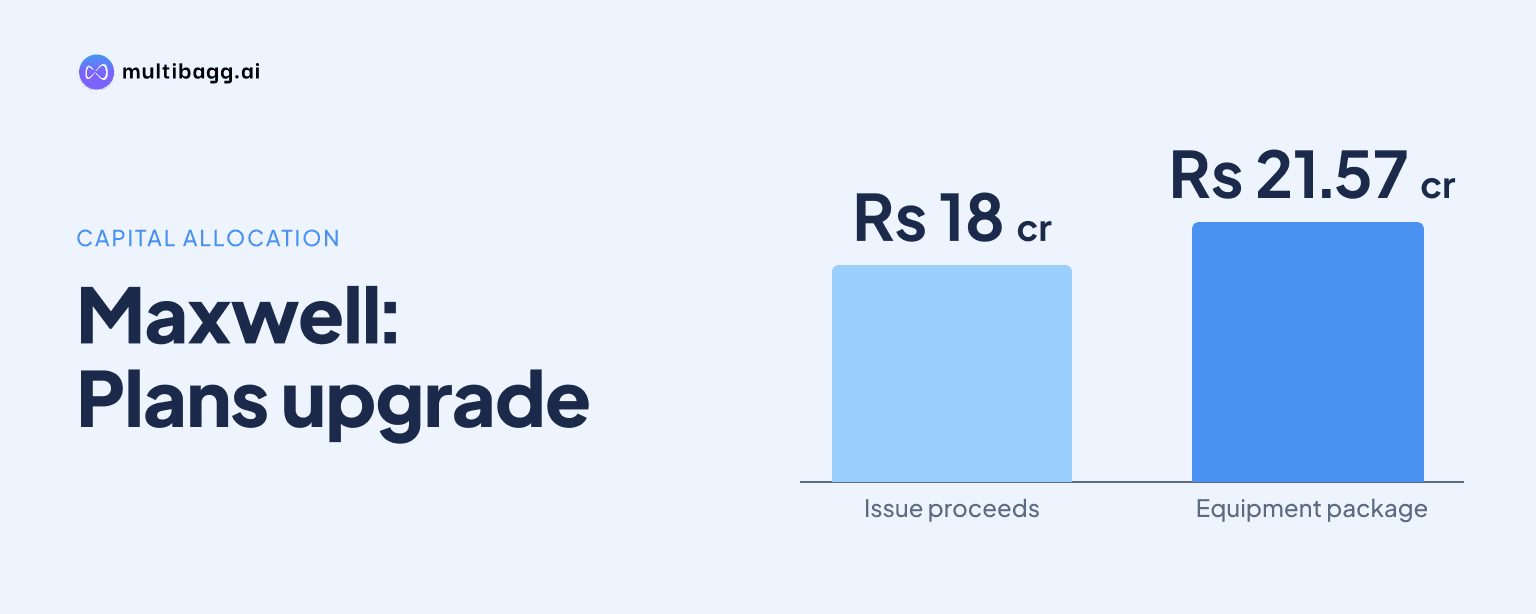
Maxwell Engineering Solutions Limited plans to deploy up to Rs 18 crore of net proceeds on machinery, laboratory equipment and utilities to shift its focus toward manufacturing and gradually reduce trading activity. The proposed equipment package totals Rs 21.57 crore, including six FANUC Robodrills, a five-axis machining centre and wire-cut machines, but no orders had been placed as of the red herring prospectus.
Why is Maxwell reducing trading activity through manufacturing?
Maxwell is seeking to make manufacturing its entire business focus while gradually reducing trading activity. Maxwell manufactures pelletizing die plates, pelletizing blades or knives, blade holders or cutter hubs, tapped driving bushes and other spare items; it also trades blades or knives, driving bushes, blade holders and related products. The company provides customised products, and the Rs 18 crore proposed machinery allocation is intended to increase its manufacturing capability.
Maxwell moved its manufacturing facility on July 1, 2025, from an approximately 7,500-square-foot unit in Makarpura to a 2,000-square-metre facility at Plot 939 and 940, Waghodia Gujarat Industrial Development Corporation, Vadodara. Capital expenditure increased from Rs 2.10 crore in Fiscal 2024 to Rs 7.37 crore in Fiscal 2025 and Rs 27.06 crore in Fiscal 2026, following equipment purchases and installation at the new facility. The shift depends on Maxwell commissioning further equipment and using the larger site to expand production.
What does Maxwell's Rs 18 crore upgrade include?
Maxwell's Rs 18 crore upgrade is concentrated in production machinery, which accounts for Rs 18.91 crore of the Rs 21.57 crore equipment, laboratory and utility package. Net proceeds would finance Rs 18 crore of the total, while Maxwell proposes to fund the remaining Rs 3.57 crore from internal accruals. The package excludes goods and services tax, freight, insurance and other applicable charges where those costs are not included in quotations.
The machinery proposal includes six FANUC Robodrills quoted at Rs 2.74 crore for surface work, slots, drilling and contours; one five-axis vertical machining centre quoted at Rs 3.96 crore; and three FANUC Robocut machines quoted at Rs 2.09 crore. The five-axis machine moves cutting tools on three linear axes and rotates them on two further axes, allowing the spindle to approach a workpiece from different angles in one setup. Maxwell also proposes five wire-cut electrical discharge machining, or EDM, machines at Rs 42.50 lakh and three computer numerical control, or CNC, drilling EDM machines at Rs 2.14 crore; EDM uses controlled electrical sparks to erode conductive metal.
Got a follow-up? Ask IRIS
How would the equipment support larger and more precise die plates?
Maxwell says the planned equipment is intended to support manufacturing of 1.6-metre-diameter pelletizing die plates in India. That outcome requires the proposed machining, grinding, EDM and brazing equipment to be acquired and commissioned, because Maxwell had not placed orders as of the red herring prospectus. The Rs 3.96 crore five-axis machining centre is the highest-cost individual machine in the stated list and is intended to machine parts from multiple angles in one setup.
The plan includes equipment for finishing and thermal joining as well as machining. Maxwell proposes two high-precision surface grinding machines at Rs 63 lakh for top and bottom die-plate grinding, a rotary grinding machine at Rs 25 lakh for flat and parallel surfaces on large components, and a vacuum hardening furnace at Rs 2.04 crore for brazing die plates. A CNC lathe quoted at Rs 1.39 crore and five CNC machines quoted at Rs 1.45 crore are also intended to produce cylindrical, conical and spherical parts.
Measurement capability is another stated element of the precision plan. Maxwell proposes a CNC coordinate measuring machine at Rs 97.51 lakh to measure critical-component dimensions, a positive material identification, or PMI, machine at Rs 13.50 lakh, and a three-dimensional measurement instrument at Rs 23.80 lakh. Maxwell says the laboratory equipment would test raw materials, work in progress and finished goods against prescribed quality standards and customer specifications, so the proposed manufacturing change relies on both production equipment and in-house verification.
When could Maxwell complete the upgrade, and what could change?
Maxwell estimates that machinery order placement, purchase and installation would run from November 2026 to March 2028, provided issue proceeds are received by November 2026. Laboratory equipment is scheduled for November 2026 to July 2027, while solar and diesel-generator utilities are scheduled for November 2026 to March 2027. The company proposes to deploy the net proceeds during Fiscal 2027 and Fiscal 2028, with up to Rs 2.67 crore of machinery expenditure in Fiscal 2027 and up to Rs 15.33 crore in Fiscal 2028.
The timing and cost remain subject to execution conditions because Maxwell had neither deployed funds nor entered into definitive vendor agreements for the proposed equipment. Most listed quotations were valid for six months, while the CNC lathe quotation was valid until November 1, 2026. If quotations expire, vendors change or equipment specifications are revised, actual costs may differ; Maxwell says cost increases would be met from internal accruals, while a surplus may be applied to other machinery, equipment or utilities as required.
The utility proposal sets out a separate operating-cost assumption. Maxwell proposes Rs 1.12 crore for 259.16 kilowatt-peak of rooftop solar systems, based on two quotations dated May 7, 2026, and Rs 19.86 lakh for a 160 kilovolt-ampere diesel generator. Maxwell estimates annual solar generation of 375,782 kilowatt-hours and annual power-cost savings of Rs 30.06 lakh at an assumed tariff of Rs 8 per kilowatt-hour, implying a 3.73-year recovery period; those outcomes depend on the stated generation and tariff assumptions.
Conclusion
Maxwell's Rs 18 crore proposed upgrade maps its move from a mixed manufacturing-and-trading model toward greater in-house production of pelletizing components. The proposed Rs 21.57 crore package combines machining, EDM, grinding, brazing, measurement and utility equipment, while the 2,000-square-metre Waghodia facility provides the operating location identified for expansion.
The next disclosed milestones are expected order placement from November 2026, utility completion by March 2027, laboratory-equipment completion by July 2027 and machinery installation by March 2028. Final delivery at the quoted costs will depend on vendor selection, quotation validity, taxes and logistics charges, equipment availability, issue-proceeds timing and Maxwell's internal accruals for Rs 3.57 crore of the package and any escalation.