










Open Acreage Licensing Policy rounds X and XI offer 262,824 sq km
Key highlights
- OALP rounds X and XI offer 46 exploration blocks covering 262,823.70 square kilometres.
- Offshore acreage totals 211,013.53 square kilometres, or about 80% of the combined offer.
- OALP-X covers 182,589.21 square kilometres across 25 blocks, making it the largest individual OALP round by area in the supplied record.
- OALP-IX attracted 60 bids from seven bidders for 28 blocks, averaging 2.4 bids per block.
powered by IRIS
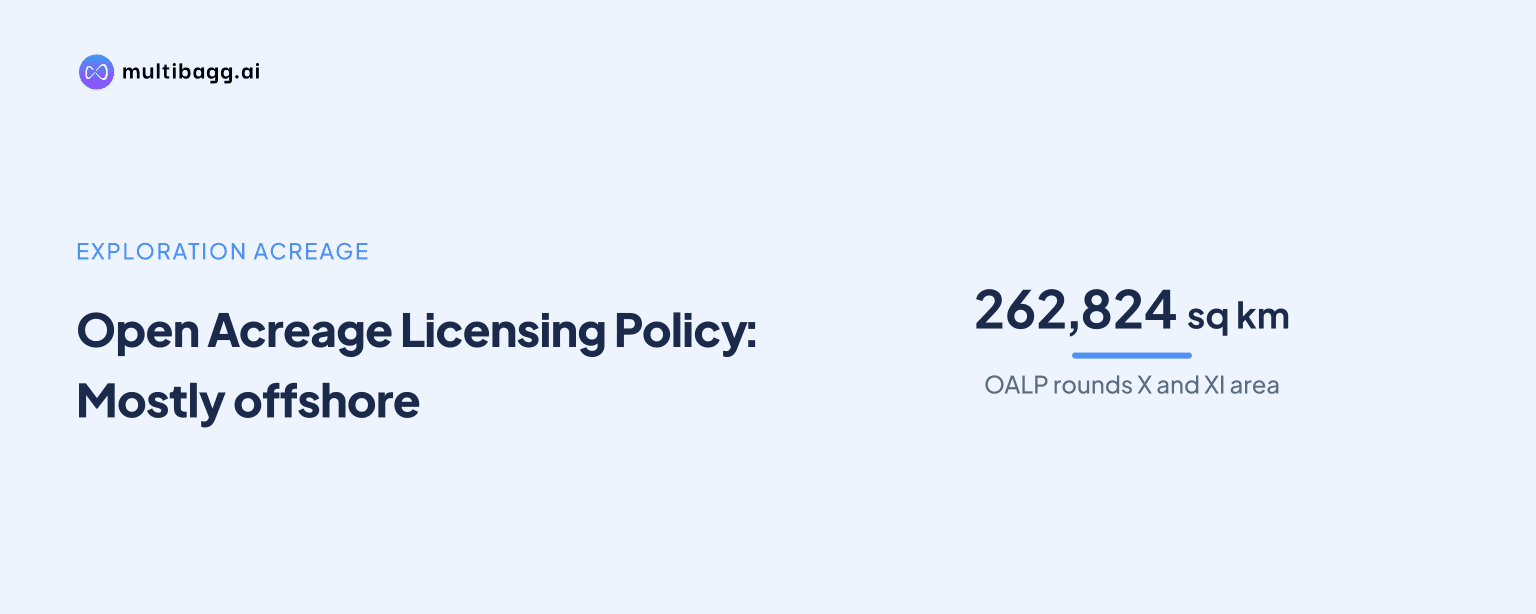
Open Acreage Licensing Policy (OALP) rounds X and XI offer 46 oil-and-gas exploration blocks covering 262,823.70 square kilometres. Offshore acreage accounts for 211,013.53 square kilometres, or about 80% of the combined offer, with OALP-X providing 25 blocks and OALP-XI providing 21 blocks under the Hydrocarbon Exploration and Licensing Policy (HELP).
How large is the OALP rounds X and XI offering?
OALP rounds X and XI together offer 46 blocks covering 262,823.70 square kilometres. OALP-X is the larger round, with 25 blocks across 182,589.21 square kilometres, while OALP-XI offers 21 blocks over 80,234.49 square kilometres across 11 sedimentary basins. The acreage is offered for exploration and development, rather than representing discovered or producing hydrocarbon resources.
OALP-X is the largest individual OALP round by area in the supplied record. OALP-IX offered 28 blocks covering 136,596 square kilometres, compared with 25 blocks and 182,589.21 square kilometres in OALP-X. OALP-X therefore offers 45,993.21 square kilometres more acreage despite having three fewer blocks, reflecting the inclusion of larger offshore areas.
OALP-X has six onland, six shallow-water, one deep-water and 12 ultra-deep-water blocks. OALP-XI has 12 onland, four shallow-water, one deep-water and four ultra-deep-water blocks. The different mix means OALP-X contains more large offshore acreage, while OALP-XI has a greater number of onland blocks.
Why does offshore acreage dominate OALP rounds X and XI?
Offshore areas dominate OALP rounds X and XI because 28 offshore blocks cover 211,013.53 square kilometres, about 80% of the 262,823.70-square-kilometre offer. OALP-X accounts for 165,718 square kilometres across 19 offshore blocks, while OALP-XI accounts for 45,295.53 square kilometres across nine offshore blocks.
OALP-X has 13 deep-water and ultra-deep-water blocks covering 124,327 square kilometres. Its listed ultra-deep-water areas include an Andaman-Nicobar block of 12,816.65 square kilometres, three Krishna-Godavari blocks totalling 32,057.06 square kilometres, and three Mahanadi blocks totalling 23,242.46 square kilometres. This concentration means the round's area is influenced by a relatively small number of large offshore licences.
OALP-XI combines large frontier areas with smaller blocks in established basins. Its Mumbai Offshore ultra-deep-water block covers 15,402.73 square kilometres and its Mahanadi ultra-deep-water block covers 14,081.94 square kilometres. In contrast, OALP-XI includes two Cambay shallow-water blocks of 6.34 and 3.17 square kilometres and a Krishna-Godavari deep-water block of 97.37 square kilometres.
What terms govern exploration under OALP rounds X and XI?
OALP rounds X and XI use HELP terms that provide a single licence for conventional and unconventional hydrocarbons, a revenue-sharing model, reduced royalty rates, no oil cess, and marketing and pricing freedom. In Category-II and Category-III basins, bids are based on 2D and 3D seismic acquisition programme commitments, with no revenue share except in the event of windfall gain.
The stated framework also includes early-monetisation incentives, concessional royalty rates for early commercial production, and exploration rights on retained acreage for the full contract life. A committed work programme is the minimum exploration activity a contractor undertakes under a contract. OALP terms also provide for swapping committed-work-programme surveys, infrastructure sharing, use of excess capacity, and exit and dispute-resolution safeguards; OALP-XI additionally specifies a neutral seat of arbitration.
Exploration timelines vary by water depth. Onland and shallow-water blocks have an eight-year exploration period from the commencement date and a three-year deadline to complete the committed work programme. Deep-water and ultra-deep-water blocks have a 10-year exploration period and a four-year work-programme deadline, applying to 13 of OALP-X's 25 blocks and five of OALP-XI's 21 blocks.
Got a follow-up? Ask IRIS
How are OALP blocks selected and supported with data?
OALP begins with an investor reviewing geological and geophysical data in the National Data Repository, identifying an area and submitting an Expression of Interest, or EoI. The government then finalises the block, invites bids, evaluates bids and awards a contract. OALP-X combines areas received during EoI cycles XVI and XVII, while OALP-XI uses EoIs submitted from cycles XVI to XXII.
OALP-XI provides basic data packages for each block through the National Data Repository, while further information can be purchased under the data policy. OALP-X states that international experts technically analysed every offered block for hydrocarbon potential and that the analysis is freely available to investors. Both rounds provide an electronic bidding portal described as supporting transparent and secure bidding.
The National Seismic Programme is another source of exploration information. The programme uses long spreads of 12 to 18 kilometres and has identified sub-trappean Mesozoic sediments in some areas while improving understanding of tectonic frameworks. Eleven blocks appraised under the programme had been awarded, including seven in Rajasthan, two in Mahanadi and two in Assam Shelf; that history does not establish commercial discoveries in the newly offered OALP blocks.
What does the expanded offer mean for exploration activity?
OALP rounds X and XI enlarge the acreage available for bidding and future exploration, but they do not confirm oil or gas production. Seismic surveys, drilling and related equipment requirements depend on bids, contract awards and contractors completing committed work programmes. OALP-IX provides a recent participation measure: 28 blocks received 60 bids from seven bidders, or 2.4 bids per block, compared with 1.3 bids per block in the preceding round.
OALP rounds I to IX offered 177 blocks over 380,610 square kilometres and awarded 172 blocks over 378,653 square kilometres. Five unawarded OALP-II blocks were coal-bed methane blocks that received no bids. The 262,823.70 square kilometres offered in OALP-X and OALP-XI equal about 69% of the acreage awarded across the first nine rounds, but the scale of future activity remains dependent on bidder participation and awards.
Conclusion
OALP rounds X and XI expand India's exploration offer through 46 blocks covering 262,823.70 square kilometres, led by 211,013.53 square kilometres of offshore acreage. The comparison with OALP-IX shows a shift towards larger acreage packages, especially in deep-water and ultra-deep-water areas, while OALP-XI also retains 12 onland blocks across Category-I, Category-II and Category-III basins.
The next point to watch is whether the offered acreage converts into contracts and committed work. The disclosed timetable requires work programmes within three years for onland and shallow-water blocks and four years for deep-water and ultra-deep-water blocks; exploration periods run for eight and 10 years respectively. Bid outcomes, awards and contractors' seismic and drilling commitments will determine the extent of active exploration.