










Red Herring Prospectus shows 2025 dates after 2026 issue
Key highlights
- The proposed Bid/Issue Period runs from October 29 to November 2, 2026, with Basis of Allotment scheduled for November 3, 2026.
- Refund or ASBA unblocking and demat credit are both dated November 4, 2025, before the stated 2026 offer period.
- Trading commencement is listed as November 5, 2025, creating a chronological conflict with the proposed 2026 issue timetable.
- The prospectus cites a mandatory T+3 listing process and says compensation may be ₹100 per day or 15% per annum for certain unblocking delays.
powered by IRIS
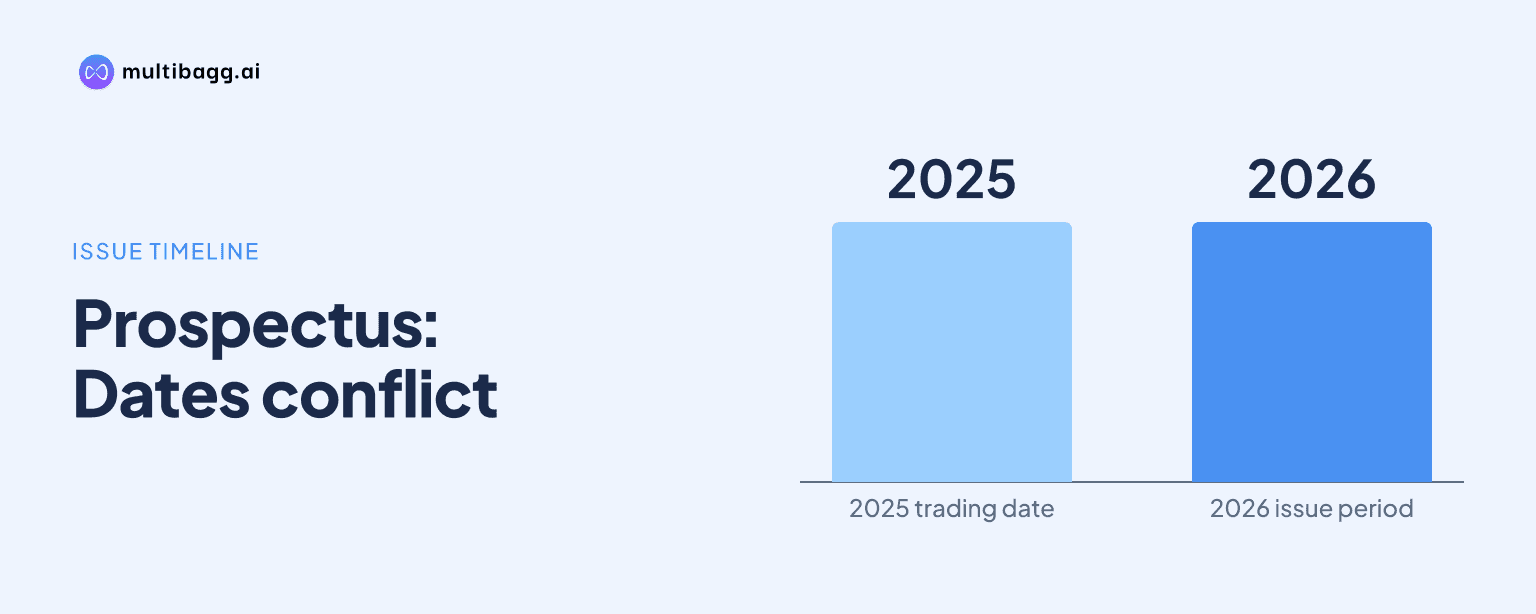
The Red Herring Prospectus contains an internally inconsistent indicative timetable: it schedules the Bid/Issue Period from October 29 to November 2, 2026 and Basis of Allotment on November 3, 2026, but lists unblocking, demat credit and trading on November 4-5, 2025. The stated post-issue dates therefore precede the proposed offer window.
Why do the prospectus dates conflict?
The prospectus dates conflict because the document places three post-issue steps in November 2025 after setting the offer period and allotment process in October and November 2026. The Bid/Issue Programme states that bidding opens on Thursday, October 29, 2026 and closes on Monday, November 2, 2026. It then lists finalisation of the Basis of Allotment with the Designated Stock Exchange on or about November 3, 2026.
The conflict occurs in the next three rows of the indicative timetable. Initiation of refunds for Anchor Investors, or unblocking of funds from an Application Supported by Blocked Amount account, is dated on or about November 4, 2025. Credit of Equity Shares to allottees' dematerialised, or demat, accounts is also dated November 4, 2025, while commencement of trading on the Stock Exchanges is dated November 5, 2025.
The date order is the material disclosure issue. A November 4 or November 5, 2025 event cannot follow a November 3, 2026 allotment step as the timetable is written. The prospectus describes the dates as indicative, but does not identify a correction, revised year or replacement timetable for the three November 2025 entries.
What post-closing timetable does the prospectus describe?
The prospectus describes a mandatory T+3 listing process, meaning the reduced post-issue timeline prescribed by the Securities and Exchange Board of India, or SEBI. It cites SEBI circular SEBI/HO/CFD/TPD1/CIR/P/2023/140 dated August 9, 2023, which made T+3 mandatory for public issues opening on or after December 1, 2023. The prospectus says the Issue will be made under Unified Payments Interface, or UPI, Phase III on that basis.
The stated 2026 rows accord with a post-closing sequence, unlike the November 2025 rows. The prospectus says the company will take necessary steps for listing and commencement of trading within three Working Days of the Bid/Issue Closing Date, unless SEBI prescribes another period. A November 2, 2026 closing date followed by a November 3, 2026 Basis of Allotment date fits that order; the stated 2025 unblocking, credit and trading dates do not.
The process also assigns timed duties to issue intermediaries. The Book Running Lead Manager, or BRLM, must submit reports on compliance with SEBI allotment and listing timelines within three Working Days from the Bid/Issue Closing Date, including non-adherence, responsible entities and reasons. The Registrar to the Issue must submit details of cancelled, withdrawn or deleted applications to self-certified syndicate banks, or SCSBs, within 60 minutes of bid closure during the Bid/Issue Period.
The timetable does not itself guarantee a trading date. The prospectus says the final listing and trading approval must be received from the Stock Exchanges after allotment, and that commencement of trading is entirely at the Stock Exchanges' discretion under applicable law. Those conditions can delay a valid post-issue timetable, but they do not provide a basis for post-issue processing before the stated 2026 bid period.
Got a follow-up? Ask IRIS
What changes can move the proposed issue timetable?
The prospectus says the timetable is indicative and may be extended for specified operational or regulatory reasons. It names an extension of the Bid/Issue Period, a revision of the Price Band, delay in final listing and trading approval from the Stock Exchanges, and delay in receiving final certificates from SCSBs. The disclosure says this timetable does not create an obligation or liability for the company or the BRLM.
A Price Band revision requires an extension of the Bid/Issue Period by at least three additional Working Days, subject to a maximum period of 10 Working Days. In force majeure, a banking strike or similar unforeseen circumstances, the company in consultation with the BRLM may extend the Bid/Issue Period by at least one Working Day, also subject to the 10-Working-Day limit. These mechanisms can move later stages forward in time after a revised closing date.
SEBI circulars or notifications issued after the date of the prospectus may change listing timelines, according to the document. The prospectus also says the offer procedure is subject to revised SEBI circulars and that final approvals are obtained after allotment. Neither qualification resolves the disclosed date mismatch because the document contains no later timetable aligning the November 2025 entries with the October 29 to November 2, 2026 Bid/Issue Period.
What does the mismatch mean for application processing?
The mismatch makes the published timetable unreliable as a complete calendar sequence, while the prospectus continues to state the applicable bid-processing rules. It says bids will be processed only after the full Bid Amount is blocked in the relevant ASBA account or through the UPI mechanism. Bids not uploaded on the electronic bidding system, or bids for which the full Bid Amount is not blocked, would be rejected.
The prospectus provides compensation for several delayed-unblocking cases that exceed two Working Days from the Bid/Issue Closing Date. The specified amount is rupees 100 per day or 15% per annum of the relevant Bid Amount, whichever is higher. The provision covers delayed unblocking for cancelled, withdrawn or deleted applications, multiple blocks through UPI, excess blocks above the Bid Amount, and non-allotted or partially allotted bids.
That mechanism is relevant because the refund and unblocking row is one of the rows dated November 4, 2025. The stated compensation is measured from the Bid/Issue Closing Date, rather than from a fixed calendar date in the indicative table. With the closing date listed as November 2, 2026, the November 2025 unblocking entry cannot coherently serve as a post-closing processing date.
The prospectus separately states that the company must refund the entire subscription amount if minimum subscription is not received, listing or trading permission is not obtained, or another disclosed condition requires refund under applicable law. It also permits withdrawal of all or part of the Issue after opening but before allotment, requiring the BRLM to arrange unblocking within one Working Day of the relevant notice. Those contingencies establish procedures, but do not correct the 2025 and 2026 date inconsistency.
Conclusion
The Red Herring Prospectus presents a material chronological discrepancy in its indicative timetable. The October 29 to November 2, 2026 Bid/Issue Period and November 3, 2026 Basis of Allotment are followed by refund, demat-credit and trading entries dated November 4-5, 2025. The stated T+3 process and three-Working-Day completion objective require a sequence that follows, rather than predates, the 2026 closing date.
The next disclosure to watch is a revised or corrected timetable that reconciles the three November 2025 entries with the stated 2026 offer window. The prospectus discloses that timetable changes can follow a Price Band revision, an extended issue period, delayed Stock Exchange approvals, delayed SCSB certificates or later SEBI circulars, but it provides no correction within the supplied timetable.