










SFC Environmental’s revenue remains tied to government work
Key highlights
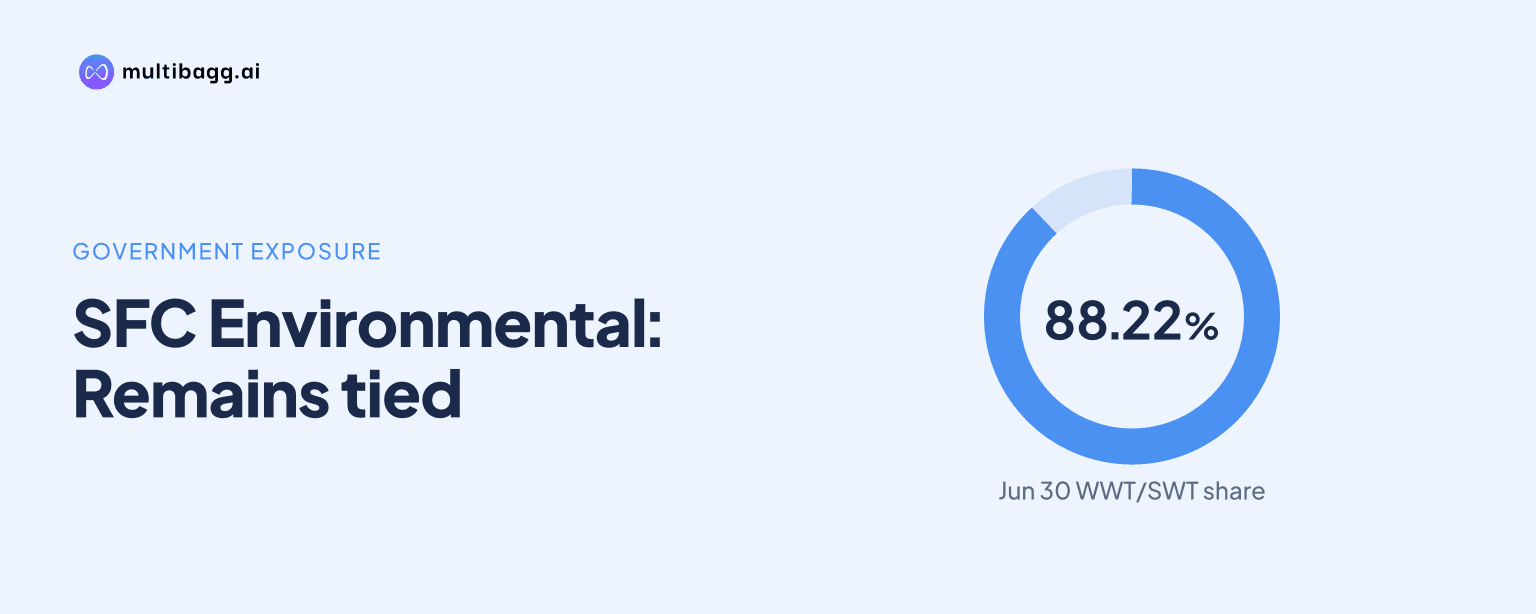
- WWT and SWT generated Rs 118.164 crore, or 88.22% of consolidated revenue, in the three months ended June 30, 2026.
- Government-linked revenue represented 91.97% of WWT revenue and 100.00% of SWT revenue in the three months ended June 30, 2026.
- SFC Environmental’s top 10 customers accounted for 79.20% of revenue from operations in the three months ended June 30, 2026, while its top 25 accounted for 92.65%.
- Government-linked SWT revenue rose from Rs 50.188 crore in Fiscal 2024 to Rs 140.163 crore in Fiscal 2026.
powered by IRIS
SFC Environmental’s wastewater and solid-waste activities are highly dependent on government-funded work: in the three months ended June 30, 2026, 91.97% of wastewater-treatment revenue and 100.00% of solid-waste-treatment revenue was directly or indirectly linked to Government Entities. That exposure makes a large part of revenue dependent on public budgets, policy priorities, tender awards and payment processes.
How dependent is SFC Environmental on government-funded work?
SFC Environmental’s wastewater treatment, or WWT, and solid waste treatment, or SWT, segments derive most of their revenue from work awarded or funded by government bodies. WWT and SWT together generated Rs 118.164 crore in the three months ended June 30, 2026, representing 88.22% of consolidated revenue from operations. Their combined contribution was Rs 682.920 crore in Fiscal 2026, Rs 588.567 crore in Fiscal 2025 and Rs 574.623 crore in Fiscal 2024, or between 84.34% and 87.40% of revenue in those fiscal years.
The direct and indirect government share was higher than the segments’ already large contribution to consolidated revenue. In WWT, government-linked revenue was Rs 59.702 crore for the three months ended June 30, 2026, equal to 91.97% of WWT revenue. In SWT, all Rs 35.251 crore of revenue in that three-month period came from government-linked projects or contracts. The prospectus defines Government Entities to include central and state governments, local bodies, municipalities, statutory and regulatory authorities, departments, agencies, public-sector undertakings and government-controlled entities.
WWT government-linked revenue represented 91.97% of segment revenue in the three months ended June 30, 2026, compared with 92.35% in Fiscal 2026, 92.40% in Fiscal 2025 and 95.72% in Fiscal 2024. SWT government-linked revenue represented 100.00% of SWT revenue in every disclosed period. The figures show that the source of WWT and SWT work, rather than only the identity of the immediate customer, determines SFC Environmental’s exposure to public-sector decisions.
Why is wastewater revenue tied to public authorities even when customers are private?
SFC Environmental’s WWT revenue is government-dependent because its target customers are private engineering, procurement and construction, or EPC, companies that bid for sewage-treatment plant projects ultimately awarded by municipalities and other public authorities. SFC Environmental may invoice a private EPC customer, but the underlying project, contract or work can still be awarded or funded by a Government Entity. This structure explains why the WWT government-linked share remained above 90% in every disclosed period from Fiscal 2024 through the three months ended June 30, 2026.
The composition changed modestly across those periods, but not enough to remove the dependency. Government-linked WWT revenue fell from Rs 501.970 crore in Fiscal 2024 to Rs 433.569 crore in Fiscal 2025, before rising to Rs 501.253 crore in Fiscal 2026. Its share of WWT revenue declined from 95.72% in Fiscal 2024 to 92.35% in Fiscal 2026 and 91.97% in the three months ended June 30, 2026. For this exposure to persist, private EPC-led orders must continue to originate from public wastewater infrastructure projects and public authorities must continue to fund and award them.
Got a follow-up? Ask IRIS
What makes SFC Environmental’s solid-waste revenue fully government-linked?
SFC Environmental’s SWT segment was fully dependent on Government Entity-funded work in each disclosed period. SWT government-linked revenue increased from Rs 50.188 crore in Fiscal 2024 to Rs 119.356 crore in Fiscal 2025 and Rs 140.163 crore in Fiscal 2026, with a 100.00% share in all three years. SFC Environmental also reported Rs 35.251 crore of such revenue in the three months ended June 30, 2026, again accounting for all SWT segment revenue.
Two operating projects in Goa illustrate the concession-based component of that dependence. SFC Environmental operates projects for Goa Waste Management Corporation, a Government of Goa undertaking, through concession agreements issued to VVPTL for the South Goa plant and HWPTL for the North Goa plant. The South Goa concession comprises 1.5 years to complete construction and a 10-year operating period, while the North Goa concession has a 10-year period. Neither agreement provides for automatic renewal, making continuation of revenue contingent on the relevant authority’s process.
The North Goa arrangement has been extended by one year until August 20, 2027, or until a subsequent operator assumes operation and maintenance responsibility after transition, whichever occurs earlier. The concession authority may invite bids for a further 10-year operating period, and HWPTL can match the best evaluated bid, subject to the commissioning authority’s revised terms; no tender had been issued as of the prospectus date. Separately, Hindustan Waste Treatment Private Limited secured April 2025 and May 2025 awards from a public-sector oil marketing company for 10-year engineering, procurement, commissioning and operation-and-maintenance work at a 125-tonnes-per-day Tinsukia compressed-biogas plant and a 300-tonnes-per-day Bhubaneswar plant.
Which government processes can change SFC Environmental’s revenue and cash flow?
SFC Environmental identifies budget allocations, government policy and the timing of tender invitations and awards as the principal mechanisms affecting WWT and SWT revenue. Government contracts may face lengthy definitive documentation, internal approval processes, renegotiation and funding constraints. They are generally awarded to the lowest bidder meeting technical tender conditions, so lower bidding prices may also affect the terms on which new work is won.
Payment timing is another operating exposure because public entities can take time to complete internal processes before paying invoices. The prospectus also identifies elections, changes in government decision-makers, policy implementation delays, tax-policy changes and lower tax revenue as factors that can alter the number and terms of contracts. These risks matter alongside customer concentration: SFC Environmental’s top 10 customers accounted for 79.20% of revenue from operations in the three months ended June 30, 2026, while the top 25 accounted for 92.65%.
SFC Environmental cannot predict whether or when it will receive a new WWT or SWT contract, and says results and cash flows can fluctuate materially with award timing. SFC Environmental usually operates WWT through purchase orders or letters of intent of varying duration rather than long-term customer contracts, and those arrangements can generally be terminated with or without notice. The disclosed dependence would therefore remain material if Government Entities keep prioritising wastewater and solid-waste infrastructure, maintain available budgets, issue tenders on schedule and process payments without extended delays.
Conclusion
SFC Environmental’s government dependence is measurable rather than merely sector-based. WWT and SWT represented 88.22% of consolidated revenue in the three months ended June 30, 2026, while government-linked projects accounted for 91.97% of WWT revenue and all SWT revenue. Private EPC customers in WWT do not materially remove that exposure because municipalities and other public bodies fund or award the underlying infrastructure work.
The next disclosed milestone is the North Goa concession extension, which runs no later than August 20, 2027 unless a successor operator takes over earlier. A future tender could allow HWPTL to match the selected bid for a further 10-year period, but the prospectus said no tender had been issued. Tender publication, contract awards, budget allocations and payment execution will therefore determine whether the current revenue mix continues.