










SFC Environmental Technologies Limited reports over 80% SBR share
Key highlights
- C-Tech holds over 80% of India’s SBR sewage-treatment market based on commissioned installations as of July 31, 2026, according to an SFC-disclosed Frost & Sullivan report.
- SFC’s cumulative wastewater-treatment installation base reached 724 installations and 17,464.61 MLD of capacity as of June 30, 2026.
- C-Tech’s disclosed comparison for a 1,000 MLD plant shows a land requirement of 5 to 8 hectares versus 8 to 12 hectares for cited alternative systems.
- Repeat customers generated 97.41% of SFC’s standalone revenue in the three months ended June 30, 2026, versus 91.98% in fiscal 2026.
powered by IRIS
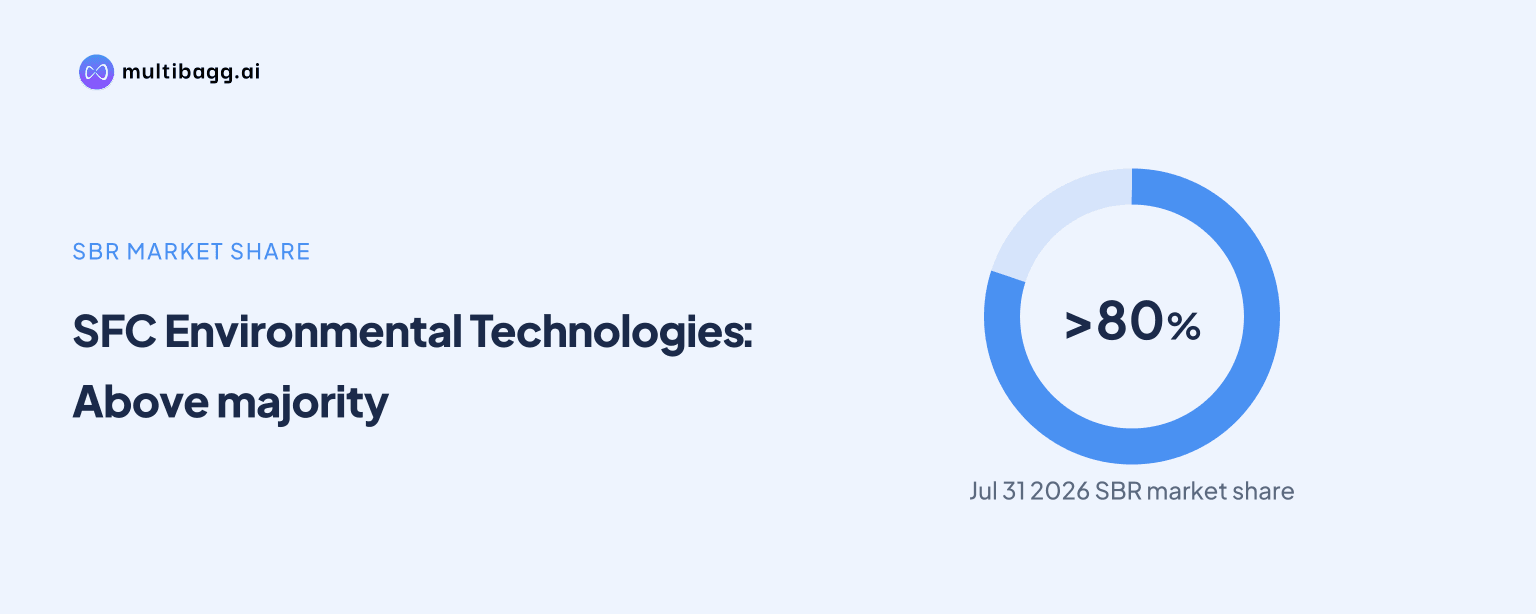
SFC Environmental Technologies Limited says its C-Tech technology holds over 80% of India’s sequencing batch reactor, or SBR, sewage-treatment market as of July 31, 2026. SFC’s technologies facilitated treatment capacity of 17,511.11 million litres per day, or MLD, on that date, while C-Tech’s stated operating advantages include lower land, power and sludge requirements.
Does SFC hold over 80% of India’s SBR sewage-treatment market?
SFC says C-Tech holds over 80% of India’s SBR sewage-treatment market, based on commissioned installations as of July 31, 2026. The statement is attributed to a Frost & Sullivan industry report commissioned and paid for by SFC for its offer document, making it a company-disclosed market-position claim rather than an independently presented market calculation in the document.
SBR is a wastewater-treatment process that treats sewage in repeating batches rather than continuous-flow stages. SFC describes C-Tech as an advanced, proprietary cyclic activated sludge system for sewage and industrial effluent, and says it can produce recyclable-quality effluent in one treatment step. SFC’s installation base covers domestic sewage as well as refinery, pharmaceutical, petrochemical and textile wastewater applications.
The supplied government table provides a different and older reference point: it lists 73 SBR installations nationally in a source published in March 2021. That table categorises sewage-treatment plants by technology, whereas SFC’s over-80% claim concerns C-Tech installations as of July 2026; the two disclosures use different dates and do not provide enough like-for-like data to independently calculate SFC’s market share.
How large is SFC’s installed wastewater-treatment base?
SFC’s cumulative wastewater-treatment installation count rose to 724 as of June 30, 2026, from 577 as of March 31, 2024. Over the same period, treatment capacity facilitated by its technology increased by 3,557.63 MLD, reaching 17,464.61 MLD at June 30, 2026.
The 19-installation increase in the three months to June 30, 2026 followed a 66-installation increase in fiscal 2026. Capacity rose by 320.60 MLD in those three months, after growing by 1,934.56 MLD during fiscal 2026. The July 31, 2026 figure of 17,511.11 MLD is 46.50 MLD above the June 30 cumulative figure, reflecting the later reporting date.
SFC also says C-Tech has been used in large SBR-based sewage-treatment plants, including a plant under development with 424 MLD capacity as of July 31, 2026. That single project represents about 2.4% of SFC’s 17,511.11 MLD technology-facilitated capacity, showing that installation counts alone do not show capacity concentration across the project base.
Why does SFC say C-Tech can support its SBR position?
SFC says C-Tech’s operating design can reduce the land, energy and sludge demands associated with sewage treatment. For a 1,000 MLD plant, the disclosed comparison puts C-Tech’s footprint at 5 to 8 hectares, compared with 8 to 12 hectares for conventional SBR, modified Ludzak-Ettinger and intermittent-cycle extended-aeration systems.
C-Tech is disclosed as delivering biochemical oxygen demand, or BOD, removal of 90% to 95% and chemical oxygen demand, or COD, removal of 95% to 98%. The comparison gives the three alternative SBR configurations BOD removal of 85% to 90% and COD removal of 90% to 95%. BOD measures oxygen consumed by biodegradable organic material, while COD measures the oxygen equivalent needed to chemically oxidise pollutants.
SFC says C-Tech provides high nitrogen and phosphorus removal, while its three cited alternatives have moderate nutrient performance or require additional processes for some nutrients. Its process uses bacterial selection before main treatment, concurrent nitrification and denitrification, and biological phosphorus removal through switching aeration on and off. SFC says this can yield treated water with suspended solids below 10 parts per million and BOD below 5 to 10 parts per million.
Power use is material because SFC says energy accounts for almost 80% of sewage-treatment-plant operation and maintenance, or O&M, cost. C-Tech is stated to offer power-consumption savings of up to 40% against conventional technologies and to require up to 50% less area. Those outcomes depend on project-specific design, influent conditions, automated operation and the comparison technology selected.
Got a follow-up? Ask IRIS
How does C-Tech operate and reach municipal projects?
SFC says C-Tech runs a three-stage cycle of filling and aeration, settling, and decanting, normally lasting about three to four hours before the next batch can begin. Programmable logic controller, or PLC, and supervisory control and data acquisition, or SCADA, systems use dissolved-oxygen readings and oxygen uptake rate calculations to adjust air supply and decanting rates.
The system’s disclosed sludge-wasting requirement is around 2% to 5% of treated effluent, compared with around 5% to 10% for conventional SBR, modified Ludzak-Ettinger and intermittent-cycle extended-aeration systems. SFC says excess sludge is removed to maintain mixed liquor suspended solids, then dewatered and dried for potential use as a soil conditioner. Its components include selectors, dissolved-oxygen meters, decanters, diffusers, blowers, pumps and automation controls.
SFC reaches sewage-treatment tenders mainly through engineering, procurement and construction, or EPC, companies that bid for municipalities and urban local bodies. It supports bids with C-Tech engineering and cost estimates, then supplies technology, equipment and installation services if the EPC bidder wins. Deliveries generally occur over six to 12 months after order receipt, subject to customer approvals, site clearance, funding and construction schedules.
The model relies substantially on repeat customers. On a standalone basis, repeat-customer revenue was 97.41% in the three months ended June 30, 2026, compared with 91.98% in fiscal 2026, 85.18% in fiscal 2025 and 89.96% in fiscal 2024. For this measure, SFC defines repeat customers as customers from which it generated revenue in any of the preceding three fiscal years.
Conclusion
SFC’s over-80% SBR sewage-treatment market claim rests on its disclosed C-Tech installation base and a Frost & Sullivan report commissioned for the offer. The operating case behind that position is specific: C-Tech is presented as a 5-to-8-hectare solution for a 1,000 MLD plant, with 90% to 95% BOD removal, lower sludge wasting and up to 40% lower power consumption than conventional alternatives.
The next evidence point is whether installations and capacity continue to grow after the 724 installations and 17,464.61 MLD reported at June 30, 2026. SFC’s August 2024 supply agreement with DSP Singapore Holdings Pte Ltd, amended in June 2025, also creates a disclosed route to add membrane-aerated biofilm technology for overloaded or outdated plants, but project completion remains dependent on EPC customer approvals, site readiness and funding.