










SFC’s solid-waste model supports recurring operating income
Key highlights
- SFC’s solid-waste treatment revenue increased from Rs 50.188 crore in Fiscal 2024 to Rs 140.163 crore in Fiscal 2026.
- SFC’s solid-waste treatment order book stood at Rs 454.541 crore on August 31, 2026, compared with Rs 502.516 crore on March 31, 2026.
- SFC’s two Goa facilities have combined treatment capacity of 350 TPD and additional handling capacity of 75 TPD, for aggregate capacity of up to 425 TPD.
- SFC’s Assam and Odisha CBG projects each include 10 years of engineering, procurement, commissioning and O&M services.
powered by IRIS
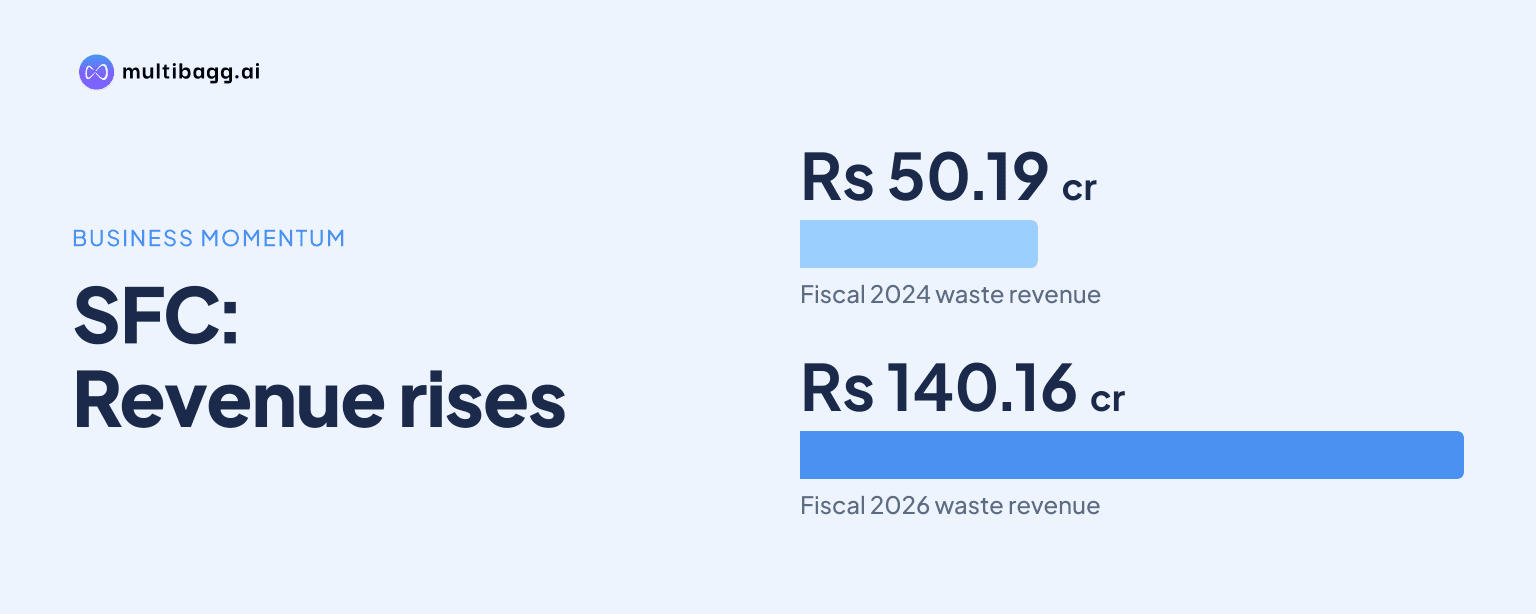
SFC’s solid-waste model supports recurring operating income because it combines project execution with plant operations, including tipping fees and sales of biogas, electricity, recyclables and compost. The solid-waste treatment order book stood at Rs 454.541 crore on August 31, 2026, following segment revenue of Rs 140.163 crore in Fiscal 2026.
How does SFC’s solid-waste model create recurring operating income?
SFC can retain an operating role after construction rather than limiting its work to equipment supply and commissioning. Its stated solid-waste treatment revenue streams include project execution, energy generation and sales, recyclables and compost sales, operation and maintenance, or O&M, services, and tipping fees. A tipping fee is paid for receiving and processing waste, while O&M covers continuing operation of a plant after completion.
SFC uses its proprietary OREX system to separate biodegradable organics and lignocellulosic fibres from inorganic material in mixed municipal solid waste. The process produces a pulped organic slurry described as more than 98% biodegradable, largely free of contaminants and non-biodegradable fractions, for use in downstream biogas digesters. This separation determines how much incoming waste can become saleable gas, compost or recovered material rather than landfill.
The integrated facility process creates several output categories from wet and dry waste. Wet waste can produce biogas, electricity, organic compost and reusable water, while dry waste can generate refuse-derived fuel, or RDF, more than 25 fractions of recyclables, and polyethylene terephthalate, or PET, flakes. SFC says RDF remaining after recyclable recovery has a calorific value of about 3,000 to 3,500 kilocalories per kilogram, allowing use as an alternative energy fuel or as a coal substitute in cement plants.
Which projects support SFC’s solid-waste model?
SFC’s operating base includes two integrated solid-waste facilities in Goa for Goa Waste Management Corporation, or GWMC, under public-private partnership and turnkey arrangements. The facilities have combined treatment capacity of 350 tonnes per day, or TPD, plus 75 TPD of handling capacity, taking aggregate capacity to up to 425 TPD. SFC undertakes capital investment in these concession projects according to the agreed project terms.
The Saligao, North Goa plant shows why waste preparation and digester operation affect output income. The facility has operated continuously for more than 10 years and achieved an average biogas yield of more than 150 normal cubic metres per tonne of organic waste in the last financial year. That exceeded the 80 to 100 normal cubic metres per tonne industry average cited in the source, although sustained yields depend on waste quality and plant performance.
SFC has also secured projects that include lengthy O&M scopes. Its subsidiary HWTPL received an April 2025 award from a public-sector oil marketing company for a 125-TPD unsegregated municipal-solid-waste compressed biogas, or CBG, plant at Tinsukia, Assam, and a May 2025 award for a 300-TPD segregated plant at Bhubaneswar, Odisha. Both awards cover engineering, procurement, commissioning and 10 years of O&M, extending SFC’s involvement beyond construction.
How has SFC’s solid-waste business changed since Fiscal 2024?
SFC’s solid-waste treatment revenue rose from Rs 50.188 crore in Fiscal 2024 to Rs 119.356 crore in Fiscal 2025 and Rs 140.163 crore in Fiscal 2026. The segment’s share of revenue from operations increased from 7.63% in Fiscal 2024 to 17.10% in Fiscal 2025 and 17.44% in Fiscal 2026. Over the same period, wastewater treatment remained the largest segment, but its share declined from 79.16% to 67.54%.
SFC’s solid-waste treatment order book fell from Rs 128.787 crore at March 31, 2024 to Rs 100.634 crore at March 31, 2025, before increasing to Rs 502.516 crore at March 31, 2026. It subsequently stood at Rs 454.541 crore on August 31, 2026. SFC defines total order book as the estimated value of unexecuted contracts and orders, including O&M contracts, and new projects supported by letters of award, letters of intent, memorandums of understanding or similar commitments considered firm or likely to materialise.
Got a follow-up? Ask IRIS
What must hold for SFC’s recurring solid-waste income to persist?
SFC’s operating receipts depend on waste availability, effective processing, contractual O&M or tipping-fee payments, and buyers for biogas, power, compost, RDF and recyclables. Its municipal-solid-waste facility process indicates that less than 5% of waste goes to landfill, with the balance directed towards organic treatment, materials recovery or fuel. The operating model therefore relies on handling mixed waste that can include bio-waste, inert material, textiles, glass, wood, metal, rubber, plastic and paper.
India’s CBG blending obligation provides the disclosed policy context for SFC’s expansion plans. The obligation is scheduled to begin at 1% in FY 2025-26 and increase to 5% from FY 2028-29 onwards, requiring oil marketing companies to blend CBG into fuel infrastructure. SFC plans to participate in tenders for joint-venture or technology-partner roles, particularly those associated with oil marketing companies that have CBG production obligations.
Customer concentration is also material to order conversion and operating continuity. SFC’s top 10 customers accounted for 79.20% of revenue from operations in Fiscal 2026, compared with 64.44% in Fiscal 2025 and 61.37% in Fiscal 2024. GWMC and oil marketing companies are identified as primary solid-waste customers, making tender awards, concession terms and counterparty arrangements relevant to future project and operating revenue.
How is SFC expanding beyond the Goa facilities?
SFC has disclosed joint-venture and collaboration efforts for CBG and waste-to-energy, or WtE, plants, alongside its two Goa facilities. These include a joint-venture agreement with an Indian city gas distribution company, a memorandum of understanding with an Indian oil and natural gas conglomerate, and provisional selection as a joint-venture partner for a Mumbai project of up to 1,000 TPD of segregated organic municipal solid waste.
SFC has also disclosed plans to enter agro-waste biogas projects through subsidiaries. Patanjan Biofuels Private Limited entered a term sheet to acquire an agricultural-residue biogas facility in Punjab, while Pentagen Biofuels Private Limited acquired land in Nanded, Maharashtra, for an agricultural-waste biogas plant. These initiatives require project development, capital investment and operating execution before they can contribute to revenue.
Conclusion
SFC’s solid-waste model differs from a purely equipment-led approach because it can combine engineering and construction revenue with O&M, tipping-fee and output-sale income. Segment revenue increased from Rs 50.188 crore in Fiscal 2024 to Rs 140.163 crore in Fiscal 2026, while the March 31, 2026 order book was Rs 502.516 crore. The outcome remains dependent on throughput, organic extraction, conversion yields, output offtake and contract terms.
The next measures to watch are execution of the Rs 454.541 crore solid-waste treatment order book reported on August 31, 2026 and progress on the Assam and Odisha CBG projects, each with a 10-year O&M scope. SFC has disclosed a plan to pursue larger municipal-solid-waste and agro-waste projects, but those plans remain subject to capital deployment, counterparties, project development and plant operations.