










SFC enters wastewater recycling through exclusive DuPont component supply
Key highlights
- SFC secured its first wastewater recycling and reuse order in July 2025 after signing its exclusive DuPont supply agreement in 2024.
- The DuPont arrangement covers UF, CCRO and MBR components for exclusive supply in India.
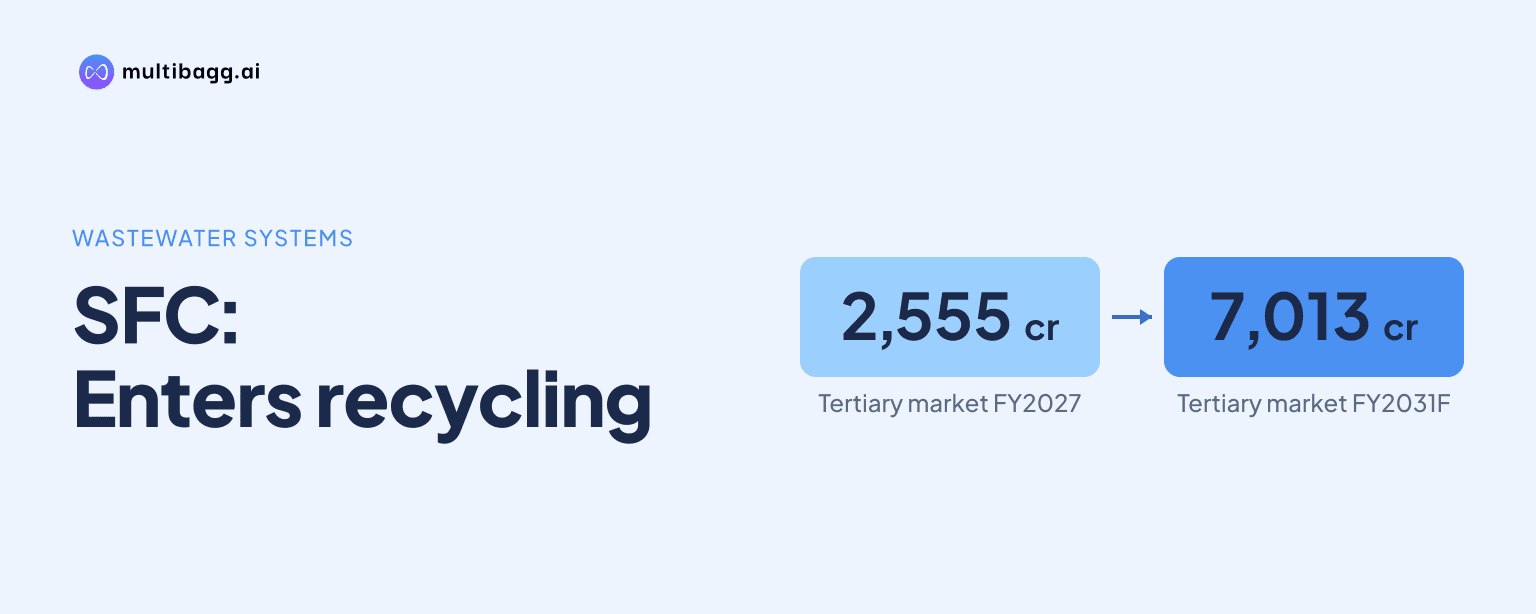
- India’s tertiary-treatment market is projected to grow from Rs 2,555 crore in FY2027 to Rs 7,013 crore in FY2031F, a 30.26% CAGR.
- SFC’s repeat customers generated 97.41% of standalone revenue in the three months ended June 30, 2026, while its top 10 customers contributed 79.20% in fiscal 2026.
powered by IRIS
SFC Environmental Technologies Limited entered wastewater recycling through an exclusive 2024 supply agreement with DSP Singapore Holdings Pte Ltd, known as DuPont. The agreement gives SFC exclusive Indian supply of specified ultrafiltration, closed-circuit reverse osmosis and membrane-bioreactor components, and SFC secured its first wastewater recycling and reuse order in July 2025.
How did SFC enter wastewater recycling?
SFC entered wastewater recycling and reuse, or WRR, through its 2024 exclusive supply agreement with DuPont, which was amended in June 2025. The arrangement covers submerged ultrafiltration, or UF, membrane modules L2N V2 and S10N V2, closed-circuit reverse osmosis, or CCRO, systems and B50N membrane bioreactor, or MBR, modules for supply in India.
SFC secured its first WRR order in July 2025 after entering the agreement and executing its June 2025 amendment. The disclosure does not state the order’s value, treatment capacity, customer or commissioning date, so the order establishes initial commercial activity rather than a disclosed revenue contribution.
SFC’s WRR scope includes design, engineering, manufacturing, procurement, supply, installation and commissioning of treatment projects. The business is intended to serve greenfield tertiary-treatment projects and to add tertiary capabilities to existing wastewater-treatment plants.
How does the DuPont supply agreement expand SFC’s wastewater offering?
The DuPont supply agreement expands SFC’s wastewater offering from C-Tech sewage treatment to tertiary treatment for industrial recycling and reuse. C-Tech is SFC’s cyclic activated sludge technology, a sequencing batch reactor process used for domestic sewage and industrial effluents that produces water suitable for low-end recycling applications.
SFC’s C-Tech package includes design and engineering, technology installation, decanters, diffusers, air blowers, fibre disc filters, solar sludge drying systems and automated controls. In the company’s comparison for a 1,000 million-litre-per-day plant, C-Tech recorded biochemical oxygen demand, or BOD, removal of 90% to 95% and chemical oxygen demand, or COD, removal of 95% to 98%, compared with 85% to 90% BOD removal and 90% to 95% COD removal for conventional sequencing batch reactors.
Tertiary treatment selection depends on required water quality, feedwater characteristics, recovery and energy-efficiency goals, space constraints and lifecycle costs. SFC can therefore use the supplied components in different configurations rather than offering one fixed recycling process for every plant.
What roles do UF, CCRO and MBR play in SFC recycling plants?
UF, CCRO and MBR address distinct treatment requirements in SFC recycling plants. UF removes suspended solids and colloids, CCRO is used to remove total dissolved solids, or TDS, and MBR combines biological treatment with membrane filtration for high-solids wastewater.
UF may lower downstream reverse-osmosis membrane fouling, reducing chemical-cleaning frequency, operating costs and system downtime. Traditional media filters generally remove particles down to about 5 microns, while the disclosed UF membranes remove particles bigger than 0.02 microns, including bacteria and viruses.
CCRO recirculates concentrate into the feed and achieves water recovery over repeated cycles, unlike conventional reverse-osmosis systems that use multiple stages in series. The disclosure states that each conventional reverse-osmosis stage typically achieves 50% recovery and that at least two stages are required to reach 75% recovery; CCRO instead uses software-based set points to begin a flush cycle while permeate production continues.
SFC offers DuPont’s B50N module, part of the MemPulse N series, in its MBR systems. Its pulsed plug-flow aeration periodically releases air bubbles that create shear forces on membrane fibres, and SFC states that the configuration can reduce aeration energy by up to 65% compared with conventional MBR systems.
Got a follow-up? Ask IRIS
What wastewater recycling market is SFC targeting?
SFC is targeting an Indian tertiary-treatment market projected to rise from Rs 2,555 crore in FY2027 to Rs 7,013 crore in FY2031F. The market estimate projects a compound annual growth rate, or CAGR, of 30.26% between FY2026 and FY2031F, with water scarcity and government water-conservation initiatives identified as demand drivers.
The forecast represents an increase of Rs 4,458 crore between FY2027 and FY2031F, but it is not a forecast of SFC revenue. Participation depends on customer specifications, the suitability of UF, CCRO or MBR for each feedwater stream, and customers’ ability to procure and construct reuse facilities.
SFC’s project cycle also depends on engineering, procurement and construction, or EPC, companies. Municipalities and urban local bodies invite EPC bids, and SFC provides bidders with technical expertise and cost estimates before a tender award; after an EPC company wins, SFC may supply technology, equipment and installation services.
How does SFC’s EPC-led model affect wastewater recycling orders?
SFC’s EPC-led model connects wastewater recycling to relationships built in sewage-treatment projects, while making order conversion dependent on bid awards and project execution. SFC said supplies are generally delivered over six to 12 months after an order, depending on customer approvals, site clearance, funding and construction schedules.
Repeat customers generated 97.41% of SFC’s standalone revenue in the three months ended June 30, 2026, compared with 91.98% in fiscal 2026, 85.18% in fiscal 2025 and 89.96% in fiscal 2024. The measure covers customers from whom SFC derived revenue in any of the three preceding fiscal years for each reported period.
Customer concentration also increased in fiscal 2026. SFC’s top 10 customers accounted for 79.20% of revenue from operations in fiscal 2026, compared with 64.44% in fiscal 2025 and 61.37% in fiscal 2024, while the largest customer accounted for 26.68% in fiscal 2026.
For WRR projects, SFC’s stated role includes pre-bid support, design and engineering, component procurement, supply, warranty servicing and spares. The EPC company undertakes design approvals, site mobilisation and civil works, and handles operations and maintenance after installation and commissioning carried out in collaboration with SFC.
Conclusion
SFC’s exclusive DuPont component supply agreement marks its move from C-Tech-based sewage treatment into tertiary wastewater recycling and reuse. The arrangement gives SFC access to UF, CCRO and MBR components that can be used for different treatment requirements, while retaining its design, supply and EPC-partner approach; the July 2025 order shows that the offering has reached the order stage.
The next disclosed developments to watch are additional WRR orders and execution of the July 2025 order. Delivery normally takes six to 12 months after an order and depends on approvals, site readiness, funding and the EPC customer’s construction timetable, while the FY2031F market estimate remains dependent on projected tertiary-treatment demand.