










The Company says 1986-91 allotment filings cannot be traced
Key highlights
- Original ROC Form 2 filings for 13 allotments made between December 18, 1986 and February 22, 1991 cannot be traced.
- The affected allotments covered 25,670 shares, or about 99.7% of the 25,740 shares outstanding before the 1996 subdivision.
- The Company reconstructed the allotment history using financial statements, statutory registers, minutes and share certificates.
- The Company disclosed no existing lawsuit, penalty or regulatory order, but warned that future legal or regulatory action remains possible.
powered by IRIS
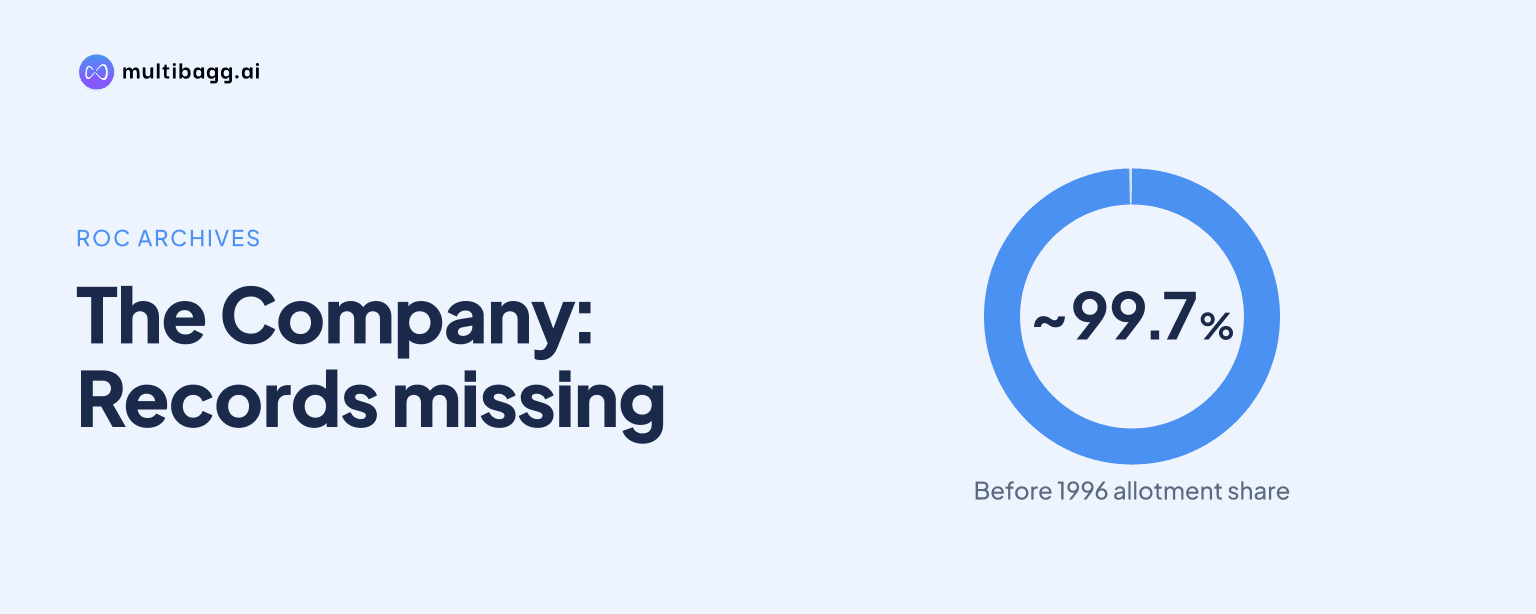
The Company says original Form 2 filings for 13 share allotments made from December 1986 to February 1991 cannot be traced in Registrar of Companies (ROC) records. The 13 cash issues added 25,670 shares of Rs 100 face value and increased paid-up capital from Rs 7,000 at incorporation to Rs 25.74 lakh, using reconstructed records.
Which allotment filings cannot The Company trace?
The Company cannot trace Form 2 filings for 13 starred allotments between December 18, 1986 and February 22, 1991. Form 2 is the allotment filing identified in the capital-history disclosure, and the Company says the forms are not traceable and unavailable in ROC records.
The Company does not state that the filings were never made. M/s. Jamb & Associates, a practising company secretary, certified that the relevant Form 2 records are unavailable with the ROC. The disclosed allotment history therefore relies on records other than the original filings held by the regulator.
The first affected allotment comprised 2,350 shares on December 18, 1986, issued for cash at Rs 100 per share. The final affected allotment comprised 740 shares on February 22, 1991, also issued for cash at Rs 100 per share. The capital-history table records nil securities premium for each of the 13 affected issues.
The Company also identifies a wider historical-record risk covering certain forms filed with the ROC, appointments of statutory auditors and directors, and filing of financial statements. The capital-structure note specifically concerns Form 2 records for share allotments, while the risk factor describes these additional corporate-record limitations.
How much early capital history do the missing filings cover?
The missing Form 2 filings cover 25,670 of the 25,740 shares outstanding immediately before the September 30, 1996 subdivision. The affected allotments therefore account for about 99.7% of the pre-subdivision share count, while the remaining 70 shares were subscribed by the initial subscribers to the memorandum of association.
The 13 allotments increased paid-up capital from Rs 7,000 at incorporation to Rs 25.74 lakh by February 22, 1991. The largest single issue was 5,270 shares on May 14, 1987, and the smallest was 225 shares on August 6, 1988. Each listed issue was a cash allotment at the Rs 100 face value.
The September 30, 1996 shareholders’ resolution changed the number, rather than the value, of the earlier shares. It subdivided 25,740 shares of Rs 100 each into 2,57,400 shares of Rs 10 each, leaving the Rs 25.74 lakh paid-up capital represented by those shares unchanged.
Later capital actions changed the share count further. The history records a 51,480-share rights issue in May 1997, a 1,08,10,800-share bonus issue in October 2009, buybacks of 16,38,880 shares in November 2021 and 23,70,200 shares in September 2024, and a 14,22,110-share bonus issue in March 2026. The Company reported 85,32,713 paid-up equity shares before the offer.
How did The Company reconstruct the allotment record?
The Company says it used available financial statements, statutory register, minutes and share certificates to ascertain the issue price, consideration and nature of the affected allotments. Those alternative records support the disclosed treatment of the 13 issues as cash further issues at Rs 100 per share.
The reconstructed sequence starts with 2,350 shares in December 1986, followed by 5,270 shares in May 1987 and 3,840 shares in September 1987. It then records issues ranging from 225 shares to 4,000 shares between January 1988 and July 1990, before the 740-share issue in February 1991.
The supplied capital-history material contains a five-share difference for the March 8, 1988 allotment. The main history table records 1,655 shares and a cumulative count of 17,275 shares, while the later detailed allottee schedule describes the issue as 1,650 shares. The Company does not explain the difference, and the 25,670-share total follows the main history table.
The Company states that all shares in its listed capital history were fully paid from their allotment dates. Financial statements, the statutory register, minutes and share certificates provide the stated reconstruction basis, but the Company separately confirms that the original Form 2 records are unavailable.
Got a follow-up? Ask IRIS
What legal or regulatory exposure does The Company disclose?
The Company says it cannot assure investors that no legal proceedings or regulatory actions will be initiated in future in relation to missing filings and corporate records. The risk factor says any such action may affect the Company’s financial condition and reputation, but it does not quantify a potential liability.
The disclosure presents a contingent risk rather than an existing order, penalty or lawsuit. The Company does not identify a current proceeding by the ROC or any other authority, and does not state that a regulator has challenged any of the 13 allotments.
The Company also does not say that any share was invalidly issued, that consideration was unpaid, or that historical capital totals are incorrect. Its stated position is narrower: Form 2 filings cannot be traced, while available records were used to determine the terms of the historic allotments.
The present offer is supported by separately disclosed 2026 approvals. The Board authorised the offer on February 12, 2026, shareholders passed a special resolution under Section 62(1)(c) of the Companies Act, 2013 on March 11, 2026, and the Board took on record selling shareholders’ consent on March 17, 2026.
How do later capital actions place the record gap in context?
The Company’s authorised share capital increased from Rs 25 lakh at incorporation to Rs 50 lakh on September 3, 1990, then to Rs 12.5 crore on September 24, 2009 and Rs 18 crore on September 26, 2014. The 1990 authorised-capital increase fell within the period in which the Form 2 allotment filings are unavailable.
Before the offer, the Company reported issued, subscribed and paid-up capital of Rs 8.5327 crore, represented by 85,32,713 equity shares of Rs 10 each. It also reported a securities premium account of Rs 5.15 lakh, compared with nil premium in every allotment covered by the unavailable 1986-91 Form 2 filings.
The proposed fresh issue of up to 23,26,000 shares would increase issued, subscribed and paid-up share capital to 1,08,58,713 shares, with face-value capital of Rs 10.8587 crore. That proposed change follows 2026 resolutions, whereas the filing gap concerns original documents for allotments completed between 1986 and 1991.
Conclusion
The Company’s disclosure shows that original ROC Form 2 filings cannot be located for 13 allotments that created 25,670 of the 25,740 shares outstanding before the 1996 subdivision. The Company reconstructed the transactions from available financial statements, statutory register, minutes and share certificates, while acknowledging that future legal or regulatory action remains possible.
The disclosed point to watch is whether a regulator, claimant or other party raises an issue over the unavailable filings or the broader historical corporate records cited in the risk factor. The Company has also not explained the five-share difference between the March 8, 1988 main capital-history entry and the later detailed allottee schedule.