










Vectras Enprocon cut combined-station revenue share to 38% in FY26
Key highlights
- Pipeline services accounted for 50.66% of Vectras Enprocon’s FY26 revenue from operations, compared with 38.09% for combined-station work.
- Combined-station revenue was Rs 45.64 crore in FY26, down from Rs 51.36 crore in FY25 and Rs 46.50 crore in FY24.
- Vectras Enprocon reported an unexecuted order book of Rs 183.28 crore covering 34 projects as of September 30, 2026.
- Labour-at-site and drilling and excavation costs together amounted to Rs 55.10 crore, or 45.99% of FY26 revenue from operations.
powered by IRIS
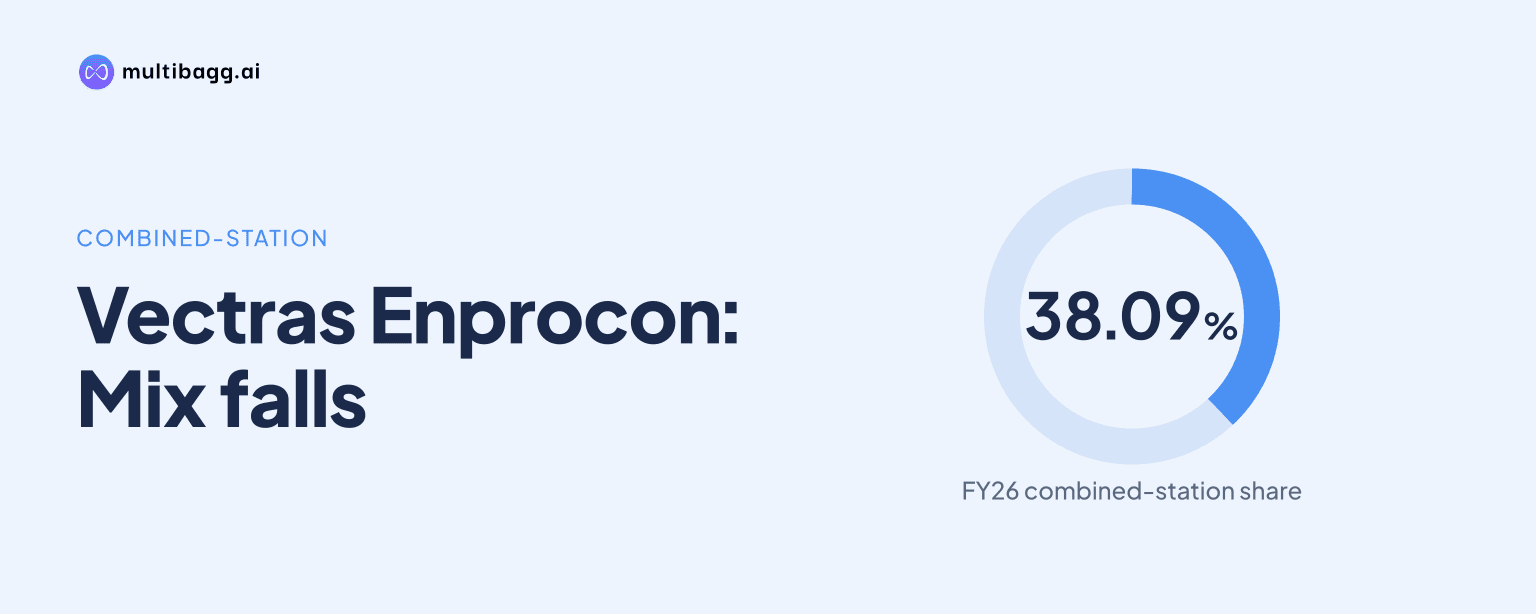
Vectras Enprocon reduced its reliance on combined-station work after entering midstream and downstream oil-and-gas pipeline projects in FY25. Combined-station work generated 38.09% of FY26 revenue from operations, down from 85.59% in FY24, while pipeline services accounted for 50.66% of FY26 revenue.
How did Vectras Enprocon's combined-station revenue share change?
Vectras Enprocon's combined-station revenue share fell by 47.50 percentage points between FY24 and FY26. Combined Oil and Gas station work contributed Rs 46.50 crore, or 85.59% of revenue from operations, in FY24; the contribution was Rs 51.36 crore, or 63.82%, in FY25, before reaching Rs 45.64 crore, or 38.09%, in FY26. This was a change in revenue mix rather than a continuous fall in the rupee value of combined-station work, which increased in FY25 before declining in FY26.
The underlying revenue base also expanded over the comparison period. Total revenue from operations rose to Rs 119.80 crore in FY26 from Rs 54.32 crore in FY24, while combined-station revenue was slightly lower in absolute terms in FY26 than in FY24. Consequently, the reduced share reflects both the introduction of another service line and the growth of revenue outside combined-station projects.
How did oil-and-gas pipeline projects alter the revenue mix?
Vectras Enprocon entered pipeline work in the oil-and-gas industry's midstream and downstream segments during FY25. The filing says these pipeline services contributed 50.66% of FY26 revenue from operations, making them the largest disclosed service contribution for that year. Engineering, Procurement and Construction, or EPC, is the contract model under which Vectras Enprocon provides its oil-and-gas services.
The FY26 pipeline contribution exceeded the 38.09% contribution from combined-station work by 12.57 percentage points. The disclosure does not provide the pipeline segment's rupee revenue, so the reported 50.66% should not be read as a separately disclosed revenue amount. It does, however, show that the new line reduced Vectras Enprocon's dependence on combined-station work within the financial year after its entry into pipeline work.
The mix shift does not mean combined-station work has ceased to be important. It remained Rs 45.64 crore in FY26 and represented 45.61% of revenue in the six months ended September 30, 2026, compared with 38.09% for the full FY26. That partial-period percentage shows combined-station work continued to supply a substantial part of operating revenue after pipeline work was introduced.
What must hold for the combined-station revenue shift to persist?
Vectras Enprocon must continue to qualify for, win and execute pipeline and combined-station contracts through competitive tenders. The filing identifies technical capability, execution experience, financial thresholds and regulatory compliance as tender eligibility requirements. A change in qualification criteria, or a failure to meet them, could limit the company's ability to bid for future projects and could alter the FY26 revenue mix.
Project execution also determines whether awarded work becomes revenue. Vectras Enprocon states that delays, documentation failures, quality issues or non-compliance with post-commissioning requirements can lead to financial penalties, work-order cancellation or blacklisting from future participation. Its contracts can require performance guarantees for a specified plant performance ratio for generally up to five years after commissioning, exposing a project to remedial work, liquidated damages or termination if those guarantees are not maintained.
Vectras Enprocon reported an unexecuted order book of 34 projects worth Rs 183.28 crore as of September 30, 2026. An order book is the value of firm projects not yet executed, but it does not assure the timing or amount of future revenue. The filing says projects may be delayed, modified or cancelled, while clients may need to acquire land, obtain rights of way, secure permits, approve designs or make advance payments before execution can proceed.
Got a follow-up? Ask IRIS
What concentration risks remain after Vectras Enprocon entered pipeline work?
Vectras Enprocon's service diversification did not eliminate customer concentration. Its top 10 customers provided 92.27% of FY26 revenue from operations, compared with 96.04% in FY25 and 97.84% in FY24. The largest customer alone accounted for Rs 28.66 crore, or 23.92%, in FY26, down from Rs 38.57 crore, or 47.93%, in FY25.
The customer list disclosed for the top 10 includes M/s. Vectras, a partnership firm of the promoters, Bharat Petroleum Corporation Limited, AGP City Gas Private Limited, Mahanagar Gas Limited and AGP CGD India Private Limited. Vectras Enprocon entered a non-compete agreement with M/s. Vectras on September 25, 2025, under which contracts already awarded and to be awarded to the partnership firm are to be subcontracted to Vectras Enprocon. The company says it has no long-term agreements with customers, leaving revenue continuity dependent on repeat business and customer relationships.
Geographic concentration also remained high. Gujarat and Maharashtra together generated Rs 85.69 crore, or 71.52%, of FY26 revenue from operations, after contributing 89.72% in FY25 and 92.59% in FY24. The FY26 share declined as other states contributed more, including Chhattisgarh at Rs 17.06 crore, or 14.24%, and Rajasthan at Rs 8.38 crore, or 6.99%; nevertheless, two states still accounted for more than seven-tenths of annual revenue.
Which operating inputs could affect pipeline project execution?
Vectras Enprocon relies on suppliers without long-term supply agreements and generally buys components through purchase orders. Its top 10 suppliers represented 68.64% of FY26 purchases, down from 72.87% in FY24, while the largest supplier represented 34.67% of purchases in FY26. Supply disruption, higher material prices, local-supplier regulation, import restrictions or transport failures can raise costs or delay construction.
Third-party providers are also important to site labour and drilling and excavation activities. Labour-at-site costs were Rs 31.75 crore, or 26.50% of FY26 revenue from operations, and drilling and excavation costs were Rs 23.35 crore, or 19.49%; together they totalled Rs 55.10 crore, or 45.99%. Vectras Enprocon has an in-house operations department of more than 900 personnel, but says third-party shortages, non-compliance or substandard work can still cause cost overruns, penalties or cancelled work orders.
Conclusion
Vectras Enprocon's FY26 revenue mix changed materially: pipeline services supplied 50.66% of revenue from operations, while combined-station work fell to 38.09% from 85.59% in FY24. The transition reflects a larger revenue base and an additional oil-and-gas project category, but combined-station work still produced Rs 45.64 crore in FY26 and remained a major operating vertical.
The next evidence on whether this diversification persists will come from execution of the Rs 183.28 crore unexecuted order book across 34 projects as of September 30, 2026. Revenue conversion will depend on tender eligibility, client approvals and payments, supplier availability, third-party execution and Vectras Enprocon's ability to meet contractual quality and timing requirements.