










Vectras Enprocon Top 10 Customers Generated 92%-98% Revenue
Key highlights
- Vectras Enprocon’s top 10 customers generated 97.29% of revenue from operations in the six months ended September 30, 2026.
- The top 10 customers contributed 92.27% of revenue in FY 2026, 96.04% in FY 2025 and 97.84% in FY 2024.
- The largest customer’s revenue share declined from 60.33% in FY 2024 to 23.92% in FY 2026 and 23.88% in the six months ended September 30, 2026.
- Vectras’s revenue from operations increased from Rs 54.3189 crore in FY 2024 to Rs 119.802 crore in FY 2026, while the company continued to have no long-term customer agreements.
powered by IRIS
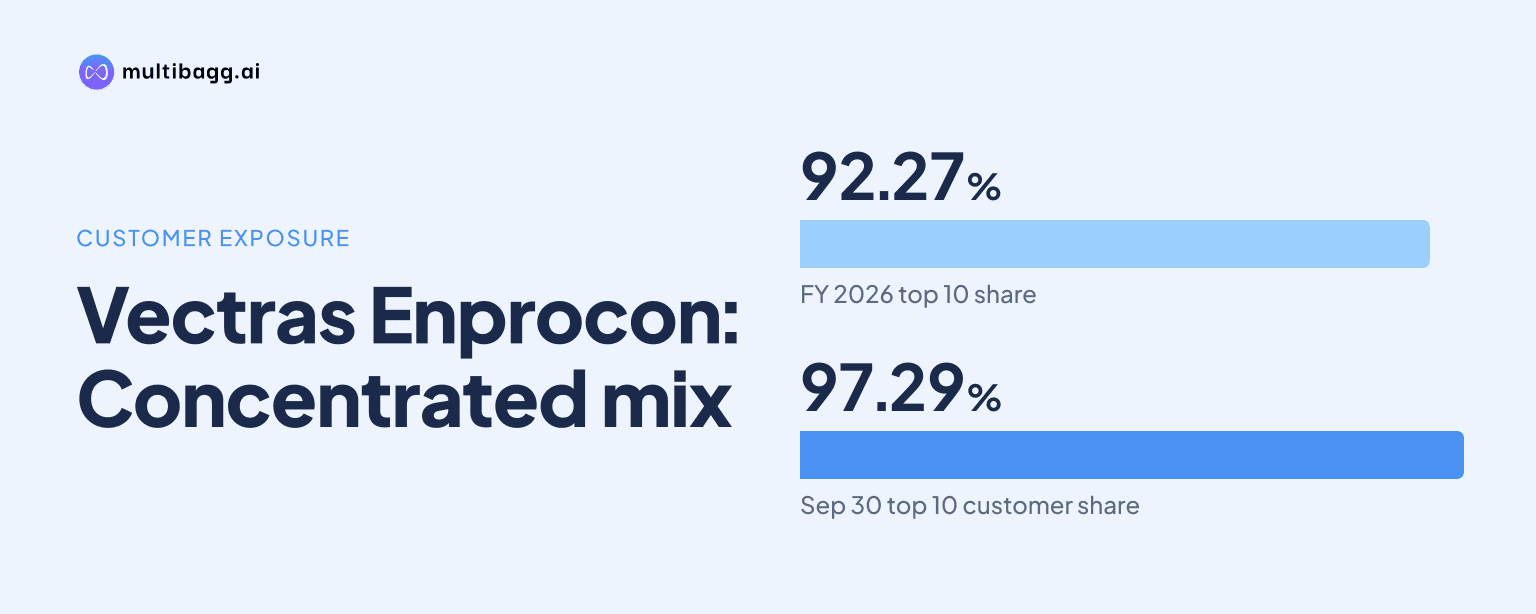
Vectras Enprocon’s top 10 customers generated 92.27% to 97.84% of annual revenue from operations in financial years 2024 to 2026, and 97.29% in the six months ended September 30, 2026. Vectras has no long-term customer agreements, so future sales depend on repeat orders and customer relationships.
How concentrated is Vectras’s revenue among its top 10 customers?
Vectras’s top 10 customers generated Rs 69.9857 crore, or 97.29%, of revenue from operations in the six months ended September 30, 2026. The concentration was above the 92.27% reported in FY 2026, when the top 10 generated Rs 110.5425 crore of Vectras’s Rs 119.802 crore revenue from operations.
Customer concentration remained high in each annual period even as revenue increased. Top-10 customers accounted for Rs 77.296 crore, or 96.04%, of FY 2025 revenue and Rs 53.1433 crore, or 97.84%, of FY 2024 revenue. FY 2026 had the lowest disclosed top-10 share at 92.27%, leaving 7.73% of that year’s revenue outside the 10 largest customers.
The measure ranks customers by revenue in each respective period rather than using a fixed list of customers. Vectras states that the largest, top-five and top-10 customers may not be the same across the disclosed periods. The percentages therefore establish reliance on a narrow customer group in each period, but do not establish that the same counterparties supplied all revenue from FY 2024 through September 2026.
What changed in Vectras’s customer dependency over time?
Vectras became less dependent on its single largest customer between FY 2024 and FY 2026, but dependence on the broader top-10 group remained high. The largest customer’s revenue share declined from 60.33% in FY 2024 to 47.93% in FY 2025 and 23.92% in FY 2026, before reaching 23.88% in the six months ended September 30, 2026.
The top-five group followed a different pattern, declining from 93.46% of revenue in FY 2024 to 74.87% in FY 2026, then rising to 86.99% in the six-month period ended September 30, 2026. Vectras’s five largest customers consequently generated Rs 62.5775 crore of its Rs 71.9386 crore revenue in that six-month period, showing that the lower share of the largest customer did not create a broadly dispersed revenue base.
Revenue from operations rose from Rs 54.3189 crore in FY 2024 to Rs 80.4803 crore in FY 2025 and Rs 119.802 crore in FY 2026. Vectras attributes the increase to an expanding order book and technical abilities, and cites project identification and cost optimisation as contributors to recent financial performance. The customer data show that most of the larger revenue base continued to come from the top 10 customers.
Got a follow-up? Ask IRIS
Why does the lack of long-term customer agreements matter for Vectras?
Vectras does not have long-term agreements with customers and says actual sales may therefore differ from management estimates. In engineering, procurement and construction (EPC) services for the oil and gas industry, future revenue depends on retaining customer relationships and securing further orders instead of relying on long-term customer agreements.
Vectras identifies loss, reduction or delay of orders, deterioration in customer financial health and changes in customer relationships as factors that could reduce business from major customers. The company also cites service quality, competition and changes in demand as factors that may affect retention. A reduction in orders from one or more significant customers could affect revenue, cash flows and operating results because the top 10 generated at least 92.27% of annual revenue in FY 2024 through FY 2026.
Vectras says it cannot assure investors that historic business levels will continue, commercially viable long-term contracts can be negotiated, or customer concentration can be materially reduced. The disclosed risk is that customers may not generate the same quantum of business, or any business, and replacement customers may not be found in time.
Which customers and promoter-linked arrangements are disclosed?
Vectras identifies M/s. Vectras, a partnership firm of its promoters, Bharat Petroleum Corporation Limited, AGP City Gas Private Limited, Mahanagar Gas Limited and AGP CGD India Private Limited among its top-10 customers. Vectras did not disclose the remaining customer names because their consent was not received, limiting public information about the counterparties behind the reported concentration.
During FY 2026, M/s. Vectras was one of Vectras’s top-10 customers. Vectras entered into a non-compete agreement with the promoter partnership firm on September 25, 2025. Under that agreement, contracts already awarded, and contracts to be awarded, to the partnership firm have to be subcontracted to Vectras.
The arrangement is relevant because the promoter-linked partnership firm was included in the top-10 customer group that generated Rs 110.5425 crore in FY 2026. Vectras does not quantify M/s. Vectras’s individual revenue contribution, so the disclosed information does not establish what share of annual revenue came through the subcontracting arrangement.
What could alter Vectras’s customer concentration next?
Vectras says the composition of its customer base and the revenue generated from those customers may change as it adds customers in the normal course of business. Lower concentration would require revenue from new or smaller customers to increase enough to reduce the top-10 share, which stood at 97.29% in the six months ended September 30, 2026.
Project execution may also affect customer retention because EPC contracts typically include performance guarantees. Vectras says these guarantees can require project completion within a specified timeline and maintenance of a specified plant performance ratio, generally for up to five years after commissioning. Failure may require remedial work, result in liquidated damages or permit contract termination.
Conclusion
Vectras’s revenue growth occurred alongside persistent customer concentration, with the top 10 customers generating more than 92% of revenue in every disclosed annual period and 97.29% in the six months ended September 30, 2026. The largest customer’s share fell from 60.33% in FY 2024 to about 24% in the latest periods, but the revenue base remained concentrated among the major-customer group.
The next disclosures to watch are whether Vectras adds customers sufficiently to reduce the top-10 share and whether it sustains repeat business without long-term customer agreements. The September 25, 2025 non-compete agreement with M/s. Vectras, including the flow of contracts subcontracted from that promoter partnership firm, remains a disclosed component of the customer mix.