










Vedant Poly Fabs Uses Packaging Production and Billet Trading
Key highlights
- Vedant Poly Fabs operates two activities: flexible-packaging manufacturing and billet-strip trading.
- The company performs five packaging stages in-house: extrusion, printing, lamination, slitting and pouching.
- Vedant Poly Fabs does not maintain billet-strip inventory because vendors supply the material directly to customers.
- The company proposes to allocate Rs 17.59 crore to working capital, Rs 8 crore to certain borrowings and Rs 6.51 crore to plant and machinery.
powered by IRIS
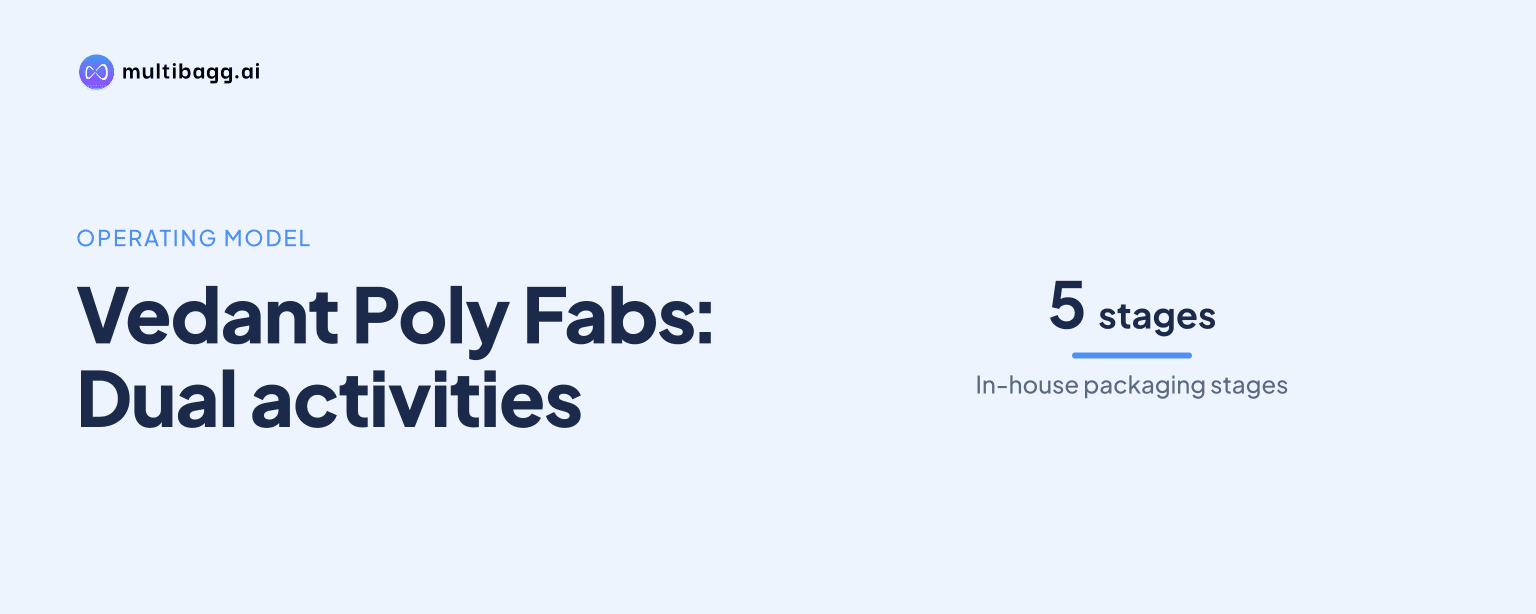
Vedant Poly Fabs combines made-to-order flexible-packaging manufacturing with a separate bill-to-ship billet-strip trading activity. Its manufacturing operation covers five stages, from extrusion to pouching, while the trading model has vendors supply material directly to customers without Vedant Poly Fabs maintaining billet-strip inventory at its facility.
How does Vedant Poly Fabs combine flexible packaging and billet trading?
Vedant Poly Fabs operates two distinct activities: business-to-business (B2B) flexible-packaging manufacturing and billet-strip trading. The packaging products are supplied to customers across India, while billet strips are traded for uses in engineering, fabrication and manufacturing. The activities differ in fulfilment: Vedant Poly Fabs manufactures flexible packaging at its facility, whereas vendors directly supply billet strips to customers.
Vedant Poly Fabs manufactures multilayer low-density (LD) films in 3-layer and 5-layer formats, alongside shrink films, barrier films, printed laminates, milk pouches and oil pouches. The company makes these products to customer specifications covering size, thickness, material composition and printing. Its billet-strip activity is instead disclosed as a bill-to-ship arrangement undertaken according to customer requirements.
The distinction is operational as well as product-based. Flexible packaging moves through extrusion, printing, lamination, slitting and pouching at Vedant Poly Fabs’ manufacturing facility. In the billet-strip activity, the vendor-to-customer route means the company does not maintain the traded material at its own facility before delivery.
What does Vedant Poly Fabs’ made-to-order flexible packaging model involve?
Vedant Poly Fabs’ flexible-packaging model begins with direct customer interaction and specifications rather than a disclosed standard-stock production model. The company generally receives orders through verbal communications covering product dimensions, material composition, printing requirements, quantities and delivery schedules. Production is therefore based on requirements communicated for each order.
Vedant Poly Fabs carries out extrusion, printing, lamination, slitting and pouching at its manufacturing facility. The five listed stages cover the conversion of materials into the flexible-packaging products in its portfolio. The company states that its facility has the machinery required to undertake these processes within its premises.
The product portfolio serves packaging applications in food and beverages and other consumer-product categories. Milk and oil pouches are specifically named products, while barrier films, printed laminates and multilayer LD films are further formats supplied by Vedant Poly Fabs. The model depends on the company’s ability to make products matching the size, composition and printing specifications received from customers.
How does Vedant Poly Fabs’ bill-to-ship billet trading avoid inventory?
Vedant Poly Fabs’ billet-strip trading uses a bill-to-ship arrangement in which vendors supply materials directly to customers. The company states that it does not maintain billet-strip inventory at its facility under this activity. The mechanism therefore differs from the packaging operation, where the company processes materials at its own manufacturing location.
The bill-to-ship activity is also customer-led, because the vendor supplies material based on customer requirements. However, the fulfilment route changes: flexible packaging passes through five in-house manufacturing stages, while billet strips are delivered from vendor to customer. The disclosure does not identify an in-house billet-strip manufacturing process.
Vedant Poly Fabs identifies engineering, fabrication and manufacturing as industries in which billet strips are used. The offer-document summary does not provide a revenue split, volume figure, vendor count or customer count for the trading activity. The disclosed information therefore establishes the transaction mechanism and the absence of company-held facility inventory, rather than the relative financial contribution of billet-strip trading.
Got a follow-up? Ask IRIS
What makes Vedant Poly Fabs’ packaging manufacturing integrated?
Vedant Poly Fabs describes an integrated packaging operation because its facility is equipped to perform extrusion, printing, lamination, slitting and pouching within its premises. The identified equipment includes multilayer extrusion machines and printing machines using central-impression (CI) flexo and rotogravure printing. These are the two printing methods specifically identified in the company’s business summary.
The in-house process supports products with different combinations of layer structure, thickness, material composition and printing requirements. Vedant Poly Fabs lists both 3-layer and 5-layer LD films, alongside printed laminates and pouches, in its portfolio. The disclosed manufacturing setup means the listed stages are performed at the company’s facility for these customer-specific requirements.
Vedant Poly Fabs was incorporated as a private limited company on December 10, 2018, and became a public limited company on August 21, 2025. Shareholders passed the conversion resolution on August 7, 2025. The business summary following that conversion identifies both flexible-packaging manufacturing and billet-strip trading as activities within the same company.
Which conditions affect Vedant Poly Fabs’ business model?
Vedant Poly Fabs identifies its ability to manage working-capital cycles and generate sufficient cash flows for additional working-capital requirements as factors that may affect results. The company also identifies fluctuations in operating costs and its ability to finance business growth on favourable terms among the uncertainties associated with its forward-looking statements. The summary does not separately quantify working-capital requirements for packaging manufacturing and billet-strip trading.
Vedant Poly Fabs also identifies dependence on a limited number of customers for a significant portion of revenue, maintaining quality standards and customising products as relevant factors. These matters apply directly to a made-to-order packaging model in which customer communications specify dimensions, composition, printing, quantities and delivery schedules. For billet strips, fulfilment also depends on vendors supplying directly to customers under the bill-to-ship arrangement.
The company’s stated offer objectives include funding incremental working-capital requirements of Rs 17.59 crore, prepaying or repaying certain borrowings of Rs 8 crore, and purchasing and installing plant and machinery at its existing manufacturing facility for Rs 6.51 crore. These proposed uses are disclosed in the offer document and are not a forecast of operating results. The general corporate-purpose allocation, if used, cannot exceed 15% of gross offer proceeds or Rs 10 crore, whichever is lower, under Securities and Exchange Board of India regulations.
Conclusion
Vedant Poly Fabs combines an integrated, specification-led flexible-packaging operation with a separate billet-strip trading route that does not require inventory at its facility. Packaging involves five in-house stages and identified extrusion and printing machinery, while the trading activity relies on direct vendor-to-customer supply based on customer requirements.
What to watch next is the disclosed plan to apply Rs 17.59 crore to incremental working capital, Rs 8 crore to certain borrowings and Rs 6.51 crore to plant and machinery at the existing manufacturing facility. The company also identifies customer concentration, quality standards, customisation, operating costs, financing and vendor fulfilment as matters that can affect whether the two-part model continues as described.