










Vedant Poly Fabs’ operating cash outflow persisted three years
Key highlights
- Vedant Poly Fabs used Rs 11.4638 crore in operating cash in financial year 2026, up from Rs 5.7398 crore in financial year 2025.
- Operating profit before working-capital changes reached Rs 19.3666 crore in financial year 2026, but working-capital movements pushed operating cash flow into deficit.
- Inventory increased to Rs 24.2888 crore and trade receivables stood at Rs 28.3754 crore at March 31, 2026.
- Investing cash used rose to Rs 28.6464 crore in financial year 2026, including Rs 26.9122 crore spent on fixed and related assets.
powered by IRIS
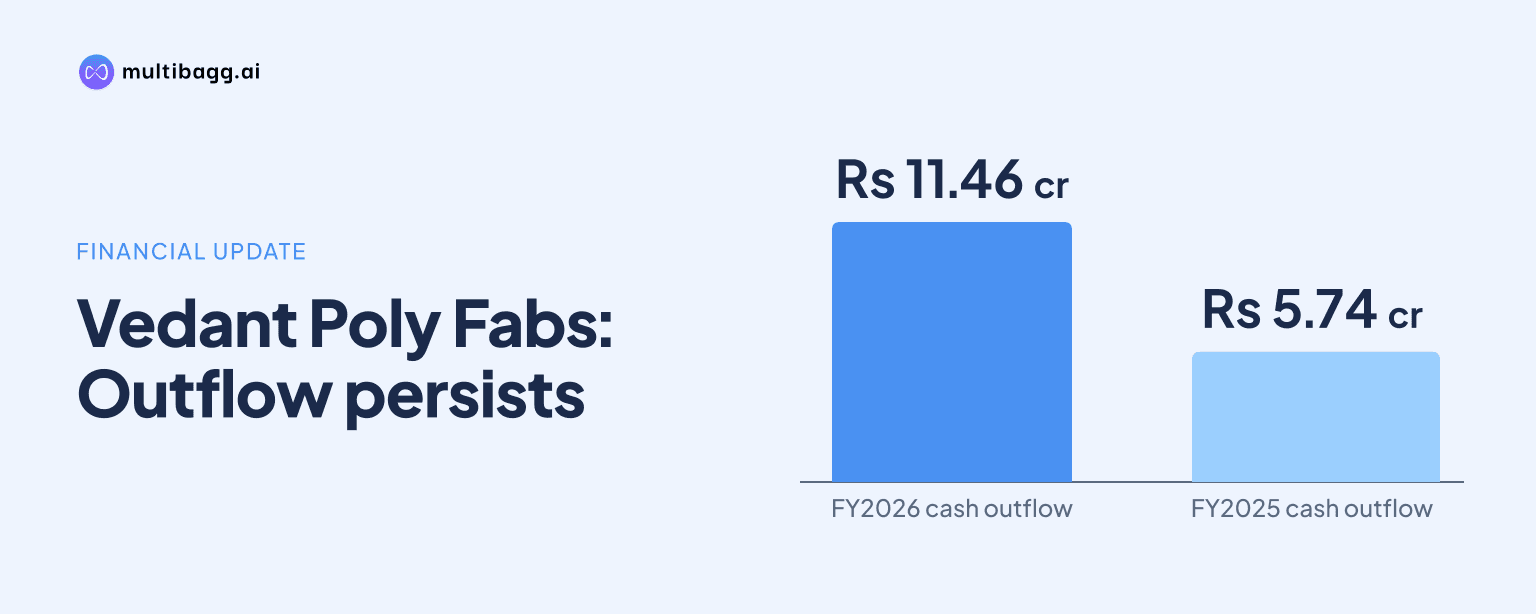
Vedant Poly Fabs recorded negative cash flow from operating activities in each of the three financial years ended March 31, 2024, 2025 and 2026. Operating cash used rose to Rs 11.4638 crore in financial year 2026 from Rs 5.7398 crore in financial year 2025, although operating profit before working-capital changes reached Rs 19.3666 crore.
Why did Vedant Poly Fabs report operating cash outflows for three years?
Vedant Poly Fabs reported operating cash outflows because working-capital movements consumed more cash than its operating profit before those movements generated. Operating profit before working-capital changes increased from Rs 1.4669 crore in financial year 2024 to Rs 8.3993 crore in financial year 2025 and Rs 19.3666 crore in financial year 2026, while cash used in operations increased in each year.
Working capital is the cash tied up in current assets, including inventory and trade receivables, net of current liabilities such as trade payables. In financial year 2026, Vedant Poly Fabs recorded a Rs 19.7254 crore decrease in trade payables, a Rs 8.8835 crore increase in inventories and a Rs 1.9803 crore decrease in other current liabilities. Those movements resulted in negative cash flow before extraordinary items and tax of Rs 11.3901 crore; direct taxes paid of Rs 7.37 lakh brought operating cash used to Rs 11.4638 crore.
The comparison shows that Vedant Poly Fabs’ pre-working-capital operating profit rose by Rs 17.8997 crore between financial years 2024 and 2026, while its operating cash deficit widened by Rs 8.0083 crore. Operating profit before working-capital changes excludes the funding effect of stock, customer credit and supplier balances, whereas cash flow from operating activities includes those changes.
Which working-capital items drove Vedant Poly Fabs’ operating cash outflow?
Vedant Poly Fabs’ inventory, trade receivables and trade payables were the main items affecting its operating cash outflow. Inventory rose from Rs 6.1716 crore at March 31, 2024 to Rs 15.4053 crore at March 31, 2025 and Rs 24.2888 crore at March 31, 2026. Trade receivables increased from Rs 8.3999 crore in financial year 2024 to Rs 29.7785 crore in financial year 2025 before declining to Rs 28.3754 crore in financial year 2026.
The receivables-and-inventory disclosure states that inventory represented 38.83% of current assets in financial year 2026, compared with 33.22% in financial year 2025 and 38.75% in financial year 2024. Trade receivables accounted for 45.36% of current assets in financial year 2026, down from 64.21% in financial year 2025. Vedant Poly Fabs states that it extends credit to customers and that collection delays or defaults could affect cash flow, liquidity and working-capital funding.
Trade payables rose from Rs 7.8661 crore in financial year 2024 to Rs 21.4047 crore in financial year 2025, then fell to Rs 1.6793 crore in financial year 2026. The financial year 2026 decline was recorded as a Rs 19.7254 crore adverse adjustment in the cash-flow statement. A reduction in amounts owed to suppliers requires cash to settle obligations, which can outweigh operating profit in the period.
Got a follow-up? Ask IRIS
How much did Vedant Poly Fabs’ working-capital requirement increase?
Vedant Poly Fabs’ working-capital requirement increased from Rs 7.1471 crore in financial year 2024 to Rs 19.2670 crore in financial year 2025 and Rs 46.3024 crore in financial year 2026, according to the risk-factor narrative. The company defines net working capital as total current assets minus total current liabilities, with funding required for inventory purchases and amounts blocked in trade receivables.
The accompanying working-capital table reports financial year 2026 total current assets of Rs 54.9970 crore, current liabilities of Rs 8.7281 crore and net working capital of Rs 46.2689 crore. The Rs 46.2689 crore table figure differs by Rs 3.35 lakh from the Rs 46.3024 crore narrative figure. Both disclosures show a substantial increase from financial year 2025, driven by higher inventory and lower trade payables.
Vedant Poly Fabs estimates net working capital of Rs 68.4743 crore for fiscal 2027 and Rs 82.9785 crore for fiscal 2028. Its fiscal 2027 funding pattern includes Rs 32 crore of bank borrowings, Rs 18.8813 crore of internal sources and a Rs 17.5930 crore gap proposed to be funded by the initial public offering. The estimate depends on the projected levels of current assets and liabilities and the availability of the stated funding sources.
What else reduced Vedant Poly Fabs’ cash availability?
Vedant Poly Fabs also had negative cash flow from investing activities in all three reported years. Cash used in investing activities was Rs 2.5158 crore in financial year 2024, Rs 6.6598 crore in financial year 2025 and Rs 28.6464 crore in financial year 2026, adding to the cash demands created by operating working capital.
Purchases of fixed assets, including intangible assets, capital work in progress and capital advances, reached Rs 26.9122 crore in financial year 2026, compared with Rs 3.1238 crore in financial year 2025 and Rs 2.0515 crore in financial year 2024. Capital work in progress is expenditure on assets not yet ready for intended use. Vedant Poly Fabs states that this expenditure included land and buildings, plant and machinery, furniture and fixtures, motor cars, office equipment and computer peripherals.
Vedant Poly Fabs anticipates that the new assets will raise production capacity, reduce operating costs and create additional revenue streams. However, the company states that there is no assurance that the expected production-efficiency and revenue outcomes will materialise. If negative operating cash flow persists while investment spending continues, the company says it may require external financing, which could increase leverage or dilute existing shareholders’ equity.
Conclusion
Vedant Poly Fabs’ three consecutive operating cash outflows reflect the difference between reported operating profit and cash conversion. Financial year 2026 operating profit before working-capital changes of Rs 19.3666 crore was offset by working-capital movements, particularly the Rs 19.7254 crore decrease in trade payables and the Rs 8.8835 crore increase in inventories, producing Rs 11.4638 crore of cash used in operations.
The disclosed fiscal 2027 plan identifies Rs 17.5930 crore of working-capital funding to come from the initial public offering, alongside Rs 32 crore of bank borrowings and Rs 18.8813 crore of internal sources. Collection of customer receivables, inventory levels, supplier-payment timing and whether newly acquired assets deliver the anticipated capacity and cost outcomes will affect whether operating profit converts into operating cash flow.