










Wisco Industries Limited: B2B Generates 99.55% of Revenue
Key highlights
- B2B sales generated Rs 195.9831 crore, or 99.55%, of Wisco Industries’ FY26 consolidated revenue of Rs 196.8746 crore.
- B2C sales through the company’s website contributed Rs 89.15 lakh, or 0.45%, of FY26 consolidated revenue.
- LED televisions and electric scooters together represented 92.66% of standalone revenue in the period ended June 30, 2026.
- Delhi accounted for Rs 151.3472 crore, or 76.87%, of FY26 consolidated revenue, while the top 10 suppliers represented 99.33% of FY26 standalone purchases.
powered by IRIS
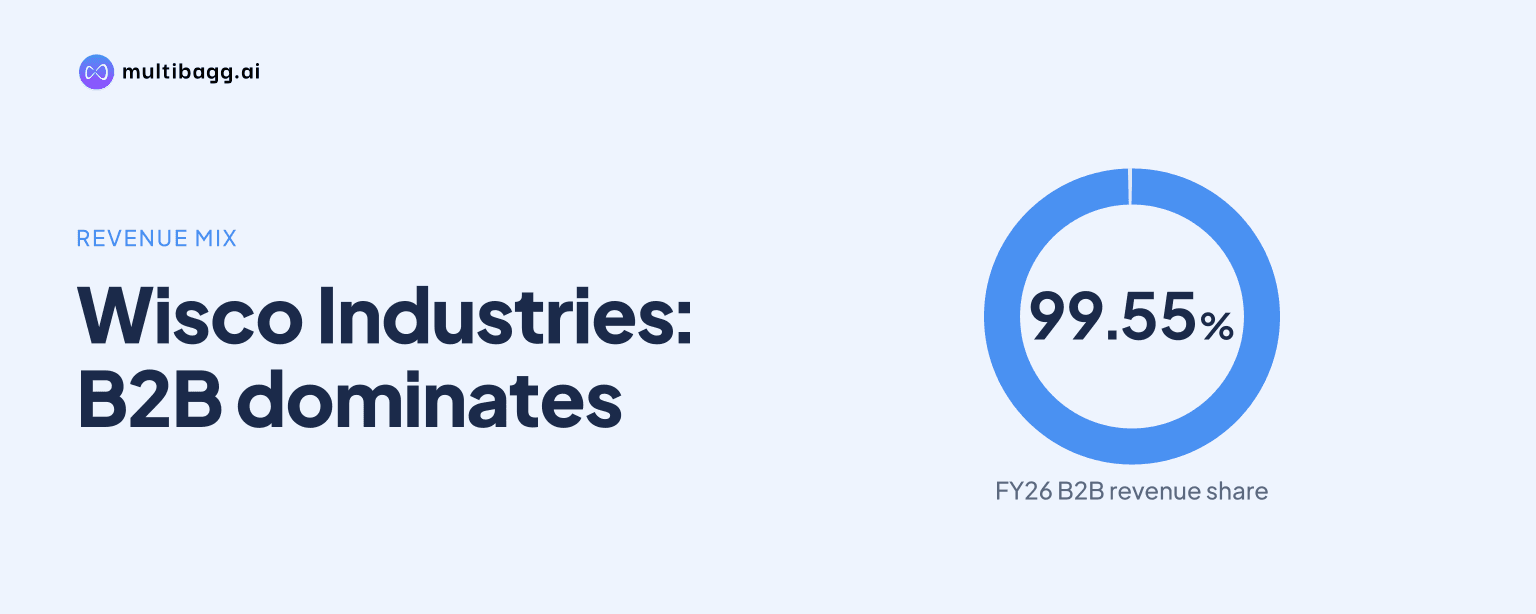
Wisco Industries Limited is overwhelmingly a business-to-business, or B2B, supplier despite operating a consumer website. B2B sales generated Rs 195.9831 crore, or 99.55%, of FY26 consolidated revenue of Rs 196.8746 crore, while business-to-consumer, or B2C, sales through its website contributed Rs 89.15 lakh, or 0.45%.
Is Wisco Industries mainly a B2B consumer-electronics business?
Yes. Wisco Industries generated Rs 195.9831 crore through B2B sales in FY26 on a consolidated basis, compared with Rs 89.15 lakh through B2C sales. The company defines its B2B channel as an offline network of customers, while its B2C platform operates through its website. This means the company’s consumer-facing route exists, but its reported sales are principally wholesale-led.
The channel split was similarly concentrated in the period ended June 30, 2026. Wisco Industries recorded consolidated B2B revenue of Rs 69.4455 crore, equal to 99.42% of revenue from operations of Rs 69.8484 crore, while B2C revenue was Rs 40.29 lakh, or 0.58%. The B2C share increased by 0.13 percentage points from FY26, but remained below 1% in both reported consolidated periods.
Wisco Industries markets LED televisions, air coolers, washing machines and air conditioners under the Wiscon brand, and sells electric scooters under a third-party brand. Its B2B-heavy outcome arises from how these products are sold: business orders are processed through offline customers, whereas direct consumer transactions are routed through the website. Maintaining this mix depends on continuing order flow through the offline network rather than growth in website sales.
How did Wisco Industries’ B2B revenue mix change over time?
Wisco Industries’ standalone disclosures show that B2B gained share as revenue increased. B2B accounted for 96.99% of standalone revenue in FY24, rising to 98.85% in FY26; B2C’s share fell from 3.01% to 1.15% over the same comparison. Consolidated channel data are available only from FY26 because Dalmia Technologies Limited became a wholly owned subsidiary in May 2025.
The standalone B2C amount rose from Rs 43.65 lakh in FY24 to Rs 84.65 lakh in FY26, but B2B revenue rose more sharply, from Rs 14.0562 crore to Rs 72.5451 crore. As a result, B2C lost 1.86 percentage points of standalone revenue share over the period. The June 2026 standalone B2C share of 1.62% was higher than FY26’s 1.15%, but still below FY24’s 3.01%.
The consolidated figures cover a broader business perimeter than the standalone results because they include Dalmia Technologies Limited from FY26. Consolidated revenue was Rs 196.8746 crore in FY26, compared with standalone revenue of Rs 73.3916 crore. Yet both measures point to the same operating conclusion: the sales model was at least 98.38% B2B in every disclosed period.
Which products make Wisco Industries’ B2B model so dominant?
LED televisions and electric scooters account for most of Wisco Industries’ standalone sales, and the disclosed channel data show that those categories are sold predominantly through B2B customers. In the period ended June 30, 2026, LED TVs generated Rs 19.2616 crore, or 79.19% of standalone revenue, while electric scooters generated Rs 3.276 crore, or 13.47%. Together, the two categories represented 92.66% of standalone revenue.
Of June 2026 LED TV revenue, Rs 19.1387 crore was B2B and Rs 12.29 lakh was B2C. Electric scooters generated Rs 3.276 crore entirely through B2B, with no B2C revenue reported. The company sold 22,340 LED TVs and 280 electric scooters during the period, compared with 1,050 air coolers, 690 washing machines and 642 air conditioners.
FY26 product data show the same sales-channel pattern. LED TVs produced Rs 49.6622 crore of standalone revenue, of which Rs 49.0762 crore was B2B and Rs 58.60 lakh was B2C. Electric scooters contributed Rs 19.8751 crore, all from B2B sales. For B2C to become material, direct sales would need to rise in LED TVs or extend to categories such as scooters, where the company reported no website-led sales.
Got a follow-up? Ask IRIS
How concentrated are Wisco Industries’ B2B customers and markets?
Wisco Industries’ B2B-led revenue is concentrated among a relatively small number of customers. Its top 10 customers generated Rs 153.9342 crore, or 78.19%, of FY26 consolidated revenue, while its largest customer contributed Rs 43.5121 crore, or 22.10%. For the period ended June 30, 2026, the top 10 customers accounted for Rs 54.4394 crore, or 77.94%, of consolidated revenue.
The standalone customer mix also shows concentration. The largest standalone customer supplied Rs 7.0158 crore, or 28.84%, of revenue for the period ended June 30, 2026, compared with 18.31% in FY26 and 48.40% in FY25. Wisco Industries reported 169 renewed customers and 904 discontinued customers in the June 2026 period, versus 180 renewed and 369 discontinued in FY26.
Geographic concentration adds to the reliance on the offline B2B network. Delhi generated Rs 151.3472 crore, or 76.87%, of FY26 consolidated revenue, while Uttar Pradesh generated Rs 20.893 crore, or 10.61%. Delhi’s share rose to 80.34%, or Rs 56.1171 crore, in the period ended June 30, 2026. The present model therefore depends substantially on sales from business customers and demand in Delhi.
What operational factors support Wisco Industries’ B2B sales model?
Wisco Industries supports B2B transactions through an offline sales, credit-check and dispatch sequence. Following a customer requirement, its sales team prepares a proforma invoice, the accounts department verifies the available credit limit, and operations verifies inventory and packages the goods. The accounts department then issues the tax invoice and e-way bill, the electronic document used for goods movement under the goods and services tax system.
The company operates from a registered office of about 6,264 square feet in Okhla, Delhi, and has two warehouses in New Delhi with plot areas of about 9,072 square feet and 4,500 square feet. These locations store traded products and facilitate dispatch. Wisco Industries also provides installation and repair services through third-party service providers, without charge under warranty and on a chargeable basis outside warranty.
Supply continuity is another condition for fulfilling B2B orders. The top 10 suppliers accounted for 99.33% of FY26 standalone purchases of Rs 64.7856 crore, while the largest supplier accounted for 41.42%. All FY26 standalone purchases were from domestic sources, and the company generally does not enter into long-term supply contracts. This leaves the sales model reliant on both customer relationships and timely availability from concentrated suppliers.
Conclusion
Wisco Industries presents both B2B and B2C routes to market, but its disclosed revenue identifies it as a wholesale-led consumer-electronics business. B2B accounted for 99.55% of FY26 consolidated revenue and 99.42% in the period ended June 30, 2026, while website-led B2C sales remained below 1%. The product mix, customer concentration and dispatch process all align with that B2B structure.
The disclosed plan to watch is Wisco Industries’ proposed Rs 15.0388 crore investment in two surface-mount technology production lines at Dalmia Technologies Limited, its wholly owned subsidiary, alongside Rs 5.225 crore planned for marketing and promotional initiatives. Surface-mount technology lines assemble printed circuit boards. The company says the manufacturing investment is intended to improve backward integration, but it has disclosed no B2C revenue target or specific website-sales expansion target.