










Wiscon restatement turned FY24 profit into Rs 135.75 lakh loss
Key highlights
- Wiscon’s FY2023-24 profit after tax changed from Rs 6.44 lakh to a restated loss of Rs 135.75 lakh.
- The largest FY24 adjustment was an Rs 81.32 lakh charge for capital work-in-progress.
- Restated net worth at March 31, 2024 fell to negative Rs 33.77 lakh from Rs 1.81 crore before restatement.
- Restated profit after tax rose to Rs 5.57 crore in FY2025-26, Rs 27.51 lakh above the originally audited figure.
powered by IRIS
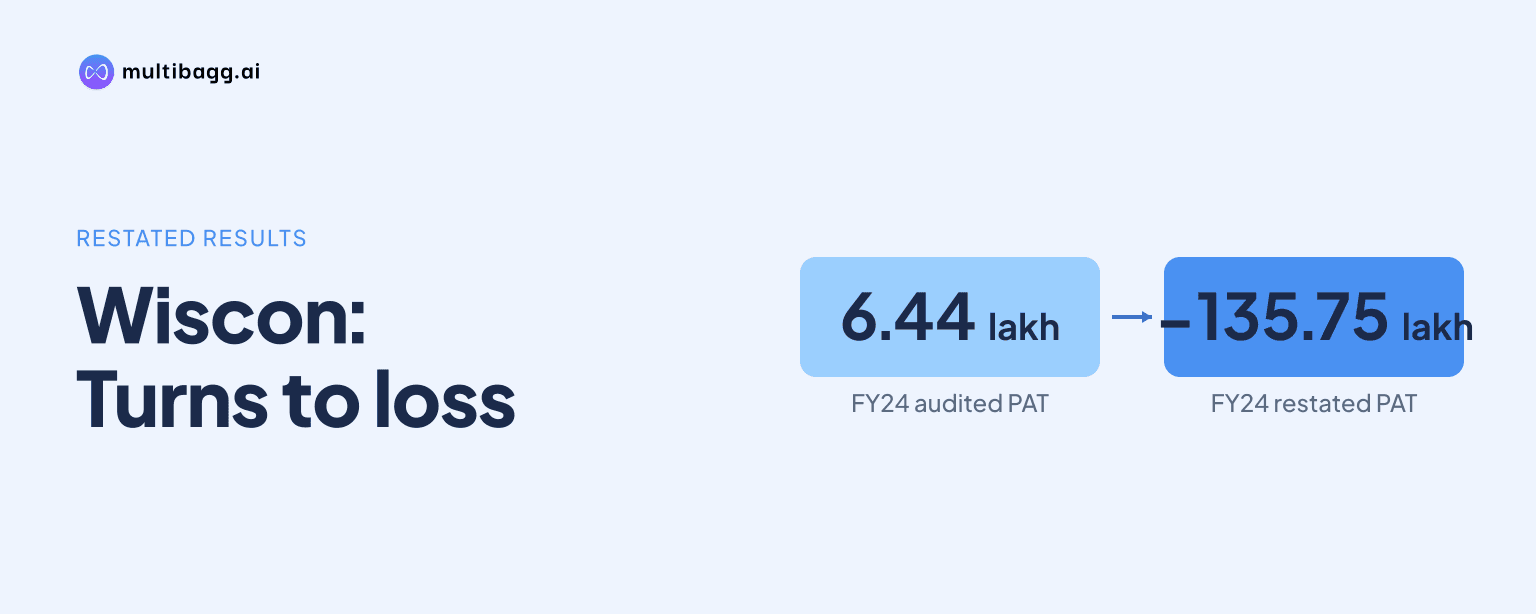
Wiscon Industries Limited restated FY2023-24 from a reported profit after tax of Rs 6.44 lakh to a loss after tax of Rs 135.75 lakh. The Rs 142.19 lakh net reduction included an Rs 81.32 lakh charge for capital work-in-progress and adjustments to provisions, tax and asset-accounting treatments.
Why did Wiscon’s FY24 restatement turn profit into a loss?
Wiscon’s FY24 restatement turned a profit into a loss because the Rs 142.19 lakh net adjustment was larger than the Rs 6.44 lakh profit reported in the audited accounts. The restated statement records a Rs 135.75 lakh loss after tax for the year ended March 31, 2024, compared with the original positive result.
The largest FY24 profit-and-loss charge was Rs 81.32 lakh for capital work-in-progress, or CWIP. CWIP is expenditure on an asset that is not yet ready for its intended use. Wiscon said software and process-development costs were classified as CWIP in FY2022-23 and FY2023-24, then capitalised as intangible assets in FY2024-25; the restatement instead charged the CWIP balance to profit and loss in the respective periods.
The FY24 reconciliation also included Rs 4.84 lakh for installation provisions and Rs 4.58 lakh for gratuity. A Rs 34.26 lakh reduction in revenue from operations was matched by an equal reduction in purchases of stock-in-trade, producing no profit effect. Wiscon said the eliminated entries related to inventory transfers between its Delhi and Haryana warehouses, which had been recorded as sales and purchases for goods and services tax, or GST, compliance rather than external-customer transactions.
What accounting treatments did Wiscon correct in FY24?
Wiscon corrected the recognition of intangible, pre-operative, employee-benefit and warehouse-transfer items in the FY24 restatement. The company determined that earlier software and process-development expenditure retained in CWIP should be expensed in the relevant periods, rather than remain as assets subsequently capitalised as intangible assets.
That conclusion affected later years because capitalised intangible assets had produced amortisation expense, meaning the periodic recognition of an intangible asset’s cost. Wiscon reversed Rs 25.10 lakh of intangible amortisation in FY2024-25 and another Rs 25.10 lakh in FY2025-26, as well as Rs 6.26 lakh in the three months ended June 30, 2026. Those reversals followed the decision to charge off the originally capitalised expenditure.
Wiscon separately concluded that pre-operative expenditure incurred before commercial operations in FY2022-23 did not qualify for capitalisation or deferred recognition. The expenditure had been included in CWIP in FY2022-23 and FY2023-24, then capitalised as deferred revenue expenditure in FY2024-25. The company charged it off in FY2022-23 and reversed related amortisation of Rs 5.15 lakh in both FY2024-25 and FY2025-26 and Rs 1.29 lakh in the period ended June 30, 2026.
How did provisions and tax alter Wiscon’s restated results?
Wiscon recognised installation, warranty, repair and gratuity obligations that had not been provided for in earlier periods. For installation, warranty and repair obligations, the company said it complied with Accounting Standard 29, or AS 29, covering provisions, contingent liabilities and contingent assets. The disclosed basis for expense recognition was historical experience and an actuarial valuation report.
Wiscon also said gratuity obligations for FY2022-23 and FY2023-24 had not been accounted for in accordance with Accounting Standard 15 (Revised), Employee Benefits. It obtained an actuarial valuation and recorded the liability and employee-benefit expense, including the Rs 4.58 lakh FY24 charge. The FY2024-25 reconciliation instead shows a Rs 1.46 lakh addition to profit from the gratuity adjustment.
Tax effects partly offset the FY24 charges. The profit-and-loss reconciliation records a Rs 48.24 lakh deferred-tax effect, while the tax-shelter statement reports a Rs 48.36 lakh tax saving on FY24 net adjustments. Deferred tax arises from temporary differences between an item’s accounting carrying value and tax base, and Wiscon said it recalculated deferred-tax assets and liabilities at each reporting date using substantially enacted normal tax rates.
Got a follow-up? Ask IRIS
How did the restatement change Wiscon’s net worth and later profits?
Wiscon’s restatement changed March 31, 2024 net worth from Rs 1.81 crore in audited accounts before adjustments to negative Rs 33.77 lakh. Net worth is defined in the ratio statement as equity share capital plus reserves and surplus, including the surplus in the statement of profit and loss. The cumulative net adjustment at that date was negative Rs 2.15 crore.
The Rs 2.15 crore cumulative adjustment comprised negative Rs 1.42 crore in cumulative profit-and-loss adjustments and negative Rs 73.03 lakh in opening-reserve adjustments. At April 1, 2023, the restated opening profit-and-loss reserve was negative Rs 73.02 lakh, against Rs 0.01 lakh in the audited statements. That opening correction included a Rs 95.46 lakh CWIP charge, partly offset by a Rs 24.56 lakh deferred-tax effect.
Later restated profits increased because previously recognised amortisation was reversed after the underlying costs were no longer treated as capitalised or deferred. Restated profit after tax in FY2024-25 was Rs 1.25 crore, Rs 20.75 lakh above the Rs 1.05 crore originally reported. In FY2025-26, restated profit after tax was Rs 5.57 crore, Rs 27.51 lakh above the Rs 5.29 crore audited figure.
What do Wiscon’s restated FY24 ratios show?
Wiscon’s restated standalone ratios show negative operating measures for FY24 after the accounting changes. Earnings before interest, tax, depreciation and amortisation, or EBITDA, was negative Rs 1.73 crore in FY24, compared with positive Rs 1.79 crore in FY2024-25 and Rs 7.58 crore in FY2025-26. The disclosed EBITDA margin changed from negative 53.89% in FY24 to 12.35% and 10.33% in the following two full financial years.
Profit before interest and tax was negative Rs 1.82 crore in FY24, compared with Rs 1.76 crore in FY2024-25 and Rs 7.68 crore in FY2025-26. At March 31, 2024, current assets were Rs 33.14 lakh and current liabilities were Rs 98.39 lakh. Wiscon disclosed a current ratio of negative 0.34 for that date, although the ratio is defined as current assets divided by current liabilities.
Total debt at March 31, 2024 was Rs 61.12 lakh, including Rs 60.95 lakh of long-term debt, while restated net worth was negative Rs 33.77 lakh. Wiscon disclosed a debt-equity ratio of negative 1.81 at that date. By March 31, 2025, total debt was Rs 45.18 lakh and restated net worth was Rs 4.17 crore, with a disclosed debt-equity ratio of 0.11.
Conclusion
Wiscon’s FY24 restatement changed both the annual result and the balance-sheet position: a Rs 6.44 lakh reported profit became a Rs 135.75 lakh loss, while March 2024 net worth moved from Rs 1.81 crore to negative Rs 33.77 lakh. The change resulted primarily from expensing CWIP, recognising provisions, removing internal warehouse transfers from revenue and purchases, and recalculating related tax effects.
The next reporting point to watch is whether the reversal effects identified in the restated accounts continue to shape later results. Wiscon has disclosed restated profit after tax of Rs 5.57 crore for FY2025-26 and Rs 1.97 crore for the three months ended June 30, 2026, after increases of Rs 27.51 lakh and Rs 15.75 lakh respectively versus the originally audited figures.