










Wiscon Industries Limited: Three Creditors Hold 92% of Payables
Key highlights
- Wiscon reported Rs 55.1494 crore of consolidated trade payables at June 30, 2026.
- Three material creditors accounted for Rs 50.5952 crore, or about 92%, of total trade payables.
- Trade payables increased by Rs 29.8819 crore, or about 118%, from March 2026 to June 2026.
- Closing inventory rose by Rs 14.2627 crore, or about 61%, to Rs 37.5359 crore as Wiscon built stock for order-book requirements and anticipated sales.
powered by IRIS
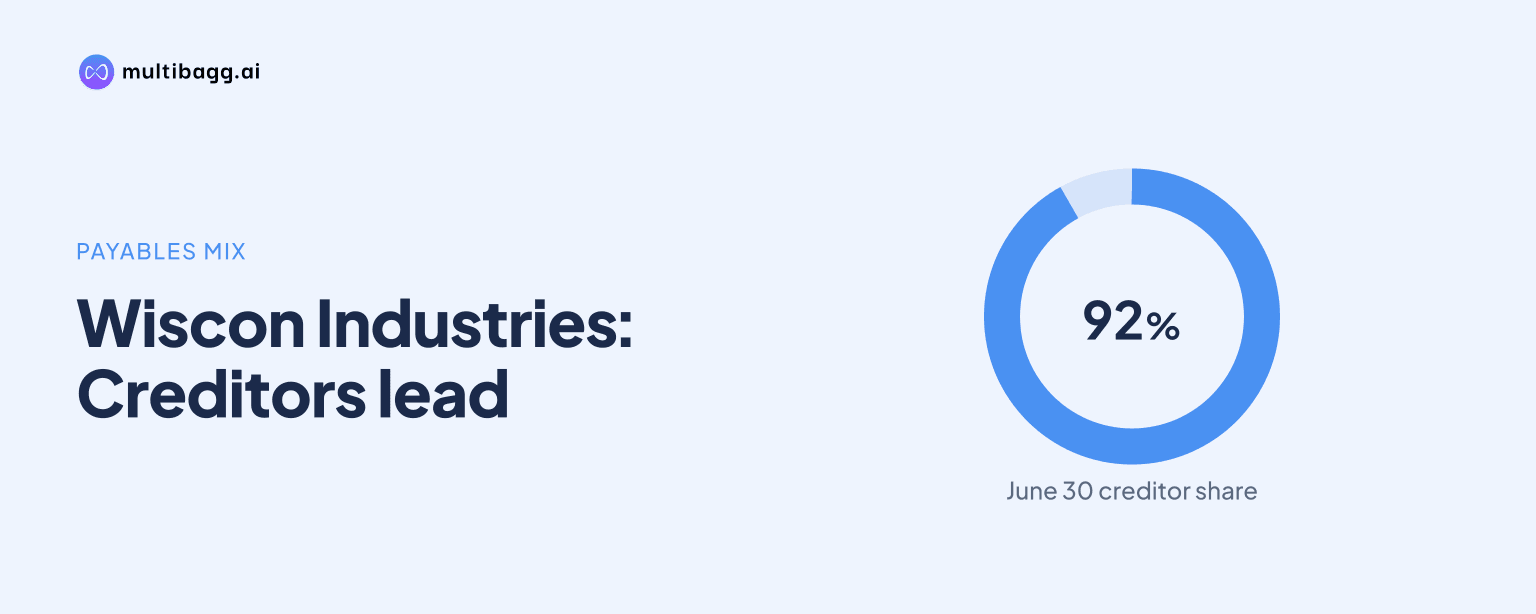
Wiscon Industries Limited reported Rs 55.1494 crore of consolidated trade payables at June 30, 2026, with three material creditors accounting for Rs 50.5952 crore, or about 92%. The concentration accompanied a Rs 29.8819 crore increase in payables from March 2026 as Wiscon built inventory for order-book requirements and anticipated sales.
Why are Wiscon trade payables concentrated with three creditors?
Wiscon trade payables were concentrated because three material creditors accounted for Rs 50.5952 crore of the Rs 55.1494 crore total at June 30, 2026. Trade payables are amounts owed to suppliers and other trade creditors for procurement. The remaining 75 other creditors accounted for Rs 4.5542 crore, making the material-creditor balance about 11.1 times the amount due to all other creditors.
Wiscon made the disclosure on a consolidated basis under its materiality policy, which treats dues exceeding 5% of the company’s trade payables as material. Five per cent of the June 30, 2026 total of Rs 55.1494 crore was about Rs 2.76 crore. The prospectus extract identifies three creditors meeting that threshold, but does not provide their names or individual dues; Wiscon said those details were available on its website.
Wiscon reported no dues to micro, small and medium enterprise, or MSME, creditors at June 30, 2026. MSME refers to enterprises covered by Section 2 of the Micro, Small and Medium Enterprises Development Act, 2006. The reported total therefore consisted of balances due to the three material creditors and 75 other creditors.
Why did Wiscon trade payables more than double in three months?
Wiscon said higher procurement requirements drove trade payables from Rs 25.2675 crore at March 2026 to Rs 55.1494 crore at June 2026. That was an increase of Rs 29.8819 crore, or about 118%, over three months. Wiscon attributed the movement to inventory building for its order book and anticipated sales, alongside the scale of business operations.
Closing inventory increased over the same period, from Rs 23.2732 crore in March 2026 to Rs 37.5359 crore in June 2026. The Rs 14.2627 crore increase, or about 61%, was the operating movement Wiscon linked to higher procurement and, in turn, to the larger payable balance. The company described the increase in trade payables as broadly in line with inventory growth and business operations.
The two movements differed in scale: trade payables rose by Rs 29.8819 crore, more than twice the Rs 14.2627 crore increase in inventory. The prospectus does not quantify purchases, supplier credit periods, inventory categories, the value of the order book or each material creditor’s contribution. The disclosure therefore establishes inventory-led procurement as Wiscon’s stated explanation, but not the duration of the elevated payable balance.
Got a follow-up? Ask IRIS
What would need to continue for Wiscon’s higher payable balance to persist?
Wiscon’s stated explanation indicates that comparable procurement needs, inventory holdings and anticipated sales support would need to continue after June 30, 2026 for the higher payable balance to persist. Wiscon specifically linked the Rs 37.5359 crore closing inventory at June 2026 to order-book requirements and anticipated sales. It did not identify a separate financing arrangement or revised supplier-credit terms as the reason for the change.
The June 2026 creditor split also creates a dependency on a limited number of supplier relationships. Three creditors represented about 92% of the Rs 55.1494 crore payable balance, while 75 other creditors represented about 8%. Changes in procurement volume, inventory requirements or credit availability from those three creditors could affect the reported balance, although the prospectus does not disclose contracts, payment terms or credit periods.
The materiality policy limits what can be inferred from the count of three creditors. The policy captures creditors with balances exceeding 5% of total trade payables, or about Rs 2.76 crore at June 30, 2026, but does not show whether one creditor accounted for substantially more than the others. M/s. Hem Sandeep & Co., Chartered Accountants and Wiscon’s statutory and peer review auditor, certified the June 30, 2026 disclosure through a certificate dated October 15, 2026, rather than providing a later balance.
Do Wiscon’s disclosed creditor dues indicate a payment or borrowing default?
No, Wiscon stated that, as of the Red Herring Prospectus date, it had no instances of non-payment or default in statutory dues, no overdues or defaults to companies or financial institutions, and no unpaid contingent liabilities. The Rs 55.1494 crore amount was disclosed as trade payables to creditors, rather than as a default to a bank or financial institution.
Wiscon also stated that no proceedings for economic offences had been initiated against it and that it had not been categorised as a wilful defaulter by a bank, financial institution or consortium under Reserve Bank of India guidelines. These disclosures distinguish the June 30, 2026 trade-payable amount from lender defaults and economic-offence proceedings; they do not reduce the reported creditor balances.
Wiscon separately disclosed a pending scrutiny assessment for assessment year 2025-26 after receiving an intimation and a notice under Section 143(2) of the Income Tax Act, 1961, dated June 20, 2026. It also reported aggregate tax deducted at source, or TDS, defaults of Rs 22,578 for 2022-23 to 2024-25, stating that the department had not taken recovery action other than issuing communication notices.
Conclusion
Wiscon’s June 2026 disclosure shows that supplier-credit exposure was concentrated: three material creditors accounted for about 92% of Rs 55.1494 crore in trade payables, while 75 other creditors accounted for Rs 4.5542 crore. Wiscon attributed the Rs 29.8819 crore increase in payables over three months to procurement associated with a Rs 14.2627 crore increase in closing inventory.
The next disclosure to watch is whether inventory requirements and anticipated sales continue to support procurement at similar levels after June 30, 2026, which is the plan Wiscon gave for its inventory build-up. Later creditor disclosures would also be needed to show whether the three-creditor concentration changed, because the October 15, 2026 auditor certificate covered the June 30, 2026 position only.