










Wiscon budgets ₹5.23 crore for marketing after ₹21.21 lakh FY26
Key highlights
- Wiscon has budgeted up to ₹5.23 crore for marketing, compared with ₹21.21 lakh spent in FY 2025-26.
- Celebrity endorsement and production is the largest proposed category at ₹1.80 crore, or 34.45% of the marketing budget.
- Television advertising is allocated ₹1 crore, while digital marketing is allocated ₹70 lakh.
- Wiscon reported an order book of ₹17.70 crore as of September 30, 2026, with orders due for fulfilment within nine months.
powered by IRIS
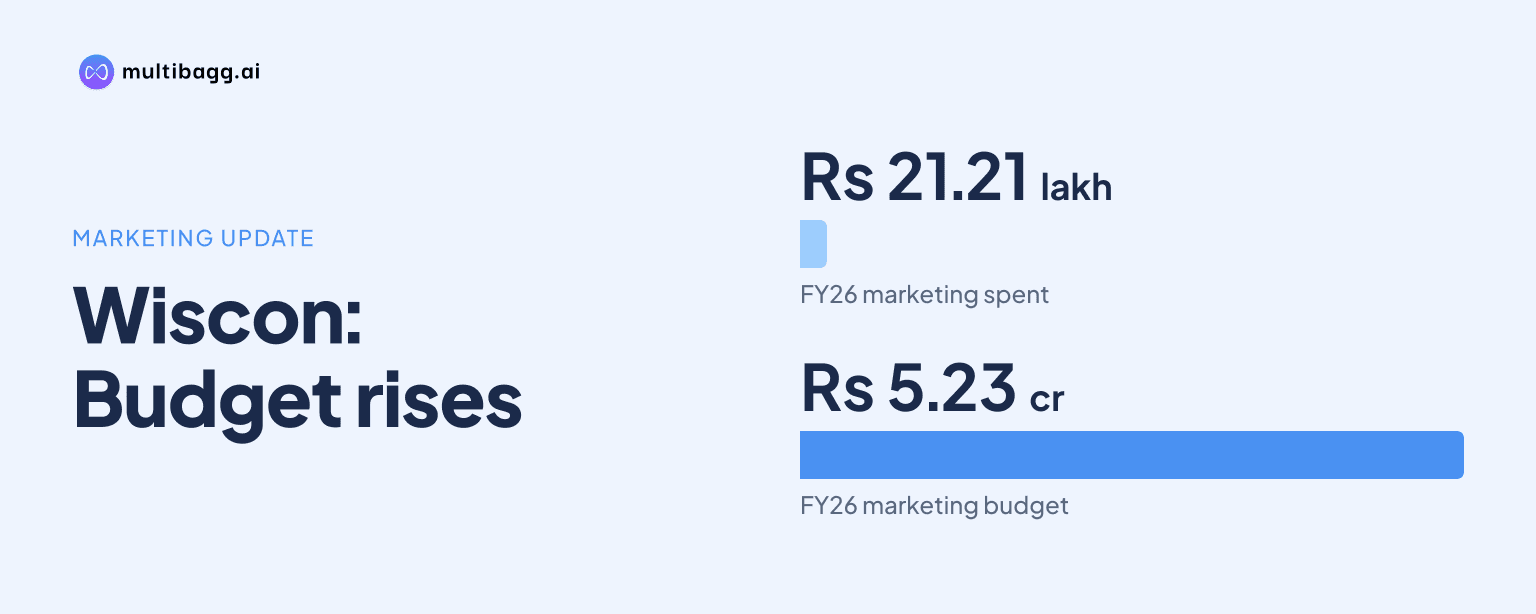
Wiscon has earmarked up to ₹5.23 crore from net issue proceeds for marketing and promotional activities, compared with ₹21.21 lakh of total marketing expense in FY 2025-26. The proposed national marketing programme is based on a vendor quotation dated September 10, 2026 that was valid for 60 days, while Wiscon had not placed orders or signed definitive vendor agreements.
Why is Wiscon planning a ₹5.23 crore national marketing spend step-up?
Wiscon says the ₹5.23 crore national marketing spend is intended to increase brand visibility, reach and customer trust among domestic business-to-business (B2B) and business-to-consumer (B2C) audiences. Wiscon’s board approved an allocation of up to ₹5.23 crore for marketing and promotional activities on July 17, 2026, as an identified use of net issue proceeds.
Wiscon’s stated objectives include building awareness of the Wiscon brand across India, generating product enquiries and sales, encouraging repeat purchases, retaining customers and increasing annual website visitors. The plan covers celebrity endorsement, television, over-the-top (OTT) streaming advertising, cinema, outdoor media, public relations, dealer meetings, below-the-line (BTL) activations, digital marketing and influencer marketing.
The proposed allocation is materially higher than Wiscon’s recorded marketing expense over the preceding three financial years. FY 2025-26 expense consisted of ₹10.23 lakh in business-promotion expense and ₹10.98 lakh in advertisement and marketing expense, totalling ₹21.21 lakh.
Total marketing expense rose by ₹12.64 lakh between FY 2023-24 and FY 2025-26, but its share of other expenses declined from 6.95% to 5.66%. The ₹5.23 crore proposal is about 24.6 times FY 2025-26 marketing expense, making the planned deployment a change in both the amount and the range of media and dealer-facing activities.
How would Wiscon allocate its ₹5.23 crore national marketing spend?
Wiscon would allocate ₹1.80 crore, or 34.45% of the ₹5.23 crore budget, to celebrity endorsement and production, its largest proposed category. That amount includes ₹1.20 crore for the endorsement and ₹60 lakh for photo and video shoots, as well as television-commercial production, digital assets, dealer communication material and point-of-sale branding across the retail network.
Television would receive ₹1 crore, or 19.14%, for awareness campaigns across news, movie, general-entertainment and regional-entertainment channels. Digital marketing is budgeted at ₹70 lakh, or 13.40%, for a full-funnel programme, meaning activity designed to address awareness, consideration and conversion across digital platforms, native advertising and online marketplaces.
OTT advertising would receive ₹45 lakh and BTL activation ₹33 lakh. The OTT plan targets connected-television users, young families, working professionals and new home buyers, while the BTL plan includes interactive mall displays for smart televisions, cooling products and washing machines intended to generate sales leads.
Wiscon has also proposed ₹27 lakh for outdoor media near dealer catchments within a three-to-five kilometre radius, ₹25 lakh for dealer meetings, ₹15 lakh each for cinema and influencer marketing, and ₹12.50 lakh for public-relations activity. The influencer plan specifies 25 creators, comprising 10 nano influencers, five regional influencers, five technology reviewers and five home creators.
Got a follow-up? Ask IRIS
How certain are Wiscon’s marketing costs and vendor arrangements?
Wiscon’s ₹5.23 crore marketing budget is an estimate, not a contracted commitment, because it is based on a quotation from Hakuhodo.Sync Private Limited dated September 10, 2026. The quotation was valid for 60 days, and Wiscon states that it had not placed orders for the proposed activities as of the date of its Red Herring Prospectus.
Wiscon had not entered into definitive agreements with Hakuhodo.Sync Private Limited or any other vendor, and says there is no assurance that the quoted vendor will ultimately be engaged at the stated costs. Actual procurement costs and vendors may change with market circumstances, while a quotation may lapse before an order is placed and lead to higher costs.
Wiscon’s management may revise estimates, change vendors, or modify, add or remove activities when orders are placed. Any surplus within the marketing allocation may be used for other marketing activities; a remaining surplus may go to general corporate purposes, subject to the lower of 10% of the amount raised or ₹10 crore under the stated Securities and Exchange Board of India (SEBI) regulations.
Taxes are excluded from the ₹5.23 crore quotation-based budget and would be paid from Wiscon’s internal accruals. The proposed issue-proceeds allocation therefore covers estimated activity costs, while tax payments depend on internal cash generation.
What must happen for Wiscon’s marketing programme to support expansion?
Wiscon says the programme is intended to help it reach new customers, enter new geographies and increase sales across its product portfolio, but those outcomes depend on campaign execution, customer response and dealer engagement. Its planned television, digital, social-media, outdoor and BTL activities are intended to increase visibility in priority markets and support enquiries at the point of sale.
The marketing programme sits alongside a working-capital expansion plan. Wiscon estimates its working-capital gap will increase from ₹25.71 crore in FY 2026-27 to ₹40.06 crore in FY 2027-28, with cumulative deployment of ₹17 crore from initial public offering proceeds earmarked for working capital by FY 2027-28.
Wiscon projects inventory holding at 34 days in both FY 2026-27 and FY 2027-28, against 21 days in FY 2025-26. Trade-receivable days are projected at 56 days, compared with 39 days in FY 2025-26, because Wiscon plans to expand into additional states and offer credit periods to new and existing customers.
Wiscon reported an order book of ₹17.70 crore as of September 30, 2026, with orders to be fulfilled within nine months of their purchase orders. The programme’s stated sales objective therefore depends on inventory availability, dealer relationships, customer-credit capacity and the ability to fund actual campaign costs after vendors are selected.
Conclusion
Wiscon’s proposed allocation would concentrate ₹2.80 crore, or 53.59% of the total budget, in celebrity endorsement and production plus television advertising. The remaining ₹2.43 crore would be spread across digital, OTT, dealer, outdoor, cinema, public-relations, BTL and influencer activity, linking brand-building plans with a broader geographical and customer-base expansion strategy.
The next disclosed milestones are the selection of vendors and placement of orders after the September 10, 2026 quotation period, as well as the eventual cost of the activities. CARE Ratings Limited has been appointed to monitor fresh-issue utilisation quarterly because the proposed fresh issue exceeds ₹50 crore, and Wiscon says it will publish monitoring reports within 45 days of each quarter-end until the proceeds are fully used.