










Wiscon sourced 30% of June purchases from non-BIS vendors
Key highlights
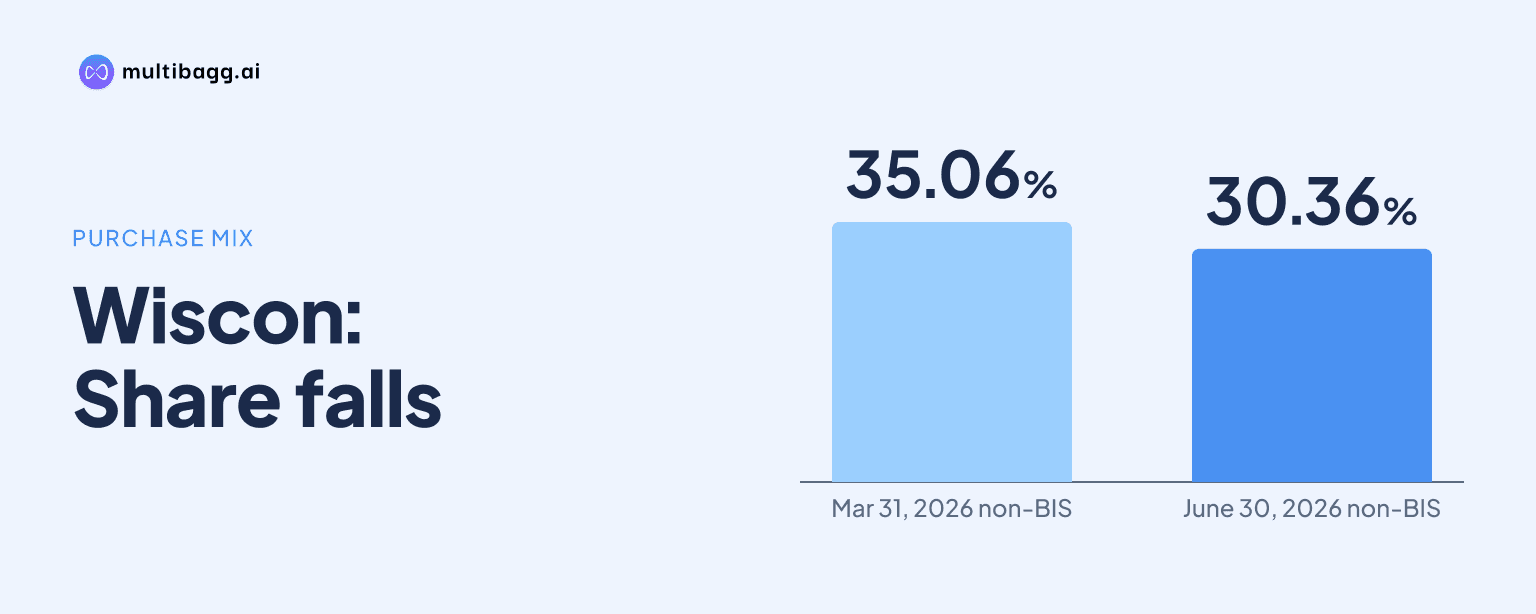
- Wiscon purchased Rs 6.3341 crore from non-BIS vendors in the period ended June 30, 2026, representing 30.36% of total purchases.
- Non-BIS vendors accounted for 35.06% of Wiscon’s purchases in the year ended March 31, 2026, up from 2.04% in the year ended March 31, 2024.
- Wiscon reported Rs 22.7155 crore of purchases from non-BIS vendors in the year ended March 31, 2026.
- Wiscon’s June 2026 purchase table contains a discrepancy: stated category amounts total Rs 20.8651 crore, while stated percentages total 70.00%.
powered by IRIS
Wiscon Industries Limited reported purchases of Rs 6.3341 crore from non-BIS vendors in the period ended June 30, 2026, equal to 30.36% of total purchases of Rs 20.8651 crore. Wiscon says it has stopped sourcing from those manufacturers, but past non-compliance could lead to seizure, penalties, sales restrictions and supply disruption.
How much did Wiscon source from non-BIS vendors?
Wiscon sourced Rs 6.3341 crore from vendors classified as non-BIS compliant during the period ended June 30, 2026. The amount represented 30.36% of total purchases, making non-BIS vendors the second-largest stated purchase category after compliant vendors, based on the company’s purchase table certified on October 15, 2026.
BIS means the Bureau of Indian Standards. Wiscon separates purchases into BIS-compliant vendors, BIS non-compliant vendors and products to which BIS does not apply. Electric scooters and air coolers are the stated non-BIS-applicable products. Purchases in that category were Rs 3.6343 crore, or 17.42%, in the period ended June 30, 2026.
Wiscon’s disclosed non-BIS share rose from 2.04% in the year ended March 31, 2024 to 5.23% in the following year, before reaching 35.06% in the year ended March 31, 2026. The 30.36% reported for the three months ended June 30, 2026 was lower than the preceding full-year share, although the periods are not directly comparable.
The June 2026 table contains an internal discrepancy. It lists Rs 10.8967 crore of purchases from BIS-compliant vendors but assigns that amount a 22.22% share; the three stated category amounts total Rs 20.8651 crore, while the three stated percentages total 70.00%. Wiscon nevertheless expressly reports the non-BIS vendor amount and share as Rs 6.3341 crore and 30.36%, respectively.
Why does BIS registration and WISCON brand inclusion matter?
Wiscon says specified electronic products may be manufactured, stored, sold, imported or distributed only in line with applicable BIS registration requirements. The framework identified by Wiscon includes the Bureau of Indian Standards Act, 2016, the Bureau of Indian Standards (Conformity Assessment) Regulations, 2018 and the Electronics and Information Technology Goods (Requirement for Compulsory Registration) Order, 2021.
The requirement is product-specific and brand-specific where a manufacturer makes covered goods for another brand owner. Wiscon states that a manufacturer must obtain inclusion of the WISCON brand under its BIS registration before manufacturing and supplying products under that brand. A registration held for the manufacturer’s own brand does not, under the disclosed framework, by itself establish the required inclusion for WISCON-branded goods.
Wiscon acknowledges that it previously procured and sold some products under the WISCON brand from vendors that had not obtained the necessary brand inclusion. It also says it procured products from certain manufacturers that lacked BIS registration or WISCON brand inclusion for products made for Wiscon. This matters because Wiscon does not own or operate manufacturing facilities and is entirely dependent on third-party manufacturers and original equipment manufacturers, or OEMs, for supply.
What regulatory consequences could Wiscon face from non-compliance?
Wiscon says an adverse finding by BIS, the Ministry of Electronics and Information Technology, or another competent authority could result in seizure, confiscation or forfeiture of non-compliant products. The disclosure applies this risk to goods held at warehouses, distribution centres or retail outlets, meaning a finding could affect stock already within the sales and distribution chain.
Wiscon also identifies a possible prohibition on manufacture, sale or distribution until registrations are obtained or regularised. Such a prohibition could interrupt operations and reduce revenue from the affected products. The company additionally cites penalties, prosecution and other enforcement action under the Bureau of Indian Standards Act, 2016, including Section 29 penalties for misuse of the Standard Mark or contraventions of statutory provisions.
The stated exposure extends beyond a regulatory penalty. Wiscon says an adverse finding on quality, safety or certification status could damage customer confidence and its reputation. It also says that discontinuing a non-compliant supplier could disrupt the supply chain if suitable BIS-compliant alternatives cannot be identified within an acceptable timeframe or on commercially reasonable terms.
Got a follow-up? Ask IRIS
Can Wiscon maintain sourcing only from BIS-compliant vendors?
Wiscon says it has discontinued procurement from manufacturers that lacked the requisite registrations or WISCON brand inclusion and has restricted sourcing to manufacturers possessing the required registrations. The restriction would depend on compliant manufacturers meeting Wiscon’s production and supply requirements while obtaining and maintaining valid registrations and brand inclusion on time.
Wiscon expressly says there is no assurance that it will not need to engage such manufacturers in the future if existing compliant manufacturers cannot meet its supply needs. The company does not quantify the capacity of its compliant supplier base, identify the amount of historical non-compliant inventory still in distribution channels, or state whether earlier products have been regularised.
The risk is therefore linked to supplier concentration and availability rather than solely to past purchases. In the year ended March 31, 2026, Wiscon reported Rs 22.7155 crore of purchases from non-BIS vendors, or 35.06% of total purchases of Rs 64.7856 crore. Continued compliant sourcing requires the alternative supplier base to replace that level of historical purchasing where products are subject to compulsory registration.
What controls and contractual protections does Wiscon have?
Wiscon says it has appointed a Quality Control Officer and uses sample-based testing before accepting products for supply. It also says in-house quality personnel test products at procurement and prepare reports against quality parameters. These measures are procurement and quality-control mechanisms, but Wiscon’s disclosure separately requires suppliers to hold applicable BIS registration and WISCON brand inclusion.
Wiscon acts as the customer contact for product complaints and coordinates inspection, installation and repair through third-party service providers. Under its stated warranty process, a response may involve repair, replacement of defective parts, refund of the purchase price or replacement of the whole product, depending on the issue and applicable warranty terms. Wiscon says it had no material product recalls, significant customer complaints or material product-quality failures during the period ended June 30, 2026 and the preceding three financial years, apart from routine returns and rejections.
Wiscon has not entered into formal indemnity arrangements with manufacturers for statutory liabilities, penalties, losses or claims arising from past or future BIS non-compliance. It says separate long-term indemnities may raise procurement costs, but also states that there is no assurance manufacturers will obtain or maintain the required registrations or WISCON brand inclusion. Wiscon further says it has received no investor complaints or claims relating to its previous sourcing from vendors without BIS registration.
Conclusion
Wiscon’s disclosure shows that BIS non-compliant vendors supplied Rs 6.3341 crore, or 30.36%, of purchases in the period ended June 30, 2026, after accounting for 35.06% in the year ended March 31, 2026. The regulatory issue arises because covered products require compliant BIS registration and, where goods are made for WISCON, inclusion of that brand in the manufacturer’s registration.
The next issue to watch is execution of Wiscon’s stated plan to source exclusively from compliant manufacturers. Wiscon has disclosed that it could need to use non-compliant manufacturers if compliant suppliers cannot meet production or supply requirements, while it has no formal indemnity agreements for manufacturer non-compliance. Any later update on supplier registrations, brand inclusion, enforcement action or supply continuity would directly affect this risk.