










Wiscon’s top 10 customers supplied 78.19% of FY26 revenue
Key highlights
- Wiscon’s top 10 customers generated Rs 153.9342 crore, or 78.19%, of FY26 consolidated revenue.
- Wiscon’s largest customer contributed Rs 43.5121 crore, equal to 22.10% of FY26 consolidated revenue.
- LED televisions and electric scooters together accounted for 93.88% of Wiscon’s FY26 consolidated revenue.
- Wiscon plans to spend Rs 5.225 crore on marketing and expand beyond Delhi, Uttar Pradesh and Haryana to broaden its customer network.
powered by IRIS
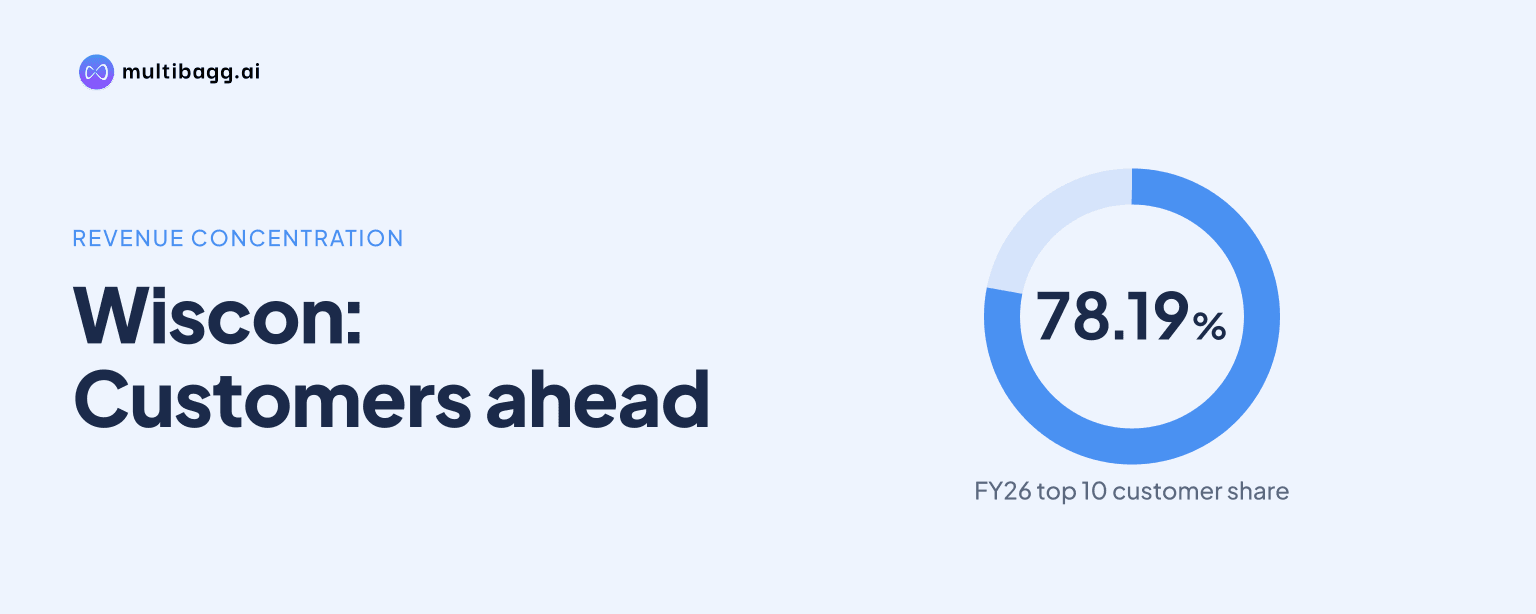
Wiscon’s top 10 customers supplied 78.19% of consolidated revenue from operations in FY26, contributing Rs 153.9342 crore out of Rs 196.874 crore. The five largest customers accounted for 61.97%, while the largest customer alone generated Rs 43.5121 crore, or 22.10%, making a limited customer group material to the FY26 revenue base.
How concentrated was Wiscon’s FY26 customer revenue?
Wiscon’s FY26 consolidated revenue was concentrated among its largest buyers, with the top 10 customers generating Rs 153.9342 crore, or 78.19% of revenue from operations. The top five customers contributed Rs 122.0128 crore, equal to 61.97% of FY26 consolidated revenue, according to the restated consolidated financial statements for the year ended March 31, 2026.
The customers outside the top 10 supplied the remaining 21.81% of FY26 consolidated revenue, or Rs 42.9398 crore. Customer concentration describes the share of sales represented by a group of major buyers; at Wiscon, the top-10 measure shows that fewer than 10 disclosed customer relationships accounted for more than three-quarters of the Rs 196.874 crore FY26 revenue total.
Wiscon’s largest customer generated Rs 43.5121 crore in FY26, while the other nine customers within the top-10 group collectively generated Rs 110.4221 crore. Maintaining FY26 revenue levels would therefore depend partly on retaining the largest accounts or replacing their orders through other customers, because the company does not disclose minimum purchase commitments for these customers.
Which Wiscon customer tiers supplied FY26 revenue?
Wiscon’s concentration extended beyond its largest account, as the top three customers supplied 46.74% and the top five supplied 61.97% of FY26 consolidated revenue. The reported tiers are cumulative, meaning each higher tier includes the customers in the preceding tier.
Customers ranked fourth and fifth accounted for Rs 29.994 crore, calculated as the difference between the top-five and top-three totals. Customers ranked sixth through 10 accounted for Rs 31.9214 crore, calculated from the difference between the top-10 and top-five totals; these five customers together supplied 16.22% of FY26 revenue.
Wiscon describes its key customer relationships as continuing relationships supported by product quality and timely delivery. However, the FY26 disclosure does not identify individual top customers, specify contract durations, or state committed purchase volumes, so the reported revenue shares do not establish the duration or contractual basis of future orders.
How did Wiscon’s customer concentration compare with June 2026?
Wiscon’s top-10 customer share was 77.94% in the period ended June 30, 2026, compared with 78.19% in FY26. The June 2026 period covers three months, whereas FY26 covers the 12 months ended March 31, 2026, so the figures are comparable as revenue shares but not as equal-duration revenue totals.
The largest customer’s share was 2.95 percentage points higher in the period ended June 30, 2026 than in FY26, at 25.05% versus 22.10%. In contrast, the top-10 share was 0.25 percentage points lower at 77.94%, indicating that the disclosed three-month revenue mix was more concentrated in the largest account but marginally less concentrated across the full top-10 group.
Wiscon does not provide consolidated concentration data for FY25 or FY24. Dalmia Technologies Limited became a wholly owned subsidiary under a share transfer agreement and memorandum of understanding dated May 25, 2025, and Wiscon states that consolidation began from FY2025-26.
Got a follow-up? Ask IRIS
What in Wiscon’s sales model affects customer concentration?
Wiscon’s standalone FY26 sales were predominantly business-to-business, or B2B, which is a distribution model selling to business customers rather than directly to consumers. B2B LED television sales were Rs 49.0762 crore in FY26, while business-to-consumer, or B2C, LED television sales through the company website were Rs 0.586 crore.
Electric scooters generated Rs 19.8751 crore of standalone FY26 revenue, and the disclosure classifies all of that scooter revenue as B2B. LED televisions and electric scooters together generated Rs 69.5373 crore out of standalone FY26 revenue from operations of Rs 73.3916 crore, equivalent to 94.75% based on the stated category totals.
At the consolidated level, LED televisions generated Rs 142.2145 crore, or 72.24%, of FY26 revenue, while electric scooters generated Rs 42.6046 crore, or 21.64%. These two categories collectively represented 93.88% of the Rs 196.874 crore consolidated revenue base, combining product concentration with the disclosed dependence on major customers.
Smaller consolidated categories accounted for the balance of FY26 revenue: services contributed Rs 8.7918 crore, air coolers Rs 0.8182 crore, air conditioners Rs 0.7862 crore, washing machines Rs 1.1417 crore and spare parts Rs 0.5137 crore. Continued FY26-scale revenue would thus require purchases from leading B2B customers and sustained demand for LED televisions and electric scooters.
What disclosed plans could change Wiscon’s customer mix?
Wiscon plans to expand beyond Delhi, Uttar Pradesh and Haryana, the states from which it says the majority of its revenue is generated. The company’s strategy includes entering additional states, identifying high-growth markets, associating with new customers and broadening its sales and customer network, although it does not disclose a target for reducing the top-10 customer share.
Wiscon proposes Rs 5.225 crore of marketing and promotional expenditure, including digital and offline marketing, television media, outdoor media, dealer meets and influencer marketing. The stated aims are brand visibility, customer acquisition, retention and product visibility; any effect on concentration would depend on whether the activity produces material sales from customers outside the existing leading group.
The company renewed 180 customers and discontinued 369 customers in FY26. In the period ended June 30, 2026, it renewed 169 customers and discontinued 904 customers, but the disclosure does not attach revenue values to those renewed or discontinued accounts and therefore does not show whether they altered top-customer concentration.
Wiscon also proposes Rs 15.0388 crore of investment in Dalmia Technologies Limited for two surface-mount technology production lines for printed circuit boards. The stated backward-integration plan is intended to reduce dependence on third-party suppliers and improve supply-chain control, rather than to directly diversify the customer base.
Conclusion
Wiscon’s FY26 revenue base was concentrated by both customer and product. Its top 10 customers supplied Rs 153.9342 crore, or 78.19%, of consolidated revenue, while its top five supplied 61.97%; LED televisions and electric scooters accounted for 93.88% of FY26 consolidated revenue. The reported sales mix makes major customer relationships and demand in those two product categories central to the company’s FY26 performance.
The next disclosures to watch are whether Wiscon’s planned expansion beyond Delhi, Uttar Pradesh and Haryana and its Rs 5.225 crore marketing programme add revenue from a wider customer set. The company has not stated a customer-concentration reduction target, while consolidated comparisons before FY26 remain unavailable because Dalmia Technologies Limited entered the group in May 2025.