










Jagatjit Industries H1 revenue climbs 69%, loss narrows
Key highlights
- Jagatjit Industries reported standalone H1 revenue of Rs 378.02 crore, up 68.8% from Rs 223.98 crore.
- Jagatjit Industries’ standalone H1 net loss narrowed to Rs 12.16 crore from Rs 37.74 crore.
- Trade receivables rose to Rs 66.15 crore at September 30, 2026 from Rs 30.59 crore at March 31, 2026.
- Total standalone borrowings increased to Rs 367.94 crore at September 30, 2026 from Rs 356.18 crore at March 31, 2026.
powered by IRIS
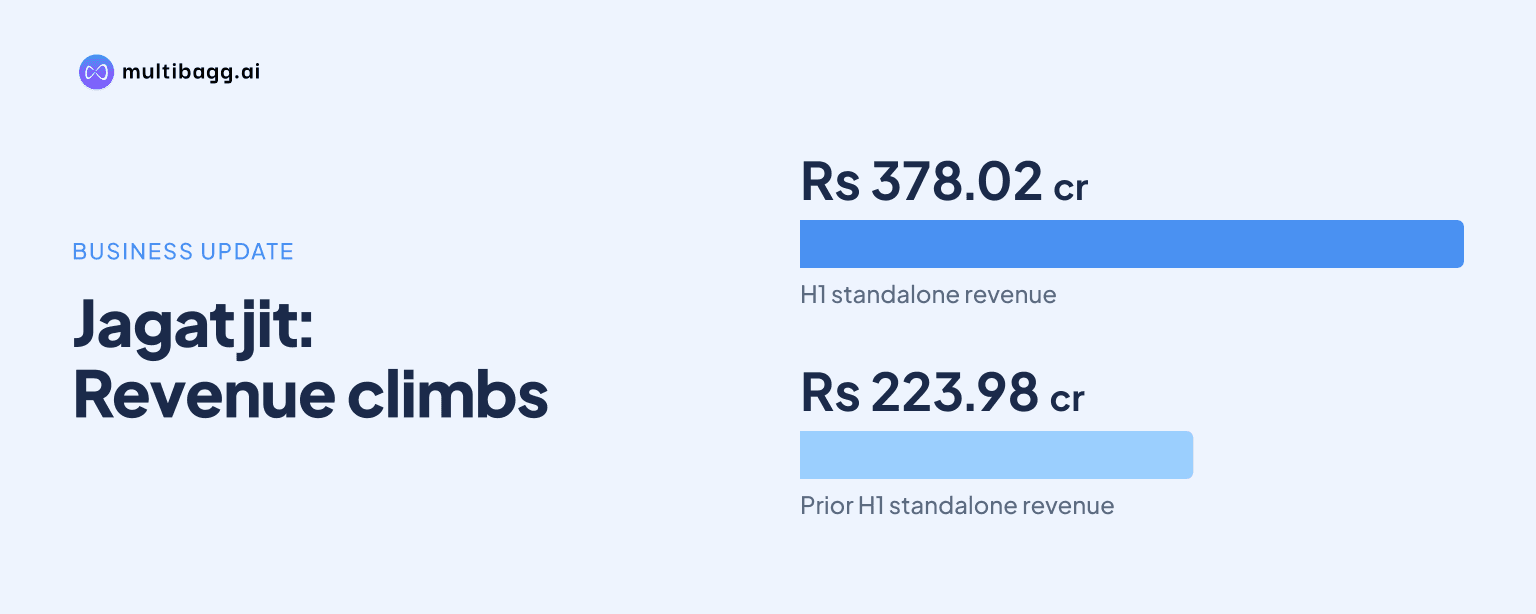
Jagatjit Industries Limited reported standalone revenue from operations of Rs 378.02 crore for the half year ended September 30, 2026, up 69% from Rs 223.98 crore a year earlier, while its net loss narrowed to Rs 12.16 crore from Rs 37.74 crore. Receivables, inventories and borrowings nevertheless rose during the six months.
Know Jagatjit Industries inside out
Results, valuation, peers and who's buying, in one view.
How much did Jagatjit Industries’ revenue grow in H1?
Jagatjit Industries’ standalone revenue from operations increased by Rs 154.04 crore, or 68.8%, to Rs 378.02 crore in the half year ended September 30, 2026. Revenue was Rs 223.98 crore in the corresponding half year ended September 30, 2025, making operating sales the main driver of the increase in income.
The quarter ended September 30, 2026 contributed Rs 192.22 crore of revenue, compared with Rs 186.80 crore in the preceding quarter ended June 30, 2026. The September-quarter figure was Rs 99.21 crore a year earlier, so quarterly revenue rose by Rs 93.01 crore year on year and by Rs 5.42 crore sequentially.
Jagatjit Industries reported other income of Rs 6.89 crore for the September 2026 half year, compared with Rs 9.64 crore in the prior-year period. Consequently, total income rose to Rs 384.91 crore from Rs 233.62 crore, showing that the increase came despite a Rs 2.75 crore reduction in other income.
Did Jagatjit Industries reduce its standalone loss?
Jagatjit Industries reduced its standalone net loss by Rs 25.58 crore to Rs 12.16 crore in the half year ended September 30, 2026. The corresponding loss in the half year ended September 30, 2025 was Rs 37.74 crore, while basic loss per share narrowed to Rs 2.59 from Rs 8.05.
The September 2026 quarter recorded a net loss of Rs 3.92 crore, compared with a Rs 8.24 crore loss in the June 2026 quarter and a Rs 27.87 crore loss in the September 2025 quarter. The September-quarter loss therefore narrowed by Rs 4.32 crore from the immediately preceding quarter and by Rs 23.95 crore from a year earlier.
Loss before tax was Rs 12.13 crore for the September 2026 half year, against Rs 37.68 crore in the comparable prior-year half. Total expenses were Rs 398.04 crore, up from Rs 271.30 crore, but the Rs 151.29 crore increase in total income exceeded the Rs 126.74 crore rise in reported expenses.
The results show purchases of stock in trade of Rs 205.45 crore for the September 2026 half year, compared with Rs 106.58 crore a year earlier. Employee-benefit expense was Rs 65.62 crore, down from Rs 69.09 crore, while the filing reported finance cost of Rs 26.55 crore and depreciation and amortisation expense of Rs 14.30 crore for the six-month period.
Got a follow-up? Ask IRIS
What changed in Jagatjit Industries’ working capital?
Jagatjit Industries’ trade receivables rose by Rs 35.56 crore to Rs 66.15 crore at September 30, 2026 from Rs 30.59 crore at March 31, 2026. Inventories increased by Rs 6.91 crore to Rs 65.75 crore over the same period, reflecting a larger amount of funds recorded in these two current-asset categories.
The standalone cash-flow statement records a Rs 36.04 crore use of cash from trade receivables and a Rs 6.91 crore use from inventories in the half year ended September 30, 2026. It also records Rs 29.76 crore generated from trade payables and Rs 19.38 crore from financial liabilities, other liabilities and provisions, with net cash generated from operating activities reported at Rs 8.63 crore.
Current assets rose to Rs 210.13 crore at September 30 from Rs 153.78 crore at March 31, while current liabilities increased to Rs 355.44 crore from Rs 295.41 crore. Assets classified as held for sale increased to Rs 17.65 crore from Rs 9.10 crore, and other current assets were Rs 48.54 crore, compared with Rs 47.81 crore at the March year-end.
How did Jagatjit Industries’ debt and cash position change?
Jagatjit Industries’ total standalone borrowings increased to Rs 367.94 crore at September 30, 2026 from Rs 356.18 crore at March 31, 2026. Non-current borrowings were Rs 315.50 crore versus Rs 311.41 crore, and current borrowings were Rs 52.44 crore versus Rs 44.77 crore.
Cash and cash equivalents declined by Rs 36 lakh during the six months to Rs 95 lakh at September 30, 2026 from Rs 1.31 crore at March 31. Bank balances other than cash and cash equivalents rose to Rs 2.33 crore from Rs 73 lakh, while the cash-flow statement reported Rs 11.75 crore of net loans taken and Rs 14.30 crore of interest paid.
Total equity declined to Rs 46.17 crore from Rs 62.48 crore during the six months, as other equity moved to negative Rs 61 lakh from positive Rs 15.70 crore. Total assets rose to Rs 759.60 crore from Rs 715.89 crore, and the independent auditor’s limited-review report drew attention to notes on contingent liabilities and going concern while saying its conclusion was not qualified on those matters.
Conclusion
Jagatjit Industries’ September 2026 half-year filing records a substantial recovery in standalone revenue and a smaller net loss, with sales rising Rs 154.04 crore year on year and the loss reducing Rs 25.58 crore. The improvement occurred alongside higher purchases of stock in trade, receivables and inventories, while total borrowings also increased by Rs 11.76 crore from March 31.
The next reported results will show whether Jagatjit Industries can convert the Rs 66.15 crore receivables balance and Rs 65.75 crore inventory balance into cash, following the Rs 8.63 crore operating cash generation disclosed for the half year. Investors can also monitor movements in the Rs 367.94 crore borrowing balance and the contingent-liability and going-concern matters highlighted in the auditor’s review.