










Jana Small Finance Bank Q2 FY27 Profit Sets Record
Key highlights
- Jana Small Finance Bank reported H1 FY27 PAT of INR 326 crore, equal to its full-year FY26 PAT.
- Management raised FY27 PAT growth guidance to 100% from 80%.
- Q2 FY27 total revenue rose 18% year on year to INR 1,816 crore, while net interest income increased 35%.
- Advances grew 22% year on year to INR 38,752 crore, with secured assets accounting for 73.7% of the loan book.
powered by IRIS
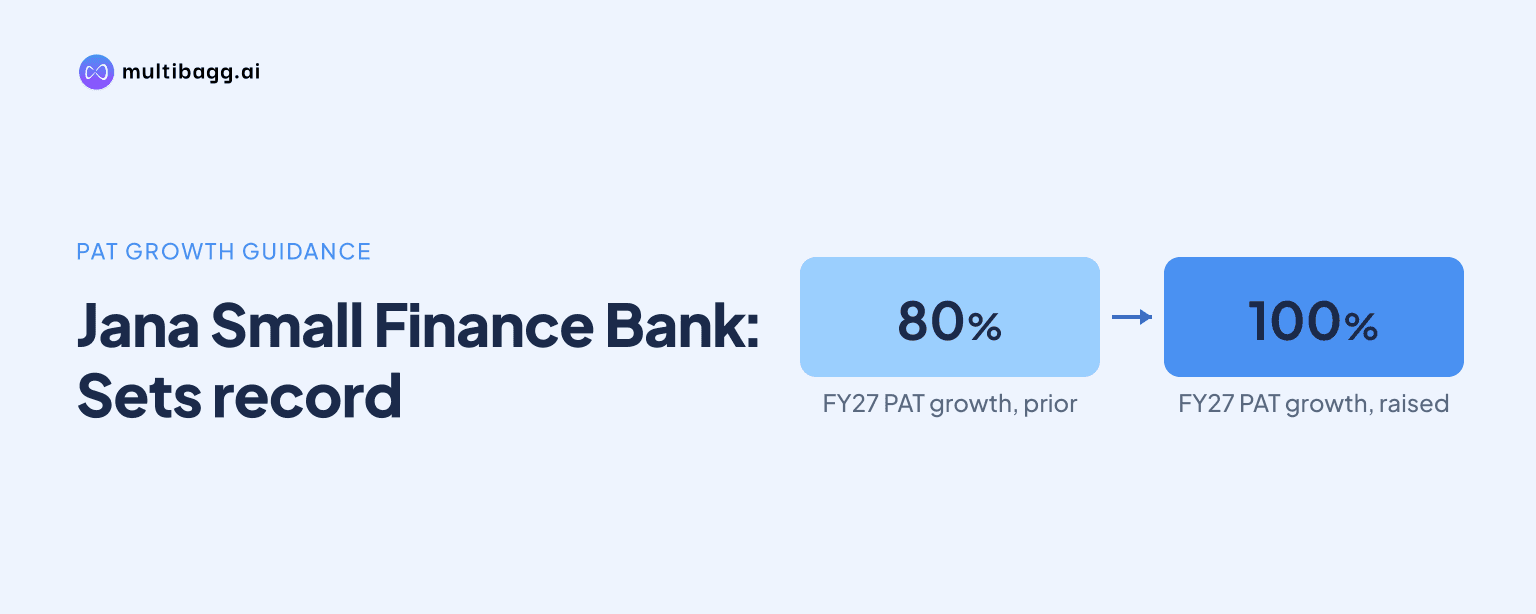
Jana Small Finance Bank reported its strongest quarterly profit before tax performance in Q2 FY27, while its first-half profit after tax matched the entire FY26 figure. The bank reported H1 FY27 PAT of INR 326 crore, equal to its full-year FY26 PAT. Based on the first-half performance, management raised its FY27 PAT growth guidance to 100% from 80%.
Know Jana Small Finance Bank inside out
Results, valuation, peers and who's buying, in one view.
Record Quarter Drives Guidance Upgrade
Managing Director and CEO Ajay Kanwal described Q2 FY27 as the highest-ever PBT quarter in the bank's history. The performance in the first two quarters took H1 PAT to INR 326 crore. This was the same as the INR 326 crore PAT reported for the full FY26.
Chief Financial Officer Abhilash Sandur said the revised outlook reflected the trends seen in Q1 and Q2. Management said it was confident of achieving 100% PAT growth in FY27. The bank also noted that the second half is typically stronger than the first half.
Revenue and Interest Income Gain Pace
Total revenue in Q2 FY27 stood at INR 1,816 crore. It rose 18% year on year and 4% sequentially. Net interest income increased 35% year on year, outpacing the growth in operating costs.
Operating costs rose 15%, resulting in a positive jaws spread of 20%. A positive jaws spread indicates income growth exceeded cost growth during the period. This operating trend was among the factors cited by management while revising its profitability guidance.
Margins Improve as Funding Cost Falls
Net interest margin for H1 FY27 improved to 7.5% from 6.5% in H1 FY26. The margin was flat sequentially, according to the earnings call highlights. The improvement was linked to a better asset mix and recovery in the microfinance segment.
The cost of funds declined to 7.4% from 7.9% in Q2 of the previous year. It remained stable compared with Q1 FY27. Stable funding costs and improved margins supported the bank's operating performance during the first half.
Profitability Ratios Strengthen
Return on assets improved to 1.4%, while return on equity reached 14%. Book value per share was INR 455. The bank's capital adequacy ratio stood at 20%, indicating that it retained a sizeable capital buffer while expanding its balance sheet.
These metrics provide context for the higher PAT growth guidance. The bank's first-half profit has already equalled the prior full-year level, but management's updated forecast remains dependent on the operating, margin and credit-cost trends it cited during the call.
Advances Rise, Secured Mix Expands
Advances grew 22% year on year to INR 38,752 crore. Secured assets grew 24% and represented 73.7% of the loan book. Jana Small Finance Bank said it intends to increase the secured asset share to about 80%.
Within the secured portfolio, affordable housing loans grew 28.2% year on year, MSME loans rose 20.6%, and vehicle loans increased 76%. Q2 disbursements were INR 4,414 crore, up 7% year on year and 5% quarter on quarter.
Got a follow-up? Ask IRIS
Asset Quality Shows Further Improvement
Gross non-performing assets declined to 2.17%, while net NPAs stood at 1.08%. Management said net NPAs could fall below 1% after the receipt of INR 68 crore in guarantee claims. This expectation is contingent on the realisation of those claims.
Credit cost was 0.92% in H1 FY27, comprising 0.43% in Q1 and 0.49% in Q2. The bank maintained guidance for full-year credit cost below 2%. Management also said it expected H2 credit costs to be lower than H1.
Deposit and Advance Targets Remain Unchanged
While profitability guidance was increased, Jana Small Finance Bank retained its operating growth targets. It continued to guide for advances growth of 19% to 21% and deposit growth of 23% to 25% for FY27.
Management said it remained confident of meeting the deposit growth target. However, the bank acknowledged that CASA growth remained weak. The CASA ratio declined 2% sequentially, and management said building the ratio into the 20% range remained an objective.
Key Q2 FY27 Metrics
Why the Results Matter for Investors
The earnings update combines higher profitability guidance with unchanged lending and deposit-growth targets. Revenue growth, net interest income growth and a positive jaws spread indicate that the bank expanded income faster than expenses in Q2. The increase in the secured-loan share and the improvement in reported asset-quality ratios are also central to management's assessment of the outlook.
At the same time, CASA remains an area to monitor because the ratio declined sequentially. The reported cost of funds, credit cost and realisation of guarantee claims will be relevant factors in assessing subsequent quarterly performance. Jana Small Finance Bank's next disclosures will show whether the first-half momentum continues through the seasonally stronger second half.