










Jeyyam Global Foods used Rs 11.94 crore operating cash
Key highlights
- Jeyyam Global Foods used Rs 11.94 crore in operating activities in the September 30, 2026 cash-flow column.
- Jeyyam Global Foods' inventories rose by Rs 36.96 crore to Rs 46.90 crore at September 30, 2026.
- Jeyyam Global Foods' trade payables increased by Rs 29.20 crore to Rs 37.59 crore at September 30, 2026.
- Jeyyam Global Foods' cash and cash equivalents fell to Rs 48.52 lakh from Rs 15.93 crore at March 31, 2026.
powered by IRIS
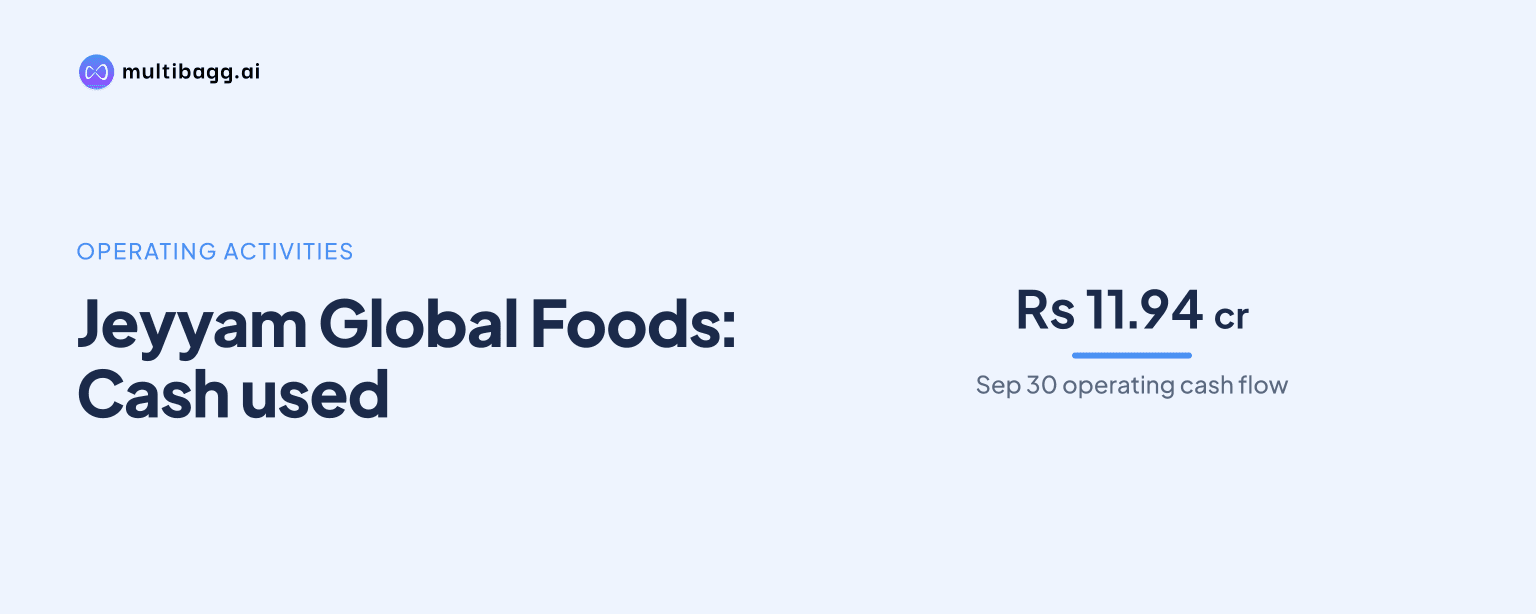
Jeyyam Global Foods Limited used Rs 11.94 crore in operating activities in the cash-flow column at September 30, 2026, as a Rs 36.96 crore inventory increase and Rs 8.01 crore rise in trade receivables outweighed a Rs 29.20 crore increase in trade payables. Cash and cash equivalents closed at Rs 48.52 lakh.
Know Jeyyam Global Foods inside out
Results, valuation, peers and who's buying, in one view.
What caused Jeyyam Global Foods' operating cash outflow?
Jeyyam Global Foods reported net cash used in operating activities of Rs 11.94 crore in the September 30, 2026 cash-flow column. Operating profit before working-capital changes was Rs 9.44 crore, but net working-capital movements consumed Rs 20.44 crore and income tax paid was Rs 93.86 lakh.
The cash-flow statement uses the indirect method under Accounting Standard 3, or AS 3, Cash Flow Statement. Jeyyam Global Foods started with profit before tax of Rs 3.73 crore, added depreciation and amortisation of Rs 2.42 crore and interest paid of Rs 3.58 crore, and deducted interest received of Rs 29.71 lakh to reach the pre-working-capital figure.
The operating cash outcome differed from the profit and loss result. Jeyyam Global Foods reported net profit of Rs 2.74 crore for April 1, 2026 to September 30, 2026, compared with Rs 10.93 crore for April 1, 2025 to September 30, 2025, while the cash outflow reflected movements in current assets and liabilities.
How much did Jeyyam Global Foods' inventory and receivables rise?
Inventory was the largest cash outflow, rising by Rs 36.96 crore in the September 30, 2026 cash-flow column. Trade receivables rose by Rs 8.01 crore, meaning more cash was tied up in customer balances during the reported period.
The balance sheet shows inventories at Rs 46.90 crore at September 30, 2026, compared with Rs 9.94 crore at March 31, 2026. Trade receivables increased to Rs 113.39 crore from Rs 105.38 crore, while other current assets fell to Rs 41.65 crore from Rs 54.52 crore.
Other current assets provided a Rs 12.87 crore cash inflow, matching their reduction on the balance sheet. That inflow partly offset the inventory and receivables movements, but it did not prevent the overall Rs 20.44 crore working-capital outflow.
Did higher trade payables fund Jeyyam Global Foods' inventory build-up?
Higher trade payables partly funded the inventory build-up, providing Rs 29.20 crore of cash, but they did not fully offset the Rs 36.96 crore inventory outflow. Inventory and payables together therefore represented a net Rs 7.76 crore cash outflow before the increase in receivables.
Total trade payables rose to Rs 37.59 crore at September 30, 2026 from Rs 8.39 crore at March 31, 2026. Dues to creditors other than micro and small enterprises increased to Rs 36.72 crore from Rs 7.22 crore, while dues to micro and small enterprises declined to Rs 86.76 lakh from Rs 1.18 crore.
Short-term borrowings decreased by Rs 14.93 crore in the cash-flow statement and stood at Rs 46.48 crore at September 30, 2026, compared with Rs 61.41 crore at March 31, 2026. Other current liabilities increased by Rs 84.57 lakh and provisions decreased by Rs 3.45 crore, contributing to the overall working-capital result.
Got a follow-up? Ask IRIS
How did September 2026 working capital compare with March 2026?
The September 30, 2026 column reversed the working-capital inflow shown in the March 31, 2026 column. Net changes in working capital were an outflow of Rs 20.44 crore at September 30, compared with an inflow of Rs 16.32 crore at March 31, a difference of Rs 36.76 crore between the disclosed columns.
Inventories had generated Rs 32.21 crore of cash in the March 31, 2026 column through a reduction, whereas they consumed Rs 36.96 crore in the September column through an increase. Trade receivables consumed Rs 10.34 crore in the March column and Rs 8.01 crore in the September column, while trade payables supplied Rs 4.21 crore and Rs 29.20 crore respectively.
The filing labels the statement as a cash-flow statement for the year ended March 31, 2026 while displaying columns headed September 30, 2026 and March 31, 2026. Its financial-results statement identifies the September figures as covering April 1, 2026 to September 30, 2026, so the comparison uses the dates displayed in the cash-flow statement.
What happened to Jeyyam Global Foods' cash balance?
Jeyyam Global Foods ended the reported period with cash and cash equivalents of Rs 48.52 lakh, down from Rs 15.93 crore at March 31, 2026. The cash-flow statement recorded a Rs 15.44 crore net decrease, reconciling the opening balance to the closing amount.
Investing activities generated Rs 13.93 lakh in the September 30, 2026 column. Additions to property, plant and equipment used Rs 76.87 lakh, while a reduction in capital work-in-progress generated Rs 63.91 lakh and interest and dividend income contributed Rs 29.71 lakh.
Financing activities used Rs 3.64 crore, including Rs 3.58 crore of interest paid and a Rs 5.91 lakh decrease in long-term borrowings. Long-term borrowings were Rs 7.66 crore at September 30, 2026, versus Rs 7.72 crore at March 31, 2026.
Conclusion
Jeyyam Global Foods' Rs 11.94 crore operating cash use was driven by working capital rather than a reported net loss. The Rs 36.96 crore inventory increase and Rs 8.01 crore receivables increase exceeded the cash provided by higher trade payables and lower other current assets, reducing cash and cash equivalents to Rs 48.52 lakh.
The next filing will show whether the Rs 46.90 crore inventory balance, Rs 113.39 crore receivables balance and Rs 37.59 crore trade-payables balance reverse or persist after September 30, 2026. Jeyyam Global Foods disclosed that it has one business segment, so subsequent company-wide cash-flow statements will remain the available measure of these working-capital movements.