










Jindal Drilling Q2 profit falls 38% despite revenue gain
Key highlights
- Jindal Drilling’s Q2 FY27 standalone profit fell 38% year on year to Rs 75.38 crore.
- Q2 FY27 net income from operations rose 20% to Rs 285.95 crore.
- Other income fell to Rs 7.79 crore in Q2 FY27 from Rs 109.02 crore a year earlier.
- Q2 FY27 consolidated profit was Rs 65.85 crore after a Rs 9.53 crore joint-venture loss share.
powered by IRIS
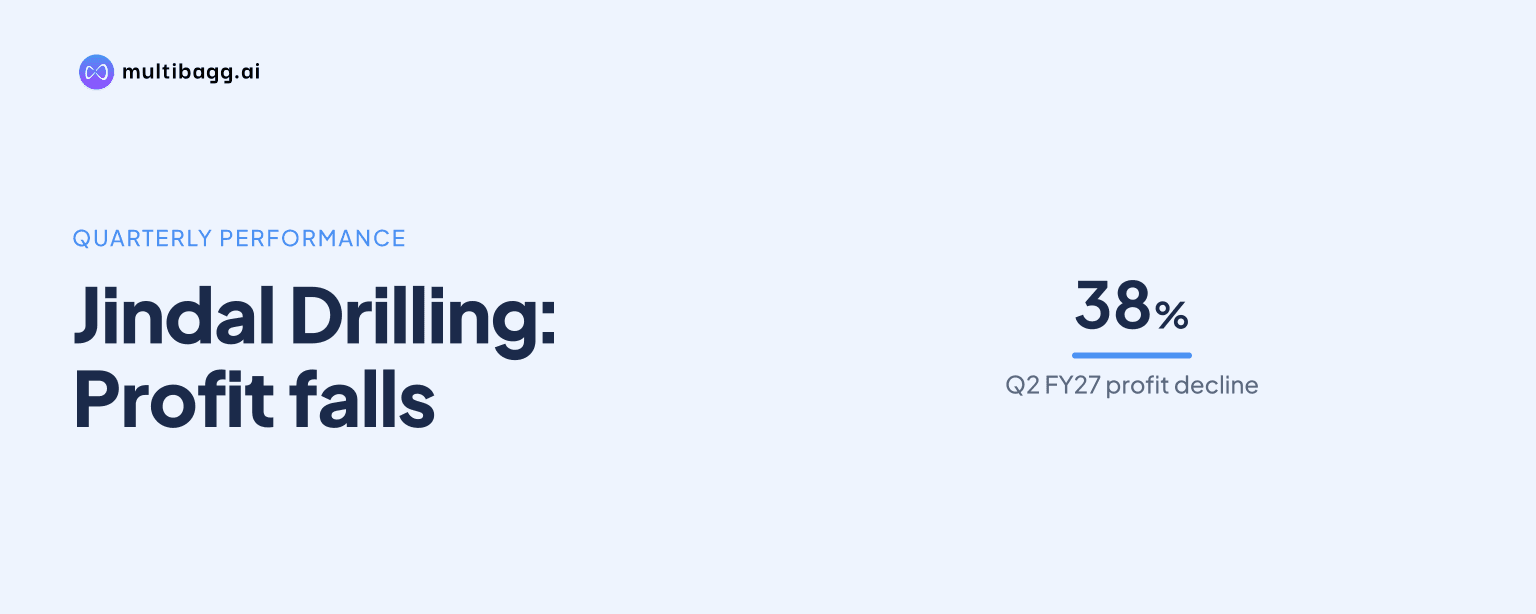
Jindal Drilling & Industries Limited reported standalone profit of Rs 75.38 crore for the quarter ended 30 September 2026, down 38% from Rs 120.74 crore a year earlier, because other income fell to Rs 7.79 crore from Rs 109.02 crore even as net income from operations rose 20% to Rs 285.95 crore.
Know Jindal Drilling & Industries inside out
Results, valuation, peers and who's buying, in one view.
Why did Jindal Drilling’s Q2 profit fall despite higher revenue?
Jindal Drilling’s Q2 profit fell because the Rs 101.23 crore year-on-year reduction in other income exceeded the Rs 47.92 crore increase in net income from operations. Other income declined from Rs 109.02 crore in the quarter ended 30 September 2025 to Rs 7.79 crore in Q2 FY27, while operating revenue increased from Rs 238.03 crore to Rs 285.95 crore.
As a result, standalone total income declined 15% to Rs 293.74 crore from Rs 347.05 crore. Profit before tax decreased by Rs 63.59 crore to Rs 98.01 crore, while tax expense fell to Rs 22.63 crore from Rs 40.86 crore; the lower tax charge was insufficient to prevent profit after tax from declining to Rs 75.38 crore.
The filing identifies no separate reason for the movement in other income between the two quarters. It does show that other income formed only Rs 7.79 crore of Q2 FY27 total income, compared with Rs 109.02 crore in the prior-year quarter, changing the composition of income despite higher drilling and related-services revenue.
How did Jindal Drilling’s Q2 costs and revenue change?
Jindal Drilling’s net income from operations grew faster than total expenses in Q2 FY27, with revenue up 20% to Rs 285.95 crore and expenses up 6% to Rs 195.73 crore. The increase in operating revenue did not translate into a higher reported profit because total income, which includes other income, declined from Rs 347.05 crore to Rs 293.74 crore.
Operational expenses increased to Rs 121.73 crore from Rs 106.58 crore, employee-benefit expenses rose to Rs 27.49 crore from Rs 20.99 crore, and depreciation and amortisation increased to Rs 40.23 crore from Rs 37.88 crore. These movements were partly offset by other expenses falling to Rs 5.27 crore from Rs 17.89 crore and finance cost declining to Rs 1.01 crore from Rs 2.11 crore.
Sequentially, Q2 FY27 profit was higher than the Rs 52.42 crore reported in the quarter ended 30 June 2026. Net income from operations rose from Rs 275.39 crore in the preceding quarter, profit before tax increased from Rs 70.70 crore to Rs 98.01 crore, and other income moved from Rs 7.21 crore to Rs 7.79 crore.
What did Jindal Drilling report for the first half of FY27?
Jindal Drilling’s standalone profit for the half year ended 30 September 2026 declined 28% to Rs 127.79 crore from Rs 177.18 crore in the corresponding prior-year half. Net income from operations nevertheless increased 14% to Rs 561.33 crore from Rs 492.12 crore during the two six-month periods.
Other income was Rs 15.00 crore in H1 FY27, compared with Rs 117.49 crore in H1 FY26, while total income declined to Rs 576.33 crore from Rs 609.61 crore. Total expenses increased to Rs 407.63 crore from Rs 372.47 crore, reducing profit before tax to Rs 168.70 crore from Rs 237.14 crore.
The results also disclose a net foreign-exchange loss within other expenses of Rs 3.93 crore in H1 FY27, compared with a Rs 12.29 crore loss in H1 FY26. For Q2 FY27, the net foreign-exchange loss was Rs 31.32 lakh, versus Rs 11.25 crore in Q2 FY26.
Jindal Drilling identifies its principal business as drilling and related services and states that it has no separate reportable segments under Indian Accounting Standard 108, or Ind AS 108. The quarterly filing therefore does not provide revenue, profit, assets or utilisation data by rig, customer category or geography.
Got a follow-up? Ask IRIS
How did joint ventures affect Jindal Drilling’s consolidated profit?
Jindal Drilling reported consolidated Q2 FY27 profit of Rs 65.85 crore, below standalone profit of Rs 75.38 crore, after recording a Rs 9.53 crore share of loss from equity-accounted joint ventures. In Q2 FY26, the joint ventures contributed a Rs 11.78 crore share of profit, when consolidated profit was Rs 132.52 crore.
The shift in the joint-venture result contributed to consolidated profit before tax falling to Rs 88.48 crore from Rs 173.38 crore. Consolidated total income was Rs 293.74 crore in Q2 FY27, the same as standalone total income, because the equity-accounted joint-venture outcome is recorded after profit before the share of joint ventures and tax.
For H1 FY27, Jindal Drilling recorded a Rs 14.80 crore share of loss from equity-accounted joint ventures, compared with a Rs 21.43 crore share of profit in H1 FY26. Consolidated half-year profit was consequently Rs 112.99 crore, compared with Rs 198.61 crore a year earlier.
The auditor stated that the joint ventures are located outside India and that their financial results were prepared under applicable accounting principles in their respective countries before management converted them to Indian accounting principles. According to the auditor, the joint-venture financial results and information were not material to the group, and the review conclusion was not modified.
How did Jindal Drilling’s financial position change by September?
Jindal Drilling’s standalone total assets rose to Rs 2,231.98 crore at 30 September 2026 from Rs 2,124.43 crore at 31 March 2026. Current assets increased to Rs 867.59 crore from Rs 735.24 crore, including current investments of Rs 338.06 crore against Rs 220.09 crore and trade receivables of Rs 261.73 crore against Rs 223.78 crore.
Standalone equity increased to Rs 1,594.91 crore from Rs 1,468.76 crore over the six months. Current borrowings declined to Rs 50.30 crore from Rs 93.18 crore, while property, plant and equipment fell to Rs 1,142.28 crore from Rs 1,175.30 crore and capital work in progress increased to Rs 17.68 crore from Rs 6.51 crore.
Net cash from operating activities in H1 FY27 was Rs 214.23 crore, while expenditure on property, plant and equipment was Rs 46.60 crore and additions to capital work in progress were Rs 11.16 crore. Short-term bank borrowings decreased by Rs 42.88 crore during the half year, and cash and cash equivalents ended 30 September 2026 at Rs 92.22 crore.
Conclusion
Jindal Drilling increased operating revenue in Q2 FY27 and H1 FY27, but a substantially smaller other-income contribution reduced total income and standalone profit from the previous year’s levels. Consolidated earnings were additionally affected by the change from a joint-venture profit share in the prior year to a loss share in FY27.
What to watch next is the unresolved movement in other income and the equity-accounted joint-venture result, neither of which the filing breaks down beyond the reported figures. Jindal Drilling also discloses no revenue target, earnings guidance or timetable concerning the joint-venture loss in its 13 November 2026 results statement.