










Jindal Worldwide loses EV Volt control after June disposal
Key highlights
- Jindal Worldwide disposed of a 52% equity interest in EV Volt on June 30, 2026.
- EV Volt became an associate of Jindal Worldwide’s subsidiary from June 30, 2026.
- Jindal Worldwide’s equity-method investments were Rs 30.7056 crore at September 30, 2026, versus Rs 22.5902 crore at March 31, 2026.
- Jindal Worldwide reported quarterly revenue of Rs 594.8843 crore and parent-attributable profit of Rs 18.5752 crore.
powered by IRIS
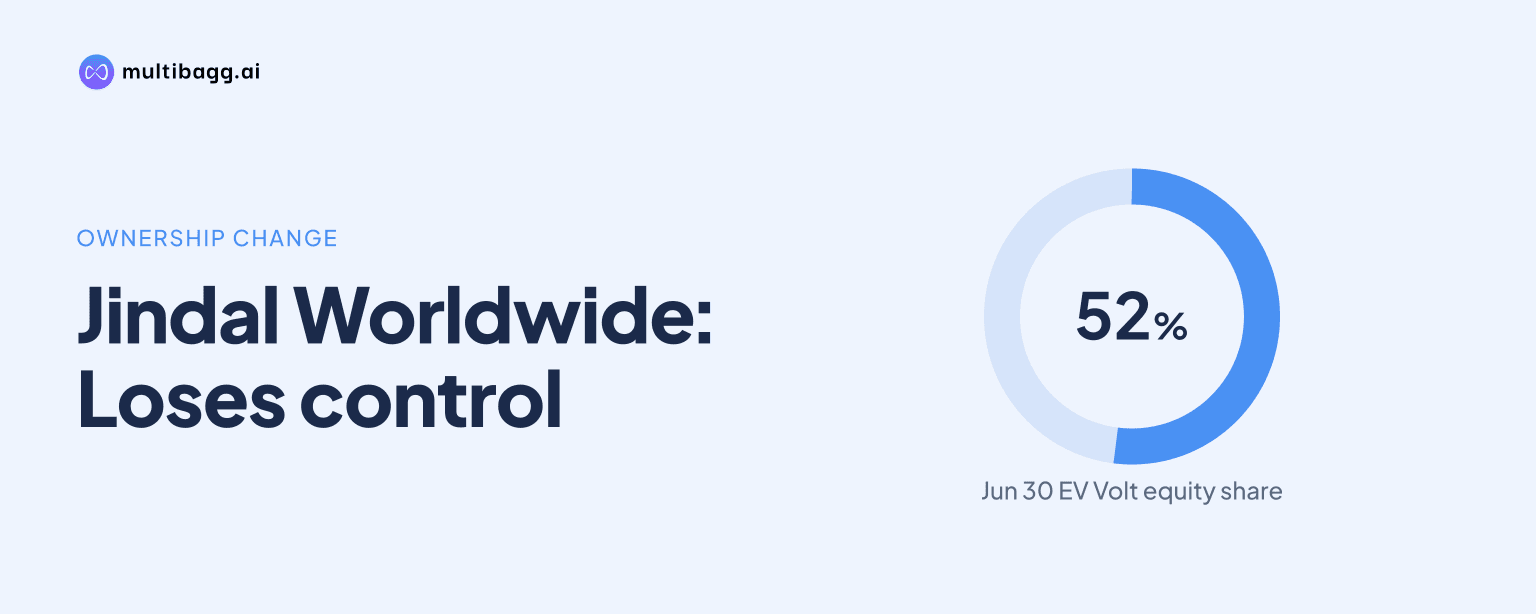
Jindal Worldwide Limited lost control of EV Volt Private Limited on June 30, 2026 after the group disposed of a 52% equity interest, ending EV Volt’s status as a step-down subsidiary. Jindal Worldwide derecognised the former subsidiary’s assets, liabilities and non-controlling interests, and accounted for any retained investment at fair value on that date.
Know Jindal Worldwide inside out
Results, valuation, peers and who's buying, in one view.
Why did Jindal Worldwide lose control of EV Volt?
Jindal Worldwide lost control because its group disposed of a 52% equity interest in EV Volt on June 30, 2026. Note 6 to the consolidated results for the quarter and half year ended September 30, 2026 says the disposal resulted in loss of control over the investee. The filing does not disclose the purchaser, transaction consideration, or the percentage retained after the sale.
The June transaction followed an earlier disposal of a 15% equity interest in EV Volt on March 31, 2026. Jindal Worldwide retained control after that first sale, so it accounted for the March transaction as an equity transaction under Indian Accounting Standard 110, or Ind AS 110, on consolidated financial statements. The difference between consideration received and the adjustment to non-controlling interest was recognised in equity.
The June 30 disposal required different accounting because control was no longer retained. Jindal Worldwide said it derecognised EV Volt’s assets, liabilities and non-controlling interests under Ind AS 110. Any retained investment was recognised at fair value on the date control was lost, while the resulting gain or loss on disposal was recognised under other income in the consolidated statement of profit and loss.
When did EV Volt become an associate of Jindal Worldwide’s subsidiary?
EV Volt became an associate of Jindal Worldwide’s subsidiary from June 30, 2026, according to the auditor’s Annexure A. The annexure identifies Jindal Mobilitric Private Limited as a Jindal Worldwide subsidiary and lists EV Volt as its associate from June 30. It also identifies EV Volt as formerly known as JM Volt Pvt Ltd.
The listing in Annexure A accompanies the limited-review report for the quarter and half year ended September 30, 2026. The report says the consolidated statement includes Jindal Worldwide, its subsidiaries and its share of net profit after tax and total comprehensive income of its associate. The auditor stated that its review found nothing suggesting a material misstatement, while also stating that a review is substantially narrower in scope than an audit.
This was a change from EV Volt’s earlier position as a step-down subsidiary. The group had included the entity in its controlled structure before the June 30 control-loss event, whereas the auditor’s annexure records the post-transaction relationship as an associate of a subsidiary. The filing does not state Jindal Mobilitric’s exact holding in EV Volt after June 30 or identify EV Volt’s products, revenue, funding or operating performance.
How did the accounting treatment change after June 30?
After June 30, Jindal Worldwide stopped consolidating EV Volt as a controlled step-down subsidiary and treated the retained interest, if any, as an associate investment. The filing specifies the initial fair-value recognition of any retained investment on the loss-of-control date. It does not disclose the value assigned to that retained investment or separately quantify the gain or loss recognised under other income.
The March 31 and June 30 transactions therefore had different consolidated-accounting effects. The 15% sale on March 31 did not end control and was recorded in equity, while the 52% disposal on June 30 led to derecognition of the former subsidiary’s balance-sheet items. The June event also ended the inclusion of non-controlling interests relating to EV Volt in the controlled-group balance sheet.
Jindal Worldwide reported investments accounted for using the equity method of Rs 30.7056 crore at September 30, 2026, compared with Rs 22.5902 crore at March 31, 2026. This was an increase of Rs 8.1154 crore across the six months. The filing does not isolate EV Volt within either figure, so the increase cannot be attributed solely to the post-June associate classification.
Got a follow-up? Ask IRIS
What do Jindal Worldwide’s September results show after the disposal?
Jindal Worldwide reported consolidated revenue from operations of Rs 594.8843 crore for the quarter ended September 30, 2026, compared with Rs 573.3446 crore for the quarter ended September 30, 2025. Profit attributable to owners of the parent was Rs 18.5752 crore, up from Rs 11.9727 crore a year earlier. The filing does not quantify how much of either movement arose from EV Volt before or after the June 30 transaction.
For the half year ended September 30, 2026, consolidated revenue from operations was Rs 1,766.2028 crore, compared with Rs 1,173.2420 crore in the corresponding 2025 period. Profit attributable to owners of the parent was Rs 50.9790 crore, against Rs 29.3492 crore. The half-year comparison covers both EV Volt’s pre-June status as a controlled entity and its post-June treatment as an associate.
Management separately showed electric vehicles as a segment in the consolidated segment statement, while saying textiles was the group’s only reportable segment under Ind AS 108 on operating segments. Management said the separate electric-vehicle presentation would provide useful information to users of the statement. The supplied segment page does not provide sufficiently legible figures to establish EV Volt’s revenue, results, assets or liabilities.
The half-year consolidated cash-flow statement includes Rs 84.2842 crore described as proceeds from sale of partial interest in a subsidiary without loss of control. That wording could relate to the March 31 partial-interest sale, but Jindal Worldwide does not explicitly link the line to that transaction or to the June 30 disposal. It therefore cannot be treated as disclosed consideration for the 52% sale that caused loss of control.
What remains undisclosed about the EV Volt transaction?
Jindal Worldwide has not disclosed the consideration, purchaser, retained stake or numerical gain or loss for the June 30 disposal of 52% in EV Volt. The company confirms that the gain or loss was included in other income, but does not provide a separate amount in Note 6. This limits the ability to measure the direct financial effect of the deconsolidation from the supplied filing.
The filing also does not set out EV Volt’s standalone results for the period to June 30, 2026 or its contribution as an associate from that date to September 30, 2026. Jindal Worldwide’s September balance sheet shows total non-current assets of Rs 323.6774 crore, compared with Rs 241.3059 crore at March 31, 2026, but it does not separately identify the former subsidiary’s balances removed on deconsolidation.
The available disclosure instead establishes the mechanics and timing of the ownership change. It distinguishes the March 31 disposal, when control remained, from the June 30 disposal, when control was lost. It also records EV Volt as an associate of Jindal Worldwide’s subsidiary from June 30, providing the basis for its changed treatment in subsequent consolidated reporting.
Conclusion
Jindal Worldwide’s June 30 disposal of a 52% interest in EV Volt changed the group’s electric-vehicle investment from a controlled step-down subsidiary to an associate of its subsidiary. The change required derecognition of EV Volt’s controlled balances and fair-value recognition of any retained investment, unlike the 15% March 31 sale that was recorded in equity because control continued.
The next results disclosures should show movements in Jindal Worldwide’s equity-method investment balance, which was Rs 30.7056 crore at September 30, 2026. The September filing leaves the retained stake, purchaser, disposal consideration and separately measured gain or loss unresolved, while management’s separate electric-vehicle presentation may provide further information in future reporting.