










JOJO Stock Split: 1:5 Plan to Improve Liquidity
Key highlights
- JOJO’s board approved the proposed 1:5 stock split on 26 October 2026.
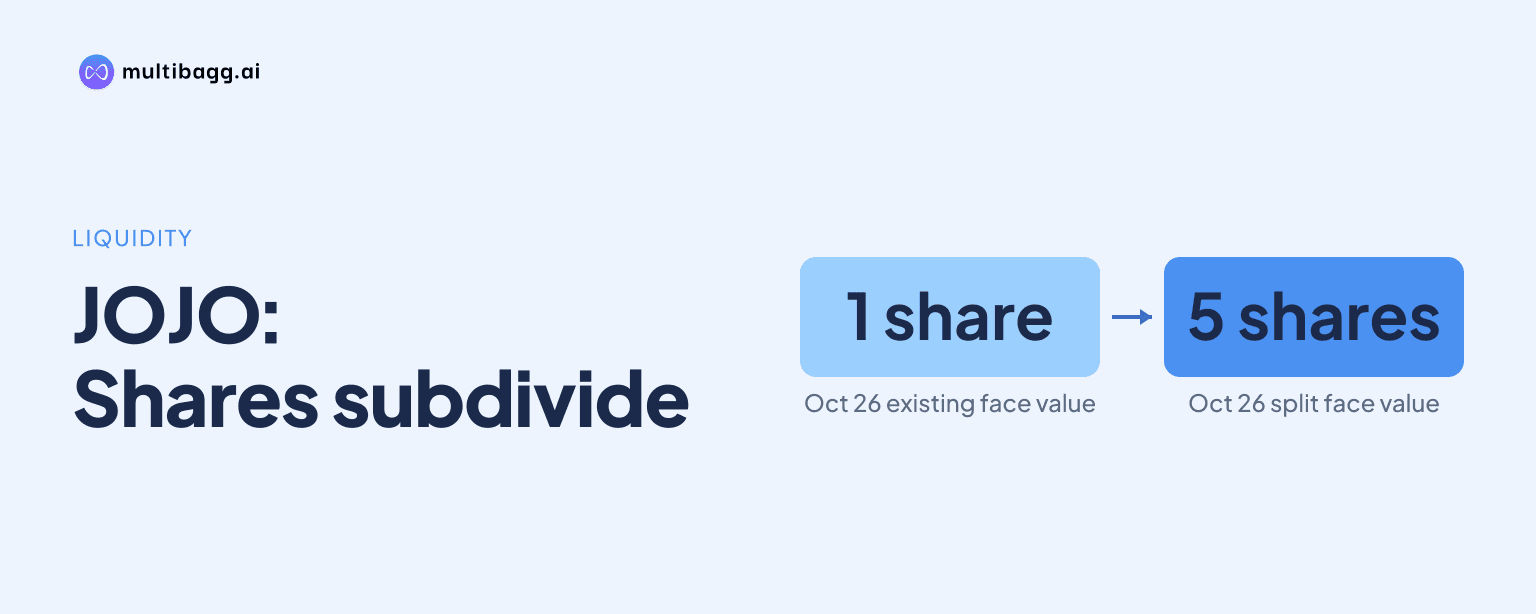
- Each existing ₹5 face-value share would be subdivided into five shares with a face value of ₹1 each.
- The proposal requires shareholder approval through a postal ballot, and the record date has not yet been announced.
- JOJO said the split is intended to improve liquidity and encourage wider public participation, but it does not change the company’s underlying value or an investor’s proportional ownership.
powered by IRIS
Board approves proposed share sub-division
Know JOJO inside out
Results, valuation, peers and who's buying, in one view.
JOJO Ltd's board approved a proposed 1:5 stock split on 26 October 2026. Under the proposal, each existing equity share with a face value of ₹5 will be subdivided into five equity shares of face value ₹1 each. The company said the move is intended to improve liquidity in its shares and encourage wider public participation. The proposal remains subject to shareholder approval. JOJO has initiated a postal ballot process to seek that approval. The board also approved a related alteration to the capital clause in the Memorandum of Association. The company filed the board-meeting outcome with BSE. The proposed action is a capital-structure change and does not by itself alter the underlying value of the company.
What the 1:5 split means for shareholders
A 1:5 split means one existing JOJO share will become five shares after the corporate action takes effect. The face value of each resulting share will be ₹1, compared with ₹5 before the proposed split. A shareholder's proportional ownership in the company will remain unchanged. Similarly, the overall market capitalisation and the total value of an investor's holding should not change solely because of the split. The number of shares held will rise in the split ratio, while the per-share price generally adjusts proportionately when the split becomes effective. The split does not represent a dividend, bonus issue, or additional economic value created for shareholders. Its principal effect is to increase the number of outstanding shares. JOJO has stated that the objective is to make trading in the stock more accessible and support liquidity.
Postal ballot approval is the next step
The board's approval is not the final implementation step. JOJO will seek shareholder consent through a postal ballot for the equity-share sub-division and the capital-clause alteration. The company has appointed a company secretary as scrutiniser for the postal ballot process. Shareholders will receive the relevant notice and voting details through the formal process. The record date for the proposed 1:5 split has not yet been disclosed. JOJO has also indicated that completion is expected within two months, subject to the required approvals and procedural steps. Investors should therefore distinguish the board approval date from the eventual record date and effective date. The company said further details will be announced later.
Key facts at a glance
JOJO's recent corporate action history
The proposed sub-division follows other recent capital-structure actions by JOJO. The company completed an earlier stock split on 7 August 2026, reducing the face value of its equity shares from ₹10 to ₹5. Corporate-action information describes that earlier split as 5:10. JOJO also executed a 1:1 bonus issue with a record date of 12 October 2026. These events occurred before the board approved the latest proposal to reduce the face value from ₹5 to ₹1. The sequence means investors need to account for each action separately when comparing historical share quantities or prices. A bonus issue increases the number of shares issued to eligible shareholders, while a stock split divides existing shares into smaller face-value units. Neither action, on its own, changes an investor's proportional stake. Company disclosures remain the appropriate source for final entitlement and record-date details.
Got a follow-up? Ask IRIS
Why face value is being reduced again
Face value is the nominal value assigned to an equity share and is distinct from its market price. JOJO's proposed reduction from ₹5 to ₹1 would create five times as many shares as existed immediately before the split, once it is implemented. This can lower the quoted price per share proportionately, assuming all other factors remain unchanged. Companies commonly use a share sub-division to increase the number of shares available for trading. JOJO has specifically cited liquidity and broader public participation as the reasons for the proposal. However, a lower face value does not alter the company's business performance, earnings, assets, or total shareholder equity. It also does not guarantee higher trading volumes or a change in valuation. The market price after implementation will continue to depend on trading activity and investor assessment of the company.
Market relevance for existing and prospective investors
For existing shareholders, the central point is that the proposed split changes the share count rather than ownership percentage. For example, one share held before implementation would become five shares after the split, subject to eligibility based on the eventual record date. The market price per share would ordinarily be adjusted to reflect the revised number of shares. Investors should not treat the multiplication of share units as a gain in total holding value. The corporate action may make smaller purchase quantities possible if the trading price adjusts proportionately. That can be relevant for retail participants, which is consistent with JOJO's stated objective. But investment decisions still require consideration of the company's disclosures, financial performance, risks, and market conditions. The postal-ballot outcome and the record-date announcement are the next formal milestones for this proposal.
Regulatory disclosure and capital clause change
JOJO's initial board-meeting intimation said that the meeting would consider a sub-division from ₹5 to ₹1. The intimation was made under Regulation 29 of the SEBI Listing Obligations and Disclosure Requirements Regulations, 2015. Following the meeting, the company reported the board's approval for the stock split. The capital clause alteration is connected to aligning the company's authorised share capital structure with the proposed lower face value. Such amendments require the stated shareholder approval process. The company has attached regulatory filings relating to the proposal. Investors should refer to the postal-ballot notice for the final terms, voting schedule, and any additional procedural information. Until shareholder approval is obtained, the 1:5 split remains a proposal approved by the board rather than a completed corporate action. No new record date was included in the available announcement.
What investors should watch next
JOJO's latest proposal continues the company's series of equity-capital adjustments during 2026. The board has approved the 1:5 sub-division, but the postal ballot is necessary before implementation. The company is expected to provide the record date and completion details after the required approvals and filings. Investors tracking the stock should monitor BSE disclosures for the postal-ballot notice, voting result, and final corporate-action timetable. The earlier August split and October bonus issue should be considered when reviewing historical share data. The proposed move is designed to increase the number of tradeable shares and improve accessibility. It does not, by itself, change JOJO's fundamentals or the proportional ownership of its shareholders.