










JSW Cement sets FY28-FY29 expansion commissioning timetable
Key highlights
- JSW Cement expects its 1.7 MTPA Fujairah unit to start in Q1 FY28, around May-June.
- JSW Cement targets Q4 FY28 commissioning for its 2.5 MTPA Nagaur expansion.
- JSW Cement plans the first 2 MTPA Dolvi unit in FY29, 20-21 months after a January FY27 start.
- JSW Cement said about Rs 7,500 crore remains to reach 43.5 MTPA capacity.
powered by IRIS
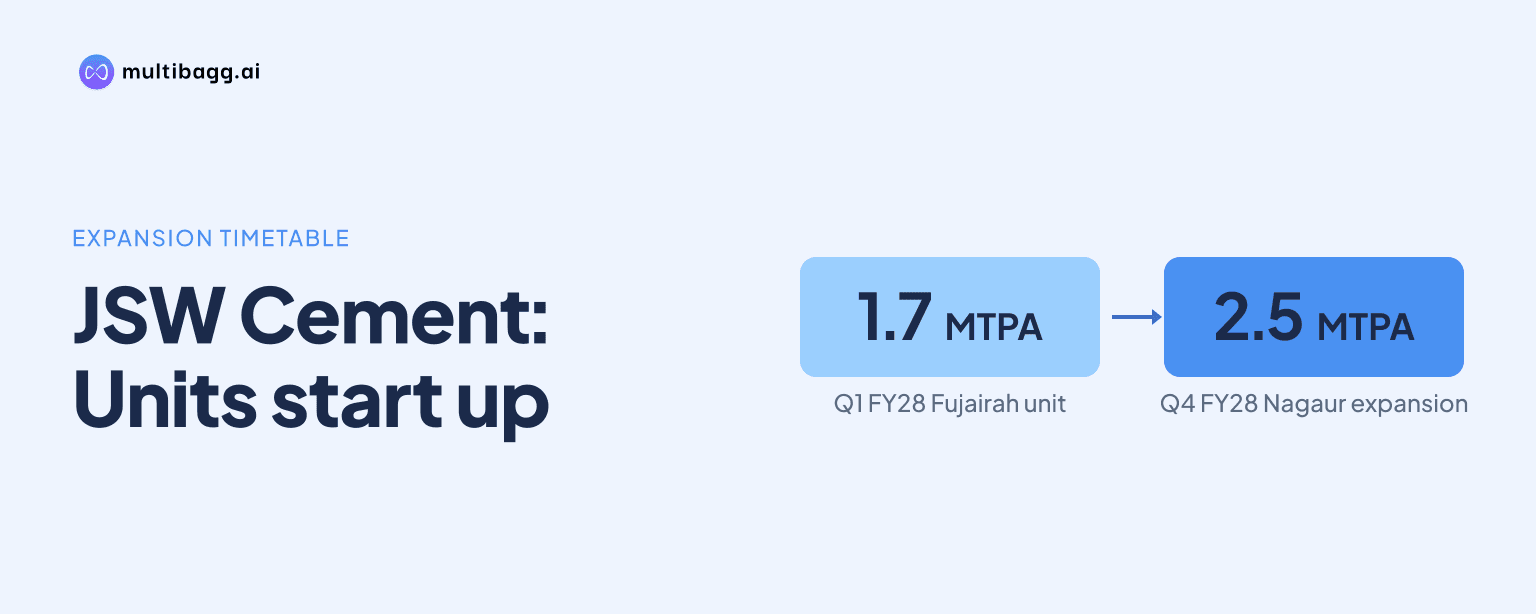
JSW Cement Limited said its 1.7 million tonnes per annum Fujairah unit should start in Q1 FY28, while its first 2 MTPA Dolvi grinding unit is expected in FY29 after work begins in January FY27. Management also set Q4 FY28 for the 2.5 MTPA Nagaur expansion and outlined a roughly 18-month construction period for Vijayanagar.
Know JSW Cement inside out
Results, valuation, peers and who's buying, in one view.
When will JSW Cement commission its announced capacity projects?
JSW Cement expects Fujairah to be ready in Q1 FY28, Nagaur’s 2.5 MTPA addition in Q4 FY28, and the first 2 MTPA Dolvi unit in FY29. Management said Fujairah should begin around May and June of the following year, while the Dolvi project is expected to take 20 to 21 months from its planned January FY27 start.
The disclosed timetable places Fujairah ahead of Nagaur, followed by Dolvi, although Dolvi has the widest timing range. Management described Dolvi completion as potentially occurring in FY29’s second quarter or around the early part of the third quarter. JSW Cement did not provide a commissioning date for the second 2 MTPA phase shown in its presentation.
MTPA means million tonnes per annum. The sequencing is tied to slag availability from JSW Steel operations: management said the urgency at Dolvi reflects the expectation that JSW Steel’s blast furnace will be ready sometime in calendar 2028. At Vijayanagar, JSW Cement is moving as the steel plant ramps from 18 million tonnes to 24 million tonnes, seeking to be ready for additional slag.
Why is JSW Cement building Dolvi in two phases?
JSW Cement is proceeding immediately with a 2 MTPA Dolvi grinding unit because land at its existing location has become available, but the remaining 2 MTPA depends on another land parcel. Management said JSW Steel had cleared land at the current site, allowing JSW Cement to use it through lease rental or lease premium arrangements rather than waiting for the plot across the creek near the PNP Jetty.
The initial project therefore differs from the 4 MTPA Dolvi capacity displayed in the company presentation. Management said it did not want to delay the first 2 MTPA unit while awaiting the PNP Jetty land, particularly given the expected availability of blast-furnace slag in calendar 2028. It is continuing to work on the alternate land parcel before deciding on the balance 2 MTPA.
The second phase is not scheduled to follow automatically after the first one. Management said it would wait for the operating first 2 MTPA unit to reach utilisation of about 65% to 70% before starting work on the next 2 MTPA. That condition makes the eventual 4 MTPA Dolvi outcome dependent on both land access and demand absorption, rather than only on construction execution.
What does the expansion programme mean for JSW Cement's capex?
JSW Cement maintained its stated capital-expenditure plan of Rs 2,300 crore for FY27 and Rs 2,000 crore for FY28, with about Rs 7,500 crore still required to reach 43.5 MTPA. Management confirmed these figures during the call, while distinguishing between actual project spending and the timing of cash payments to vendors.
For FY27, management said cash outgo should not be read as the full measure of capex executed. An analyst cited Rs 800 crore in first-half cash-flow spending, and management said work completed during February or March may be paid for at March-end or in April. On that basis, JSW Cement still expected actual FY27 capex to close at about Rs 2,200 crore to Rs 2,300 crore.
An analyst referred to a roughly Rs 500 crore to Rs 550 crore cost for the first 2 MTPA Dolvi project, including the land question. Management clarified that the available land would involve only lease rental or a lease premium from JSW Steel. It said the cost of the later 2 MTPA phase would be much lower than the earlier Rs 1,600 crore estimate for 4 MTPA, without giving a revised absolute figure.
Got a follow-up? Ask IRIS
How does the capacity plan affect JSW Cement's GGBS outlook?
JSW Cement said growth in ground granulated blast-furnace slag, or GGBS, may slow to high single digits in FY28 before increasing as additional slag becomes available at Dolvi and Vijayanagar. This compares with management’s high-single-digit GGBS volume-growth forecast for the current year, after growth moved from 2.3% in the first quarter to 7% in the second quarter.
Management linked the FY28 moderation to the timing of additional slag rather than to a stated change in its penetration strategy. It is maintaining GGBS prices to broaden usage in ready-mix concrete, or RMC, rather than raising prices alongside ordinary Portland cement, or OPC. JSW Cement said GGBS currently accounts for roughly 35% to 40% of the relevant concrete mix design and that its objective is to reach 50%, which it said is approved under Bureau of Indian Standards norms.
At Nagaur, management also expects utilisation to improve from the second-quarter level of about 5.8 lakh tonnes, including clinker sales. It said 3.5 million tonnes of grinding capacity is currently operational there, including an additional 1 million-tonne grinding unit. The planned 2.5 MTPA Nagaur expansion due in Q4 FY28 would follow this operational ramp-up.
How will JSW Cement fund the expansion while managing leverage?
JSW Cement said it intends to remain aggressive on expansion but has a mandate to keep net debt to earnings before interest, tax, depreciation and amortisation, or EBITDA, below 3 times. Management said the ratio could remain around 3 times for another year or so before falling below that level in later years.
The funding approach also explains management’s comments on trade payables, which an analyst said stood at about 80 days on a consolidated basis versus an industry range of 30 to 40 days. Management said it must balance capex with its debt ceiling and expects payables to decline substantially after the Rajasthan operation begins generating sufficient cash, which it indicated could happen around the end of Q4 or in Q1 of the next year.
Conclusion
The timetable shows a phased build-out rather than simultaneous completion of all announced capacity. Fujairah and Nagaur have explicit FY28 targets, while Dolvi and Vijayanagar are designed around future slag availability from steel operations. The Dolvi plan is particularly conditional: its first 2 MTPA is advancing on available land, but the second 2 MTPA remains subject to land progress and 65% to 70% utilisation of the first phase.
The next points to watch are the January FY27 start of Dolvi construction, the December start at Vijayanagar, and whether Fujairah starts around May-June in Q1 FY28 as management expects. Investors can also monitor the Rajasthan entitlement certificate, which management said it was awaiting from RIPS before recognising the Rs 650 crore incentive over 10 years.