










JSW Dulux calls industrial margin hit temporary in Q2 FY27
Key highlights
- JSW Dulux said Q2 FY27 gross margin declined 400 basis points, largely due to industrial coatings.
- Industrial COGS rose 30% to 35% in Q2 FY27, versus industrial price increases of 6% to 7%.
- JSW Dulux reported Q2 FY27 EBITDA of Rs 110.9 crore, up 4.4% from Rs 106.3 crore on a like-for-like basis.
- Project Akshaya delivered Rs 7.3 crore of synergies in Q2 FY27.
powered by IRIS
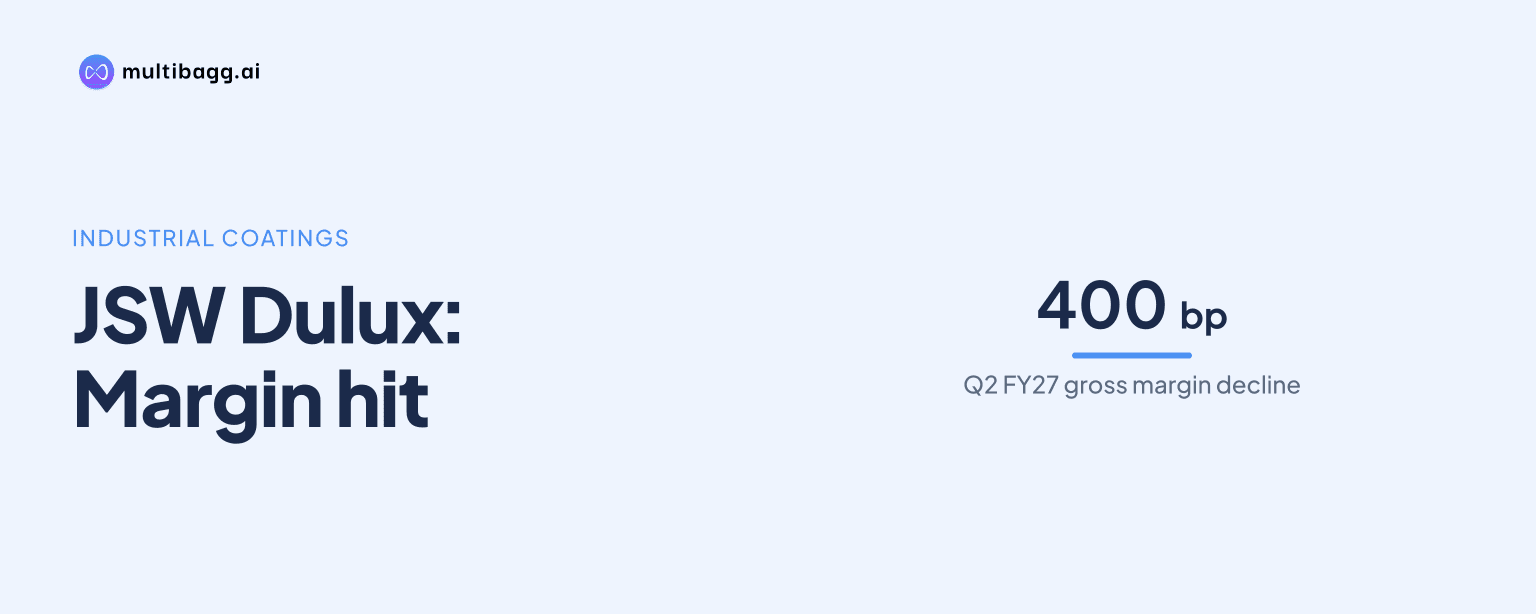
JSW Dulux Limited said its Q2 FY27 gross margin fell by 400 basis points, mainly because industrial-coatings costs rose 30% to 35% while price increases were only 6% to 7%. JSW Dulux described the mismatch as temporary, citing an approximately 4% industrial price increase, further recovery efforts and cost actions.
Know JSW Dulux inside out
Results, valuation, peers and who's buying, in one view.
Why did JSW Dulux's gross margin fall in Q2 FY27?
JSW Dulux's gross margin fell by 400 basis points in Q2 FY27 largely because industrial-coatings pricing lagged input costs. Management said decorative represented 60% of the business mix and industrial represented 40%, while industrial grew more than 32%, increasing the effect of its cost-price gap on consolidated margins.
The pressure was concentrated in Marine & Protective, industrial coil coatings and packaging coatings. Management said cost of goods sold, or COGS, rose about 30% to 35% in these verticals during Q2 FY27, while price increases were only about 6% to 7%.
Management linked the inflationary gap to crude oil and foreign-exchange movements. It said its annual operating plan, or AOP, had been prepared at different assumptions, while crude rose from about $95 when it last commented to a peak of $114, and the rupee-dollar rate reached Rs 96 from around Rs 93 to Rs 94.
Is JSW Dulux's industrial margin pressure temporary?
Management said the industrial margin pressure was short term rather than structural. JSW Dulux announced an approximately 4% industrial price increase during Q2 FY27 and said it was seeking additional recovery while reviewing low-margin accounts to make growth margin-accretive and earnings before interest, tax, depreciation and amortisation, or EBITDA, accretive.
The recovery has not been even across industrial verticals. Management said automotive and vehicle-refinish price increases had by and large been recovered by the end of October, although not fully within Q2 FY27, whereas Marine & Protective, coil coatings and packaging coatings faced the larger lag.
Decorative coatings provided a contrast with industrial. Management said decorative margins had largely held sequentially and that price increases were substantially covered, while industrial accounted for most of the 400-basis-point gross-margin decline. Decorative pricing was raised in three tranches beginning September 30 and October 14, followed by a further increase.
Management said cumulative additional decorative price increases were about 3.2% to 3.5%, including another 1% announced in November. It also cited research and development, value engineering and cost actions that were intended to address inflation without affecting product quality, but did not quantify expected savings or give a date for full industrial recovery.
Got a follow-up? Ask IRIS
How did JSW Dulux grow despite the margin decline?
JSW Dulux reported 21.3% revenue growth and about 21% volume growth on a comparable basis in Q2 FY27 despite the gross-margin decline. In its volume-price-mix discussion, management cited 21.8% volume growth, a 7.9% price increase and an adverse 8.4% mix effect, primarily reflecting faster growth in industrial business.
EBITDA was Rs 110.9 crore in Q2 FY27, up 4.4% from a like-for-like Rs 106.3 crore. Profit after tax, or PAT, excluding exceptional items rose 2% to Rs 71.2 crore from Rs 69.8 crore, with management saying lower investment income limited PAT growth.
In decorative coatings, management said first-half premium products recorded high-single-digit volume growth and double-digit revenue growth. Velvet Touch and Weathershield continued to perform, while waterproofing and wood-care adjacencies grew faster; JSW Dulux also said it had de-weighted selected lower-margin areas in decorative and industrial businesses.
Management described growth as more broad based geographically than in earlier periods. It said North and West had previously grown faster, some South markets had since shown good growth, and parts of East India remained challenging despite a bounce-back in October that management said required further monitoring.
What will determine whether JSW Dulux restores margins?
Industrial price recovery and movements in crude oil and foreign exchange will determine the pace of margin restoration, according to management. At the November 4 call, management said crude was about $105 to $106, below the $114 peak but elevated, while the rupee-dollar rate had returned to around Rs 94.5 after reaching Rs 96.
Management said Q2 FY27 EBITDA margin was 11.5% and reiterated its aim of reaching about 13% to 14% during the year. It qualified that aim by noting that crude and currency conditions remained inflationary and difficult to predict, making the 13% to 14% figure a management objective rather than quantified guidance.
Project Akshaya could also contribute to costs and margins. Management said it realised Rs 7.3 crore of synergies in Q2 FY27 through supply-chain efficiencies, cross-manufacturing and a unified projects business, and said enterprise resource planning, or ERP, and systems integration was scheduled for December.
Capacity investment remains linked to demand growth. Management said cross-manufacturing had started across JSW Dulux's five plants and JSW Paints' three plants, while capacity utilisation in certain industrial verticals had approached 75%, requiring investment earlier in the year; spending on tinting machines and stores was also continuing.
Conclusion
JSW Dulux's Q2 FY27 performance combined 21.3% revenue growth and more than 32% industrial-business growth with a 400-basis-point gross-margin decline. The result reflects a specific industrial cost-price lag, as 30% to 35% COGS inflation in several industrial verticals exceeded 6% to 7% pricing, while decorative pricing and margins were comparatively more stable.
The next disclosed markers are industrial price recovery after the approximately 4% Q2 increase, crude and currency movements from the November 4 levels of about $105 to $106 and Rs 94.5, and the planned December ERP integration. Management's stated aim of about 13% to 14% EBITDA margin for the year also depends on these conditions and its cost actions.