










JTEKT India Q2 revenue rises 31% as net profit slips 4%
Key highlights
- JTEKT India’s September-quarter revenue from operations rose 30.6% to Rs 834.74 crore.
- September-quarter net profit after tax declined 4.1% to Rs 17.48 crore.
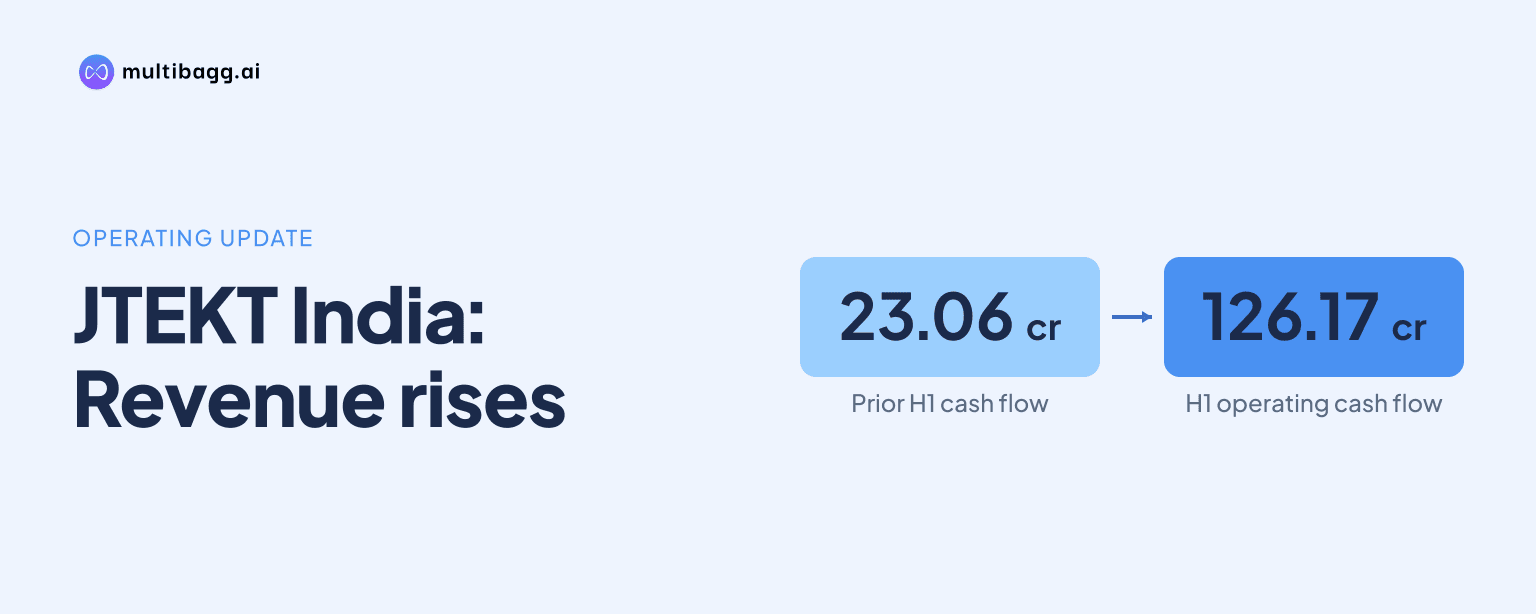
- First-half operating cash flow increased to Rs 126.17 crore from Rs 23.06 crore a year earlier.
- JTEKT India approved an investment of up to Rs 2.40 crore for a 26% stake in a proposed solar SPV.
powered by IRIS
JTEKT India Limited reported revenue from operations of Rs 834.74 crore for the quarter ended 30 September 2026, up 31% from a year earlier, while net profit after tax fell 4% to Rs 17.48 crore as material, finance, depreciation and other costs rose. The results were approved by the board on 4 November 2026.
Know JTEKT India inside out
Results, valuation, peers and who's buying, in one view.
How did JTEKT India perform in the September 2026 quarter?
JTEKT India increased revenue from operations by 30.6% year on year to Rs 834.74 crore in the quarter ended 30 September 2026, from Rs 639.11 crore in the quarter ended 30 September 2025. Including other income, total income rose to Rs 837.50 crore from Rs 642.72 crore, although other income itself declined to Rs 2.76 crore from Rs 3.61 crore.
Net profit after tax was Rs 17.48 crore, compared with Rs 18.23 crore a year earlier, a decline of 4.1%. Profit before tax declined by 4.5% to Rs 23.85 crore despite the higher sales base, while basic and diluted earnings per share, not annualised, declined to Rs 0.63 from Rs 0.68.
JTEKT India also recorded sequential revenue growth from Rs 717.98 crore in the quarter ended 30 June 2026 to Rs 834.74 crore in the September quarter. Net profit increased from Rs 6.22 crore in the preceding quarter, and profit before tax rose from Rs 8.62 crore, indicating that the year-on-year decline in quarterly profit differed from the immediate sequential trend.
Why did JTEKT India’s profit decline despite higher revenue?
JTEKT India’s total expenses rose to Rs 813.65 crore from Rs 617.74 crore a year earlier. Cost of materials consumed, the largest expense line, increased by Rs 154.27 crore to Rs 617.05 crore, while purchases of stock-in-trade were Rs 7.31 crore versus Rs 7.16 crore.
Finance costs nearly tripled to Rs 5.63 crore from Rs 1.90 crore, and depreciation and amortisation rose to Rs 31.37 crore from Rs 23.00 crore. Employee benefit expenses increased to Rs 78.35 crore from Rs 67.47 crore, while other expenses rose to Rs 76.37 crore from Rs 62.52 crore; together, these four cost lines were Rs 36.83 crore higher year on year.
Inventory changes provided a Rs 2.43 crore reduction in expenses in the September 2026 quarter, compared with a Rs 7.08 crore reduction a year earlier. Tax expense fell to Rs 6.37 crore from Rs 6.76 crore, comprising current tax of Rs 3.51 crore and deferred tax of Rs 2.86 crore, but that reduction did not offset the Rs 1.13 crore decline in profit before tax.
What do JTEKT India’s half-year results show?
JTEKT India reported first-half revenue from operations of Rs 1,552.73 crore for the period from 1 April 2026 to 30 September 2026, up 28.8% from Rs 1,205.12 crore in the corresponding 2025 period. Total income grew to Rs 1,559.42 crore from Rs 1,217.61 crore, as other income fell to Rs 6.69 crore from Rs 12.48 crore.
Half-year net profit after tax declined 18.4% to Rs 23.70 crore from Rs 29.04 crore, and profit before tax declined to Rs 32.47 crore from Rs 39.52 crore. Basic and diluted earnings per share for the six-month period were Rs 0.85, compared with Rs 1.10 in the prior-year period.
The half-year cost pattern mirrors the quarterly outcome: materials consumed rose to Rs 1,139.82 crore from Rs 870.20 crore, finance costs increased to Rs 10.83 crore from Rs 6.10 crore, and depreciation rose to Rs 59.68 crore from Rs 43.99 crore. JTEKT India reports one operating segment, manufacturing, assembling, trading and sale of automotive components, so the filing does not separate revenue or profit by product category.
Got a follow-up? Ask IRIS
How did JTEKT India’s balance sheet and cash flow change?
JTEKT India’s total assets stood at Rs 2,070.17 crore on 30 September 2026, compared with Rs 1,971.21 crore on 31 March 2026. Property, plant and equipment increased to Rs 938.81 crore from Rs 808.11 crore, while capital work-in-progress fell to Rs 372.94 crore from Rs 400.29 crore and trade receivables increased to Rs 426.31 crore from Rs 377.86 crore.
Total borrowings were Rs 412.82 crore at 30 September 2026, comprising Rs 289.15 crore of non-current borrowings and Rs 123.67 crore of current borrowings. This compared with Rs 337.31 crore at 31 March 2026, as non-current borrowings increased by Rs 90.05 crore while current borrowings declined by Rs 14.54 crore.
For the half year, JTEKT India generated operating cash flow of Rs 126.17 crore, compared with Rs 23.06 crore in the prior-year period. Investing cash outflow was Rs 163.11 crore, including Rs 199.47 crore spent on property, plant, equipment, capital work-in-progress and related advances and payables; financing cash inflow was Rs 39.33 crore, compared with Rs 328.13 crore a year earlier when JTEKT India received rights-issue proceeds.
What capital and energy plans has JTEKT India disclosed?
JTEKT India’s board approved an investment of up to Rs 2.40 crore, in one or more tranches, for a 26% equity interest in a proposed special purpose vehicle for a group captive solar power project. The project is intended for captive consumption at JTEKT India’s manufacturing facilities under the Electricity Act, 2003.
The proposed special purpose vehicle is to be promoted by a renewable-energy developer and incorporated in India. JTEKT India said it will enter into a share purchase agreement, shareholders’ agreement, performance incentive agreement and energy supply agreement with the special purpose vehicle and/or developer, with details to be disclosed after execution.
JTEKT India also paid its final dividend for financial year 2025-26 during the September 2026 quarter. The dividend was Rs 0.75 per equity share, following shareholder approval on 26 August 2026, while paid-up equity share capital remained Rs 27.74 crore following the earlier rights issue.
Conclusion
JTEKT India delivered higher September-quarter and half-year revenue, but higher materials, employee, finance, depreciation and other expenses resulted in lower profit than in the comparable 2025 periods. The September-quarter revenue increase of 30.6% was accompanied by a 4.1% decline in net profit, while first-half profit after tax fell 18.4% despite 28.8% revenue growth.
Next, readers can watch execution of the proposed solar special purpose vehicle investment of up to Rs 2.40 crore and the related agreements that JTEKT India says will be disclosed upon execution. The filing also shows Rs 199.47 crore of first-half capital expenditure and a rise in non-current borrowings to Rs 289.15 crore, making subsequent disclosures on investment deployment and financing relevant.