










Jyothy Labs Q2 EBITDA margin falls to 2.5% on input costs
Key highlights
- Jyothy Labs' Q2FY27 operating EBITDA margin fell to 2.5% from 16.1% in Q2FY26.
- Gross margin declined 13.3 percentage points to 34.8% in Q2FY27.
- Q2FY27 operating EBITDA fell 83.8% year on year to Rs 19.2 crore.
- Revenue excluding Pril and Fa grew 12.4% by value and 8.1% by volume in Q2FY27.
powered by IRIS
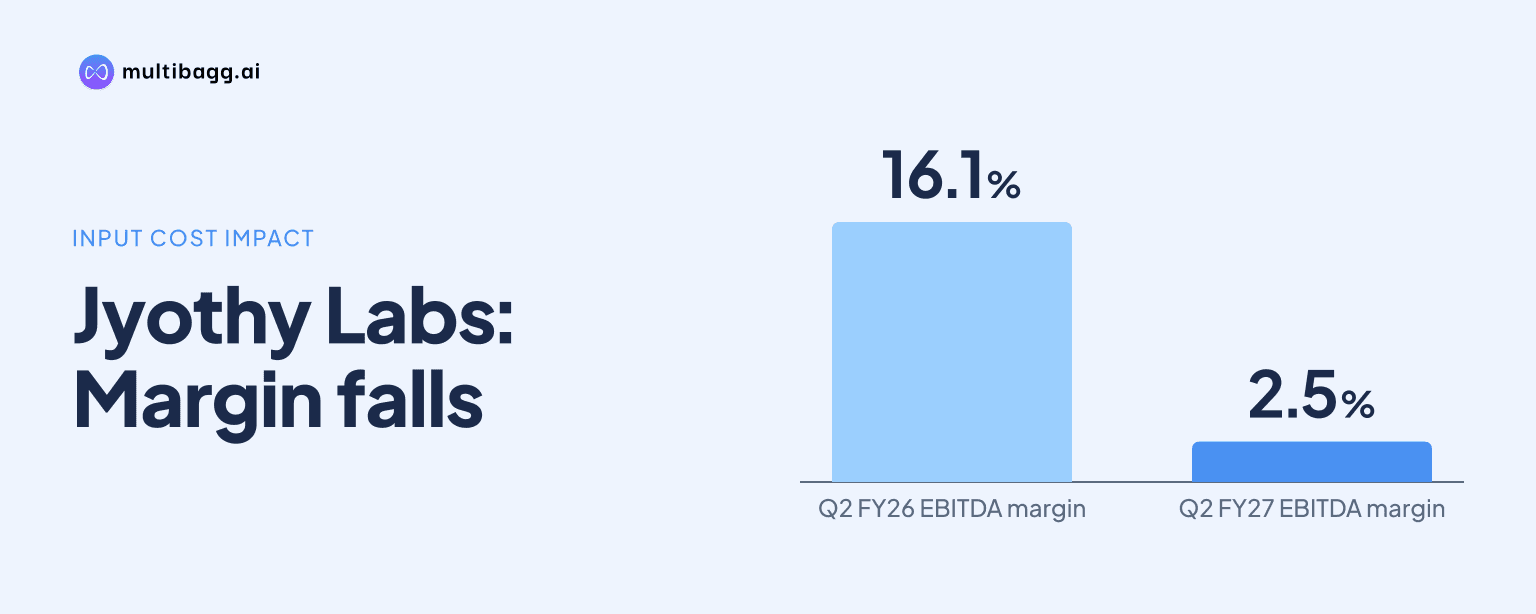
Jyothy Labs reported a 2.5% operating EBITDA margin in Q2FY27, down from 16.1% a year earlier, after gross margin fell 13.3 percentage points to 34.8% amid abnormal inflation in raw materials and packaging. Operating EBITDA declined 83.8% year on year to Rs 19.2 crore, despite revenue from operations rising 3.3% to Rs 760 crore.
Know Jyothy Labs inside out
Results, valuation, peers and who's buying, in one view.
What caused Jyothy Labs' Q2FY27 margin decline?
Jyothy Labs attributes the Q2FY27 gross-margin contraction to abnormal inflation in raw materials and packaging costs. Gross margin was 34.8% in the September quarter, compared with 48.1% in the same period of FY26, a 13.3-percentage-point decline that was the largest listed factor in the movement of operating earnings before interest, tax, depreciation and amortisation, or EBITDA.
The bridge from Q2FY26 to Q2FY27 shows the 13.3-point gross-margin decline outweighed changes elsewhere in the cost base. Advertisement and sales promotion, or A&P, added 0.9 percentage points to EBITDA margin, while employee cost reduced it by 0.3 points and other expenditure by 0.9 points. The combined result was a 13.6-point reduction in operating EBITDA margin, from 16.1% to 2.5%.
The input-cost issue occurred in a market where Jyothy Labs said demand remained resilient, helped by rural consumption and gradual improvement in urban markets. The company nevertheless identified crude-linked and packaging inputs as elevated, and said this inflation was creating significant margin pressure. That distinction matters because reported revenue rose by Rs 24 crore from Rs 736 crore in Q2FY26 to Rs 760 crore in Q2FY27.
How much did Jyothy Labs' earnings fall in Q2FY27?
Jyothy Labs' operating EBITDA fell to Rs 19.2 crore in Q2FY27 from Rs 118.3 crore a year earlier, an 83.8% decline. Profit after tax, or PAT, fell 87.9% to Rs 10.6 crore from Rs 87.8 crore, while PAT margin declined to 1.4% from 11.9% in the company’s financial-parameters table.
The first half shows that the pressure extended beyond one quarter, although Q2 was below the half-year average. H1FY27 operating EBITDA was Rs 83.9 crore, down 65.4% from Rs 242.4 crore in H1FY26, and its margin was 5.5% versus 16.3%. H1 PAT was Rs 58.2 crore compared with Rs 184.6 crore, a 68.4% decline.
Jyothy Labs spent Rs 56.5 crore on A&P in Q2FY27, below Rs 61.5 crore a year earlier. A&P represented 7.4% of revenue from operations, compared with 8.4% in Q2FY26, so the lower spending ratio partly offset but did not counter the gross-margin movement. In H1FY27, A&P was Rs 107.2 crore, or 7.0% of revenue, versus Rs 120.3 crore and 8.1% a year earlier.
Got a follow-up? Ask IRIS
Did demand and category growth weaken at Jyothy Labs?
Jyothy Labs reported 12.4% value growth and 8.1% volume growth in Q2FY27 when Pril and Fa sales were excluded, compared with 3.3% reported revenue growth including the relevant comparison base. For H1FY27, revenue excluding Pril and Fa grew 10.2% by value and 6.2% by volume, while reported revenue increased 3.1% to Rs 1,533 crore.
The category figures show different outcomes depending on whether Home Care includes Pril. Fabric Care grew 10.4% in Q2FY27 and 12.3% in H1FY27. Home Care including Pril declined 7.1% in the quarter and 8.1% in the half year, whereas Home Care excluding Pril grew 15.3% in Q2FY27 and 8.8% in H1FY27. The presentation states that Pril and Fa sales are included only up to 31 May 2026.
Personal Care grew 11.2% in Q2FY27 and 5.4% in H1FY27. Fabric Care accounted for 51% of category-wise business share, Home Care for 37%, and Personal Care for 12% in the Q2FY27 presentation. The 10.4% quarterly Fabric Care growth therefore applied to Jyothy Labs' largest disclosed business category, while the Home Care comparison was affected by the Pril inclusion basis.
The longer-term category data also differed by segment. Fabric Care recorded a 5.5% three-year compound annual growth rate, or CAGR, in Q2FY27, compared with negative 3.3% for Home Care including Pril, 3.3% for Home Care excluding Pril, and 0.5% for Personal Care. On a four-year CAGR basis, Fabric Care was 6.9%, Home Care excluding Pril was 4.7%, Personal Care was 5.6%, and Home Care including Pril was negative 0.5%.
What do Jyothy Labs' balance-sheet indicators show?
Jyothy Labs reported a cash balance of Rs 846 crore as at 30 September 2026, including fixed deposits and mutual fund investments. This was lower than Rs 997 crore at March 2026 but higher than Rs 801 crore at September 2025. The presentation does not state how Jyothy Labs plans to use this cash balance.
Working capital was Rs 191 crore at September 2026, compared with Rs 119 crore at March 2026 and Rs 180 crore at September 2025. Working-capital days were 23 at September 2026, versus 15 at March 2026 and 22 a year earlier. The return on equity measure, annualised for September periods, was 7.7% at September 2026, down from 25.7% at September 2025; excluding goodwill, it was 8.3% versus 27.7%.
Conclusion
Jyothy Labs' Q2FY27 performance indicates that disclosed input-cost inflation, rather than a contraction in the company’s underlying sales measures, drove the earnings decline. Gross margin lost 13.3 percentage points, operating EBITDA fell by Rs 99.1 crore year on year, and the 2.5% operating EBITDA margin was below both the 16.1% prior-year quarter level and the 5.5% H1FY27 level.
The disclosed unresolved matter is whether elevated crude-linked raw-material and packaging costs continue to pressure margins. The next results should show whether gross margin moves from the 34.8% Q2FY27 level and whether the 12.4% Q2FY27 value growth excluding Pril and Fa is maintained alongside A&P spending of 7.4% of revenue.