










Karbonsteel first-half profit falls 6.6% as revenue declines
Key highlights
- Karbonsteel reported profit after tax of Rs 6.5693 crore for the half year ended 30 September 2026, down 6.6% year on year.
- Revenue from operations fell by Rs 9.105 crore year on year to Rs 130.5978 crore in the September 2026 half.
- Inventory increased by Rs 19.7131 crore in the period, while operating cash flow was an outflow of Rs 1.4154 crore.
- Long-term borrowings rose to Rs 28.7899 crore at 30 September 2026 from Rs 10.1377 crore at 31 March 2026.
powered by IRIS
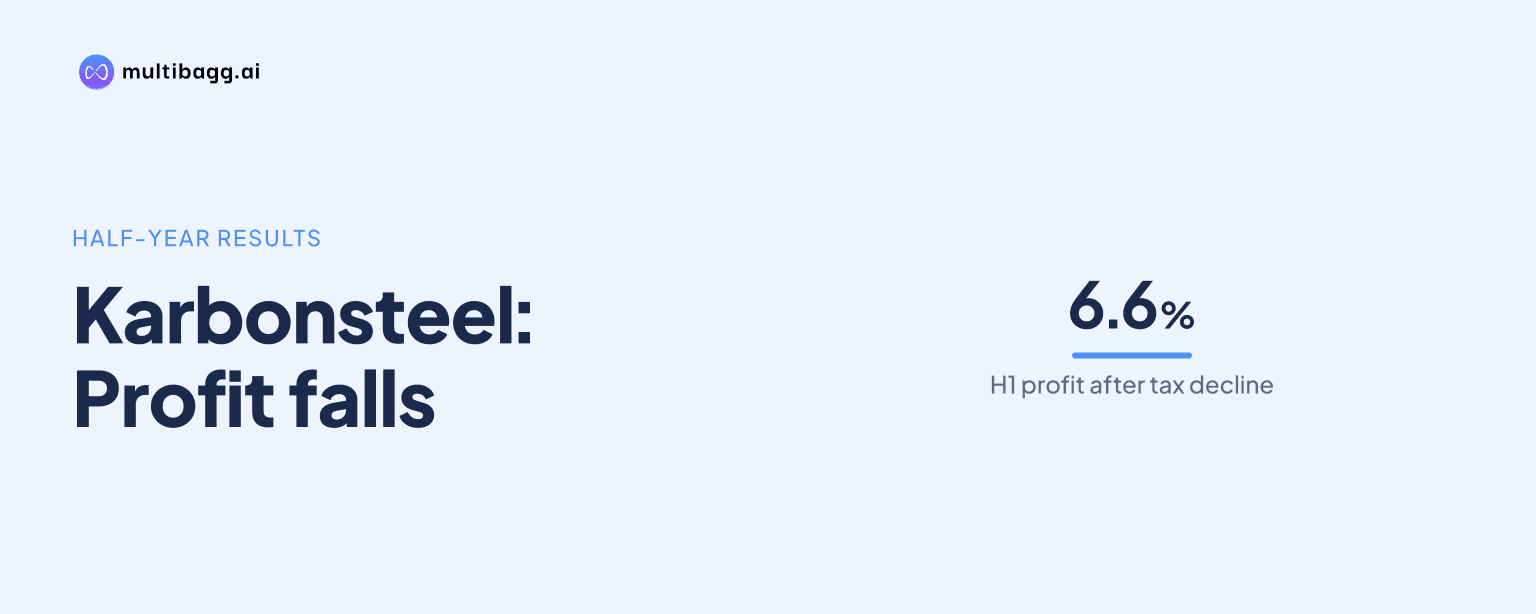
Karbonsteel Engineering Limited reported profit after tax of Rs 6.5693 crore for the half year ended 30 September 2026, 6.6% below Rs 7.0328 crore a year earlier, as revenue from operations fell to Rs 130.5978 crore and operating cash flow was an outflow of Rs 1.4154 crore.
Know Karbonsteel Engineering inside out
Results, valuation, peers and who's buying, in one view.
How did Karbonsteel’s first-half earnings compare with last year?
Karbonsteel’s profit after tax fell to Rs 6.5693 crore in the half year ended 30 September 2026 from Rs 7.0328 crore in the corresponding 2025 half. Revenue from operations declined by Rs 9.105 crore to Rs 130.5978 crore, while total income decreased to Rs 130.9368 crore from Rs 139.8924 crore. Both half-year result columns were classified as unaudited in the statement.
Profit before tax declined to Rs 9.1288 crore from Rs 9.8257 crore, a reduction of Rs 0.6969 crore. Current tax was Rs 2.6928 crore, compared with Rs 2.7464 crore, while deferred tax was a credit of Rs 13.33 lakh against a Rs 4.65 lakh expense in the prior-year half. Basic and diluted earnings per share were Rs 4.65, versus Rs 6.16, as the weighted average share count rose to 1,41,41,822 from 1,14,17,809 after considering bonus and rights issues.
What changed from the preceding half year?
Karbonsteel’s profit after tax increased from Rs 3.4285 crore in the half year ended 31 March 2026 to Rs 6.5693 crore in the September 2026 half, even as revenue from operations declined from Rs 161.1747 crore to Rs 130.5978 crore. Profit before tax rose from Rs 4.7182 crore to Rs 9.1288 crore between the successive half-year periods.
The reported expense mix changed materially. Cost of materials consumed declined by Rs 5.3085 crore to Rs 100.7694 crore, other expenses fell by Rs 4.1521 crore to Rs 18.0811 crore, and employee benefits expense reduced to Rs 5.9493 crore from Rs 6.6172 crore. Changes in inventories of stock in trade were a Rs 11.8593 crore credit in the September half, compared with a Rs 13.0218 crore expense in the March half. Finance costs decreased to Rs 6.8528 crore from Rs 7.2502 crore, while depreciation and amortisation increased to Rs 2.0147 crore from Rs 1.8836 crore.
Why did Karbonsteel report negative operating cash flow?
Karbonsteel reported net cash used in operating activities of Rs 1.4154 crore for the period ended 30 September 2026. Operating profit before working-capital changes was Rs 17.7828 crore, but cash generated from operations became an outflow of Rs 64.07 lakh after working-capital movements, and income tax paid or refunded added an outflow of Rs 77.47 lakh.
The cash-flow statement identifies a Rs 19.7131 crore increase in inventories as the largest use of operating cash. Trade receivables increased by Rs 99.81 lakh and short-term loans and advances by Rs 5.5959 crore, while trade payables increased by Rs 11.6638 crore and partly offset those uses. Other current liabilities decreased by Rs 3.7565 crore. The statement compares the six-month period with the year ended 31 March 2026, when it reported operating cash generation of Rs 22.8971 crore, so the two periods are not like for like.
Got a follow-up? Ask IRIS
How did Karbonsteel’s borrowings and assets change?
Karbonsteel’s total assets rose to Rs 290.9112 crore at 30 September 2026 from Rs 255.6607 crore at 31 March 2026. Inventory increased to Rs 124.9326 crore from Rs 105.2194 crore and work-in-progress rose to Rs 35.5653 crore from Rs 23.483 crore. Trade receivables were Rs 51.2694 crore, compared with Rs 50.2714 crore, while balance-sheet cash and cash equivalents declined to Rs 13.9017 crore from Rs 18.6842 crore.
Long-term borrowings increased to Rs 28.7899 crore at 30 September 2026 from Rs 10.1377 crore at 31 March 2026. Short-term borrowings rose by Rs 29.82 lakh to Rs 45.5087 crore. The cash-flow statement recorded Rs 18.6522 crore of proceeds from long-term borrowing and Rs 29.82 lakh from short-term borrowing, while finance cost was Rs 6.8528 crore. Shareholders’ funds increased to Rs 121.6607 crore from Rs 115.0914 crore, including reserves and surplus of Rs 107.5189 crore.
What does Karbonsteel disclose about its operations and review?
Karbonsteel describes its single operating segment as structural engineering and fabrication, covering the design, fabrication and assembly of heavy and precision steel structures. Its filing names steel plants, railway bridges, oil and gas plants, refineries, chemical plants, industrial plants and high-rise buildings as sectors served. Because it operates in one segment, the filing does not provide a segment-wise split of the Rs 130.5978 crore first-half revenue.
The board approved the standalone results on 14 November 2026, and the statutory auditor issued a limited review report for the half year ended 30 September 2026. The auditor said nothing had come to its attention to indicate a material misstatement, but drew attention to the stock register being maintained partly electronically and partly manually. Karbonsteel prepared the results under Indian generally accepted accounting principles, and reported nil investor complaints for the half year.
Conclusion
Karbonsteel’s reported result combines a year-on-year reduction in revenue and profit with a sequential recovery in profit before and after tax. The balance sheet expanded by Rs 35.2505 crore from 31 March 2026, led by inventory and work-in-progress, while the working-capital movements reported in the cash-flow statement turned operating cash flow into a Rs 1.4154 crore outflow.
The next disclosure should show whether the Rs 124.9326 crore of inventory and Rs 35.5653 crore of work-in-progress convert into sales and cash. It will also clarify whether long-term borrowings, which increased by Rs 18.6522 crore during the period, change further and whether the auditor’s observation on the hybrid stock-register process results in additional disclosure.