










Katare Spinning Mills cotton-yarn loss widens after sales return
Key highlights
- Cotton-yarn revenue was Rs 132.19 lakh in the September 2026 quarter, compared with Rs 0 a year earlier.
- The cotton-yarn segment loss widened by Rs 1.70 lakh to Rs 29.11 lakh.
- Solar power generation moved to a Rs 28,000 quarterly segment profit from a Rs 4.79 lakh loss.
- Katare Spinning Mills reported a Rs 28.83 lakh loss before tax for the September 2026 quarter.
powered by IRIS
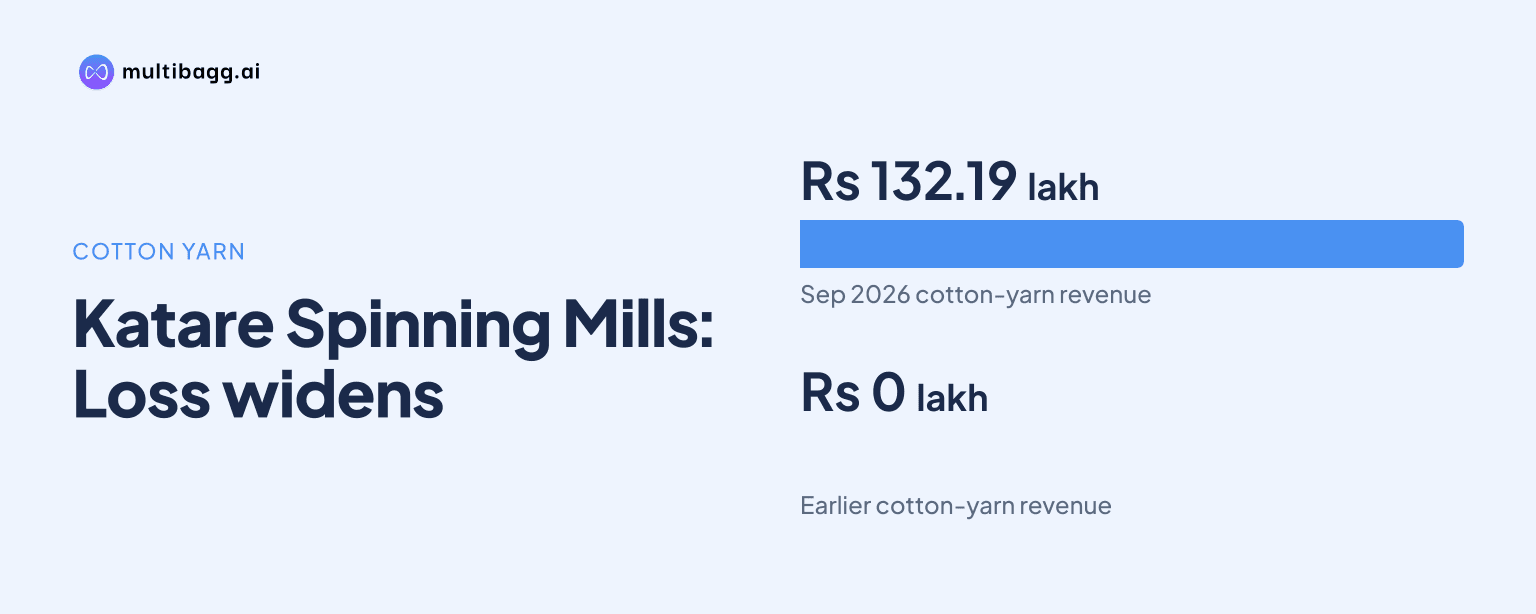
Katare Spinning Mills Limited recorded Rs 132.19 lakh of cotton-yarn revenue in the three months ended 30 September 2026, after Rs 0 a year earlier, but the segment loss widened to Rs 29.11 lakh from Rs 27.41 lakh. The unaudited segment statement shows sales returning without a profitable cotton-yarn result.
Know Katare Spinning Mills inside out
Results, valuation, peers and who's buying, in one view.
How did Katare Spinning Mills' cotton-yarn revenue change?
Katare Spinning Mills reported Rs 132.19 lakh of revenue from cotton-yarn manufacturing for the three months ended 30 September 2026, compared with Rs 0 in the corresponding quarter ended 30 September 2025. Total segment revenue rose to Rs 148.64 lakh from Rs 11.46 lakh over the same comparison, according to the unaudited segment disclosure.
Solar power generation contributed Rs 16.46 lakh of September-quarter revenue, up from Rs 11.46 lakh a year earlier. The filing identifies cotton-yarn manufacturing and solar power generation as Katare Spinning Mills' operating segments, with no unallocated revenue reported in either of the two quarterly periods.
For the six months ended 30 September 2026, cotton-yarn revenue was Rs 185.02 lakh and solar-generation revenue was Rs 38.02 lakh, producing total revenue of Rs 223.03 lakh. The comparison shown in the filing is the audited year ended 31 March 2026, when total revenue was Rs 278.59 lakh, including Rs 230.69 lakh from cotton yarn and Rs 47.90 lakh from solar generation, rather than a comparable six-month prior-year period.
Why did Katare Spinning Mills' cotton-yarn loss widen?
The filing does not state why the cotton-yarn loss widened. It reports a segment loss before interest and tax of Rs 29.11 lakh for the September 2026 quarter, compared with a Rs 27.41 lakh loss in the corresponding prior-year quarter, a widening of Rs 1.70 lakh despite the return of Rs 132.19 lakh in revenue.
This segment result is not the company's final profit or loss because it is measured before interest and tax. Katare Spinning Mills recorded a combined segment loss of Rs 28.83 lakh in the September 2026 quarter, compared with Rs 32.20 lakh a year earlier, as a Rs 28,000 solar segment profit partly offset the cotton-yarn loss.
Katare Spinning Mills reported a loss before tax of Rs 28.83 lakh for the three months ended 30 September 2026, narrower than the Rs 32.34 lakh loss before tax a year earlier. The filing shows Rs 0 interest and Rs 0 of other unallocable expenditure in the latest quarter, against Rs 14,000 of other unallocable expenditure in the September 2025 quarter.
Got a follow-up? Ask IRIS
How did solar power generation affect Katare Spinning Mills' results?
Solar power generation recorded a segment profit before interest and tax of Rs 28,000 in the three months ended 30 September 2026, compared with a segment loss of Rs 4.79 lakh in the corresponding quarter a year earlier. Revenue from the segment increased by Rs 5 lakh to Rs 16.46 lakh during that period.
The improvement in solar reduced the effect of the cotton-yarn loss on the combined segment result. The Rs 29.11 lakh cotton-yarn loss and Rs 28,000 solar profit resulted in the reported combined segment loss of Rs 28.83 lakh for the September 2026 quarter.
For the six months ended 30 September 2026, solar generation reported revenue of Rs 38.02 lakh and a segment profit of Rs 5.69 lakh. Cotton yarn reported Rs 185.02 lakh in revenue but a Rs 57.04 lakh segment loss over the same six-month period, so the solar profit offset only part of the cotton-yarn loss.
What do Katare Spinning Mills' six-month cash and balance-sheet figures show?
Katare Spinning Mills reported a loss before tax of Rs 51.61 lakh for the six months ended 30 September 2026, after a combined segment loss of Rs 51.35 lakh and Rs 26,000 of other unallocable expenditure. The company generated Rs 223.03 lakh of revenue over that six-month period, but the segment schedule provides no corresponding six-month result for the previous financial year.
Total standalone assets were Rs 117.80 crore at 30 September 2026, down from Rs 118.74 crore at 31 March 2026. Property, plant and equipment declined to Rs 112.32 crore from Rs 113.03 crore, while trade receivables fell to Rs 1.39 crore from Rs 1.58 crore and inventories remained Rs 82.69 lakh.
The cash-flow statement recorded net cash used in operating activities of Rs 33.40 lakh for the period ended 30 September 2026, compared with Rs 18.32 lakh for the year ended 31 March 2026. It reported cash and cash equivalents of Rs 2.55 lakh at period end, down from Rs 8 lakh at the beginning of the period.
The balance sheet separately lists cash and cash equivalents of Rs 46,000 at 30 September 2026, differing from the Rs 2.55 lakh closing balance in the cash-flow statement. The filing does not explain the difference, while the review report dated 12 November 2026 states that the reviewer performed a limited review and did not express an audit opinion.
Conclusion
Katare Spinning Mills returned to reported cotton-yarn sales in the September 2026 quarter, with Rs 132.19 lakh of revenue after none in the year-earlier period. Yet the cotton-yarn segment loss increased by Rs 1.70 lakh to Rs 29.11 lakh, while improved solar performance, including a Rs 28,000 segment profit, contributed to the narrower company-level loss before tax of Rs 28.83 lakh.
The unresolved matter to watch is the difference between the Rs 2.55 lakh closing cash-and-cash-equivalents figure in the cash-flow statement and the Rs 46,000 balance-sheet figure at 30 September 2026. The filing provides no reconciliation for those two reported amounts.