










Keerthi Industries halt leaves material going-concern uncertainty
Key highlights
- Keerthi Industries suspended manufacturing operations on 12 June 2026.
- Keerthi Industries reported a Rs 7.27 crore net loss for the quarter ended 30 September 2026.
- Current liabilities exceeded current assets by Rs 55.42 crore at 30 September 2026.
- Cash and cash equivalents fell to Rs 7,000 at 30 September 2026 from Rs 50.13 lakh at 31 March 2026.
powered by IRIS
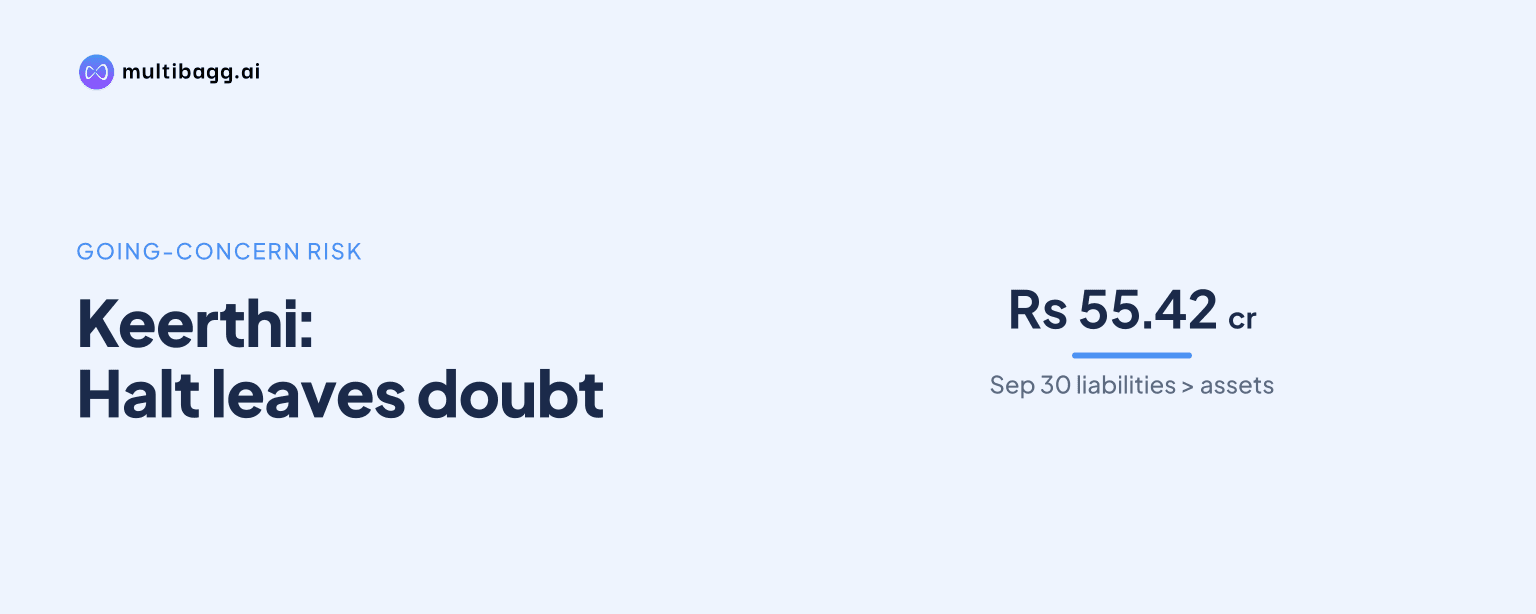
Keerthi Industries Limited suspended manufacturing on 12 June 2026 and reported a Rs 7.27 crore net loss for the September 2026 quarter, while current liabilities exceeded current assets by Rs 55.42 crore at 30 September. Its auditor said these conditions create material uncertainty that may cast significant doubt on Keerthi Industries' ability to continue as a going concern.
Know Keerthi Industries inside out
Results, valuation, peers and who's buying, in one view.
Why did Keerthi Industries suspend manufacturing?
Keerthi Industries suspended manufacturing operations from 12 June 2026 because of adverse market conditions and an unfavourable business environment. The company said it is monitoring market and business conditions and intends to recommence operations only when conditions improve and manufacturing becomes commercially viable.
The shutdown was reflected in the quarter ended 30 September 2026, when revenue from operations was nil, compared with Rs 19.11 crore in the preceding June 2026 quarter and Rs 22.48 crore a year earlier. September-quarter total income was Rs 46.30 lakh, entirely comprising other income rather than operating revenue.
Keerthi Industries continued to incur costs despite the absence of manufacturing revenue. Employee-benefit expense was Rs 2.61 crore, power and fuel expense was Rs 1.77 crore, and depreciation and amortisation was Rs 1.70 crore in the September quarter, contributing to total expenses of Rs 7.74 crore.
What did the auditor find about Keerthi Industries' going concern?
Brahmayya & Co. said Keerthi Industries' losses in the half year ended 30 September 2026, the Rs 55.42 crore excess of current liabilities over current assets, and delayed payments to certain overdue creditors create material uncertainty related to going concern. The auditor said those conditions may cast significant doubt on Keerthi Industries' ability to continue as a going concern.
The auditor did not modify its limited-review conclusion on the unaudited September-quarter and half-year results issued on 14 November 2026. It said the accounts were prepared on a going-concern basis and no adjustments had been made to carrying values, including potential impairment adjustments, or to asset and liability classifications.
The report also included an emphasis-of-matter paragraph on the manufacturing suspension effective 12 June 2026, without modifying the conclusion on that matter. This means the auditor did not identify a material misstatement in the results, while separately highlighting uncertainty about continued operations and the basis on which the accounts were prepared.
How did Keerthi Industries' losses and cash flow change?
Keerthi Industries' net loss widened to Rs 14.41 crore for the half year ended 30 September 2026 from Rs 7.82 crore in the corresponding 2025 period. The current half-year loss came entirely from continuing operations, whereas the prior-year comparison included Rs 33.06 lakh of profit from discontinued operations.
The September-quarter net loss of Rs 7.27 crore was Rs 12.35 lakh higher than the Rs 7.14 crore loss in the June 2026 quarter and Rs 1.83 crore above the Rs 5.43 crore loss reported a year earlier. Basic and diluted loss per equity share was Rs 9.06 for the September 2026 quarter, compared with Rs 8.91 in the preceding quarter.
Net cash used in operating activities was Rs 7.36 crore for the half year ended 30 September 2026, against net cash generated from operating activities of Rs 3.57 crore in the corresponding 2025 half year. Operating profit before working-capital changes deteriorated to a negative Rs 9.52 crore from a negative Rs 2.38 crore a year earlier.
Financing activities generated Rs 6.49 crore during the 2026 half year, compared with an outflow of Rs 2.09 crore in the prior-year period. Net proceeds from long-term loans and borrowings were Rs 8.22 crore, but cash and cash equivalents still fell from Rs 50.13 lakh at 31 March 2026 to Rs 7,000 at 30 September 2026.
Got a follow-up? Ask IRIS
What do Keerthi Industries' balance sheet and funding plans show?
Keerthi Industries reported total assets of Rs 116.01 crore at 30 September 2026, down from Rs 126.30 crore at 31 March 2026. Property, plant and equipment declined to Rs 78.65 crore from Rs 81.98 crore, while inventories declined to Rs 7.37 crore from Rs 10.98 crore.
Non-current borrowings increased to Rs 31 crore at 30 September 2026 from Rs 22.73 crore at the March 2026 year-end. Trade payables due to creditors other than micro and small enterprises rose to Rs 44.38 crore from Rs 43.50 crore, while dues to micro and small enterprises increased to Rs 4.36 crore from Rs 3.02 crore.
Management said losses were temporary and attributed them principally to lower operating volumes, industry conditions and related factors. It cited revenue-enhancement and cost-control measures, monetisation of non-core assets including sugar land, and discussions with financial institutions and other lenders as measures intended to improve working capital and future cash flows.
Keerthi Industries also sold its Electronic Division as a going concern through a slump sale in financial year 2025-26 for Rs 36 crore. The company recorded an exceptional gain of Rs 8.22 crore on disposal of assets and liabilities, and now manages and monitors operations as a single Cement Division segment.
What funding has Keerthi Industries approved?
The board approved unsecured borrowing of up to Rs 11 crore from Managing Director J.S. Rao and up to Rs 11 crore from Chairperson and Whole-Time Director Triveni Jasti on 14 November 2026. Together, the approvals permit up to Rs 22 crore of unsecured funding from the two directors.
The announcement does not say that either facility had been drawn by 30 September 2026, when cash and cash equivalents were Rs 7,000. Management said it expects improved working capital, continued operations and projected cash flows to support its ability to meet obligations as they fall due, alongside potential lender funding and asset monetisation.
The same 14 November board meeting accepted the resignation of Company Secretary and Compliance Officer Anupama Iyer, effective at the close of business that day. It also accepted Chief Financial Officer P.V. Subba Rao's resignation, with the final effective cessation date to be disclosed separately, while Managing Director Seshagiri Rao Jasti was named interim compliance officer.
Conclusion
Keerthi Industries' September filing brings together a manufacturing shutdown from 12 June 2026, nil operating revenue in the September quarter, a Rs 14.41 crore half-year loss and a Rs 55.42 crore current-liability deficit. The auditor's unmodified limited-review conclusion does not remove the separate material uncertainty it identified over the company's ability to continue as a going concern.
The next operating trigger disclosed by Keerthi Industries is a manufacturing restart once market conditions improve and operations are commercially viable, with no date provided. The key disclosed matters to watch are whether the up-to-Rs 22 crore unsecured loan approvals are used, whether asset monetisation or lender discussions produce funding, and whether cash improves from the Rs 7,000 reported at 30 September 2026.