










Kenvi Jewels revenue and profit fall 60% in September quarter
Key highlights
- Kenvi Jewels' September 2026 revenue from operations fell 60.29% year on year to Rs 18.22 crore.
- September-quarter profit after tax declined 60.18% year on year to Rs 14.70 lakh, but the company remained profitable.
- First-half revenue fell 51.44% to Rs 37.28 crore, while profit after tax declined to Rs 46.50 lakh from Rs 55.63 lakh.
- Net cash used in operating activities was Rs 2.55 crore in the first half, while current borrowings rose to Rs 17.25 crore at 30 September 2026.
powered by IRIS
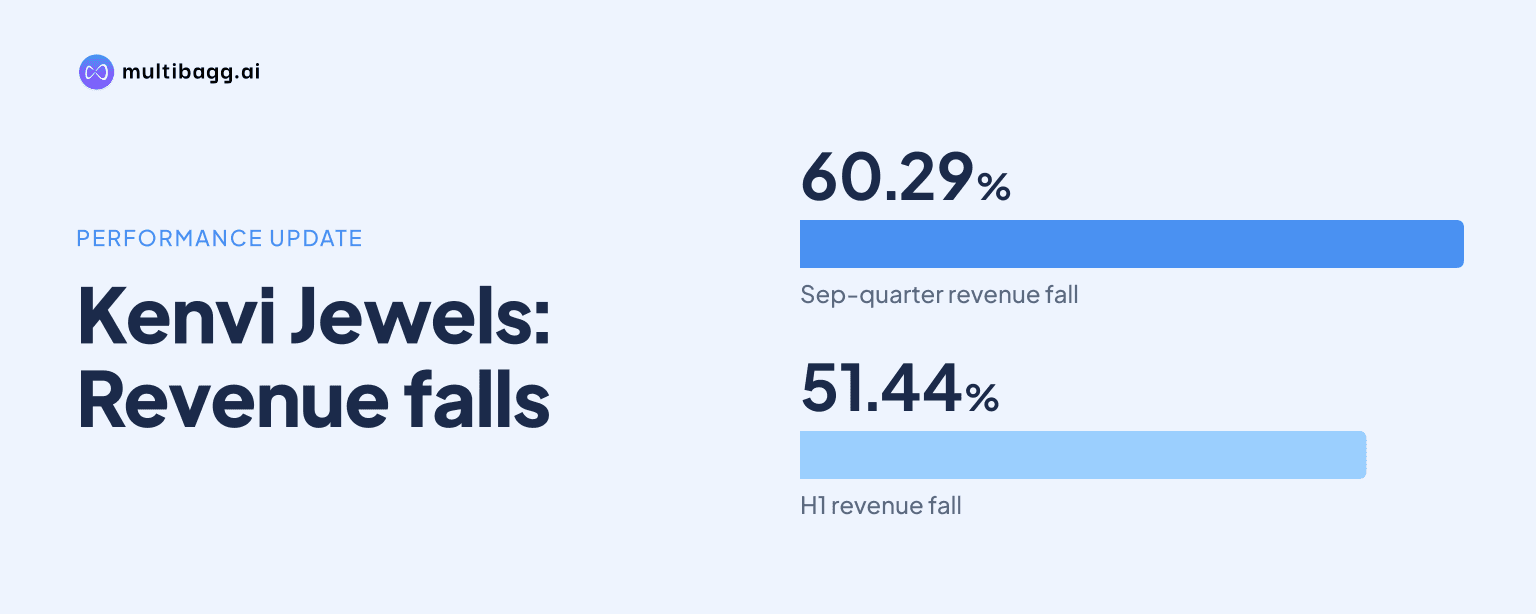
Kenvi Jewels Limited reported revenue from operations of Rs 18.22 crore for the quarter ended 30 September 2026, down 60.29% from Rs 45.88 crore a year earlier. Profit after tax fell 60.18% to Rs 14.70 lakh from Rs 36.92 lakh, although Kenvi Jewels remained profitable during the quarter.
Know Kenvi Jewels inside out
Results, valuation, peers and who's buying, in one view.
Why did Kenvi Jewels' September-quarter revenue fall?
Kenvi Jewels' revenue from operations fell to Rs 18.22 crore in the quarter ended 30 September 2026 from Rs 45.88 crore in the quarter ended 30 September 2025. The Rs 27.66 crore reduction also drove the change in total income because Kenvi Jewels recorded no other income in the latest quarter, against Rs 0.03 lakh a year earlier.
The latest quarter was also lower than the immediately preceding quarter. Revenue was Rs 19.06 crore in the quarter ended 30 June 2026, making September-quarter revenue Rs 0.84 crore, or 4.43%, lower sequentially. Total income followed the same direction, declining from Rs 19.06 crore in June to Rs 18.22 crore in September.
How did Kenvi Jewels' profit change in the September quarter?
Kenvi Jewels reported profit after tax of Rs 14.70 lakh for the September 2026 quarter, compared with Rs 36.92 lakh in the corresponding quarter of 2025. Profit before tax declined to Rs 19.09 lakh from Rs 45.92 lakh, while current tax expense was Rs 4.39 lakh, compared with Rs 9 lakh a year earlier.
Profit was also below the June 2026 quarter, when Kenvi Jewels reported profit after tax of Rs 31.81 lakh and profit before tax of Rs 37.42 lakh. Basic and diluted earnings per share were Rs 0.01 for September 2026, compared with Rs 0.03 in both the June 2026 quarter and the September 2025 quarter.
Kenvi Jewels reported no exceptional items and no profit or loss from discontinued operations in the quarter ended 30 September 2026. Total comprehensive income therefore matched profit after tax at Rs 14.70 lakh, compared with Rs 36.92 lakh in the year-earlier quarter.
What happened to Kenvi Jewels' costs and profit before tax?
Kenvi Jewels' total expenses fell to Rs 18.03 crore in the September 2026 quarter from Rs 45.42 crore in the September 2025 quarter. The decline in expenses broadly tracked the reduction in revenue, leaving profit before tax at Rs 19.09 lakh on total income of Rs 18.22 crore.
Cost of materials consumed was Rs 20.35 crore in the latest quarter, compared with Rs 47.86 crore a year earlier. That cost was partly offset by a Rs 3 crore reduction in inventories of finished goods, work in progress and stock in trade, compared with a Rs 3.10 crore inventory reduction in the year-earlier quarter.
Employee benefit expense increased to Rs 21.25 lakh from Rs 12.69 lakh despite lower revenue, while finance costs rose to Rs 17.48 lakh from Rs 16.63 lakh. Other expenses declined to Rs 28.95 lakh from Rs 37.65 lakh, and the filing identifies Kenvi Jewels as operating in a single primary business segment without a segment-level revenue or profit split.
Got a follow-up? Ask IRIS
How did Kenvi Jewels perform in the first half?
Kenvi Jewels reported revenue from operations of Rs 37.28 crore for the half year ended 30 September 2026, down 51.44% from Rs 76.77 crore in the half year ended 30 September 2025. Total income was also Rs 37.28 crore because no other income was recorded, compared with Rs 0.06 lakh in the prior-year half.
First-half profit after tax was Rs 46.50 lakh, compared with Rs 55.63 lakh a year earlier, while profit before tax was Rs 56.50 lakh against Rs 70.63 lakh. Current tax expense declined to Rs 10 lakh from Rs 15 lakh across the two half-year periods.
The June 2026 quarter supplied Rs 31.81 lakh of profit after tax, more than twice the Rs 14.70 lakh reported for the September quarter. For the full year ended 31 March 2026, Kenvi Jewels reported revenue from operations of Rs 179.13 crore and profit after tax of Rs 86.81 lakh.
What do Kenvi Jewels' balance sheet and cash flows show?
Kenvi Jewels' total assets were Rs 33.95 crore at 30 September 2026, compared with Rs 30.85 crore at 31 March 2026. Inventories rose to Rs 25.99 crore from Rs 24.75 crore, trade receivables increased to Rs 5.15 crore from Rs 3.42 crore, and cash and cash equivalents rose to Rs 1.51 crore from Rs 1.28 crore.
Current borrowings increased to Rs 17.25 crore at 30 September 2026 from Rs 14.01 crore at 31 March 2026. Total equity was Rs 16.39 crore, including paid-up equity share capital of Rs 12.64 crore and other equity of Rs 3.76 crore, while the balance sheet reported no non-current liabilities at either reporting date.
Net cash used in operating activities was Rs 2.55 crore for the half year ended 30 September 2026, compared with Rs 4.57 crore used in the previous-year half. Financing activities generated Rs 2.81 crore, including a Rs 3.24 crore increase in short-term borrowings, resulting in a Rs 23.40 lakh increase in cash and cash equivalents.
Conclusion
Kenvi Jewels remained profitable in the September 2026 quarter, but revenue fell 60.29% year on year and profit after tax declined 60.18%. The first-half figures also showed lower sales and earnings, while inventories, receivables and current borrowings increased from their levels at 31 March 2026.
The 30 October 2026 filing does not disclose a revenue target, expansion plan or outlook. The unresolved issues for the next reported results are whether revenue recovers from Rs 18.22 crore in the September quarter and whether operating cash outflow, at Rs 2.55 crore for the half year, changes alongside inventory, receivable and borrowing levels.