










Kings Infra says its aquaculture park is technically ready
Key highlights
- Kings Infra said on 13 November 2026 that its aquaculture park DPR is technically ready.
- The proposed RAS model is expected to deliver approximately four to five times higher productivity and four to six annual cycles, versus two conventional cycles.
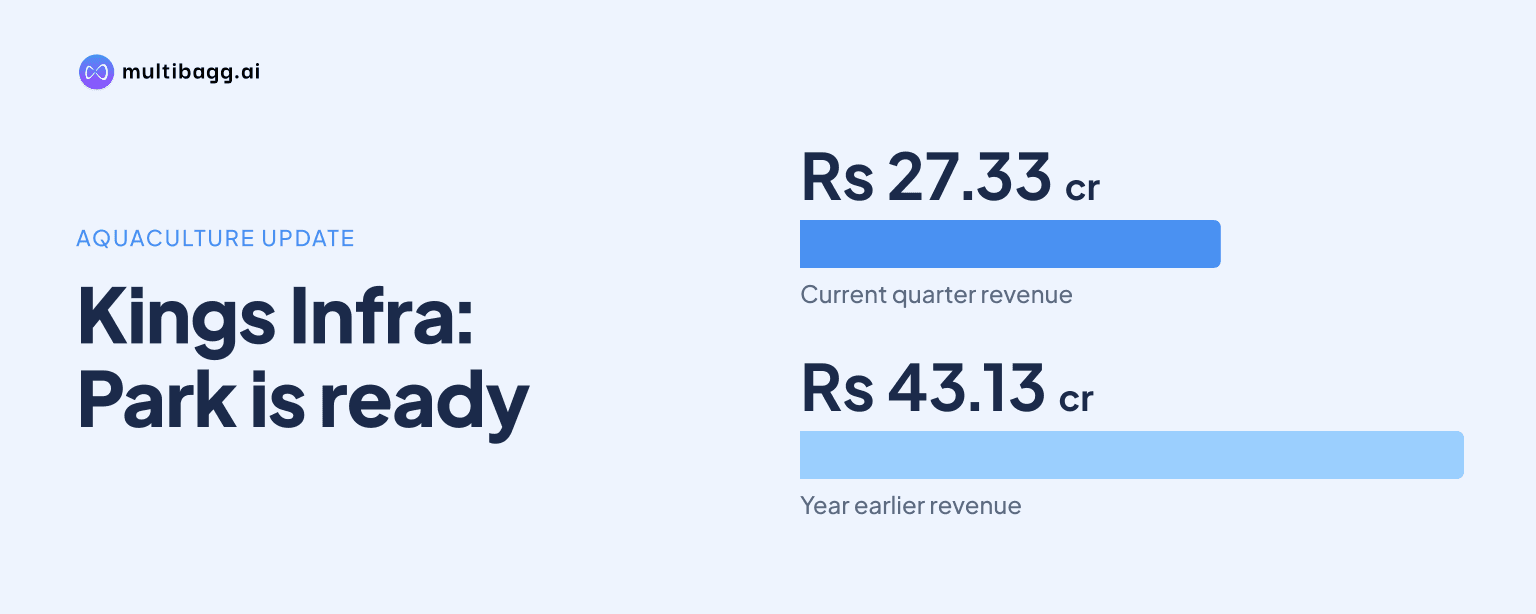
- Kings Infra reported standalone revenue from operations of Rs 27.33 crore for the quarter ended 30 September 2026, versus Rs 43.13 crore a year earlier.
- The project requires governmental approvals before its planned commercial-scale demonstration phase can begin.
powered by IRIS
Kings Infra Ventures Limited said on 13 November 2026 that the detailed project report for its proposed integrated aquaculture technology park is technically ready, with a state-government memorandum of understanding expected shortly; the proposed tank-based system is projected to deliver roughly four to five times the productivity of conventional farming.
Know Kings Infra Ventures inside out
Results, valuation, peers and who's buying, in one view.
What has Kings Infra said about the proposed aquaculture park?
Kings Infra said its proposed integrated aquaculture technology park has reached technical readiness because the detailed project report, or DPR, has been prepared. The Board received this update at its meeting on 13 November 2026, when the Chairman and Managing Director also said the park would be established on land already owned by Kings Infra.
Kings Infra said it had recently discussed the proposal with relevant state-government authorities, who received it well, and that a memorandum of understanding, or MoU, with the state government is expected shortly. The filing did not specify an MoU signing date, project cost, land area, capacity, financing arrangement or start date as of 13 November 2026.
The use of company-owned land means Kings Infra does not require additional land allocation or acquisition assistance for the project. That feature does not remove the stated need for governmental approvals before the company begins its planned commercial-scale demonstration phase.
How would the proposed RAS model differ from conventional farming?
Kings Infra proposes a gradual shift from earthen pond aquaculture to tank-based Recirculating Aquaculture System, or RAS, technology. The company said the RAS model is expected to reduce land and water requirements while enabling approximately four to five times higher productivity and four to six production cycles annually, compared with two cycles in conventional farming.
The proposed change is not described as an immediate replacement of all conventional ponds. Kings Infra said the technology would be adapted to Indian conditions with support from overseas technology providers, with discussions still under way to obtain the necessary technology rather than a completed provider agreement disclosed on 13 November 2026.
RAS is central to the proposed park because each tank would operate as an independent park unit. Kings Infra said these units could be used by entrepreneurs and investors, creating a participation model alongside the company’s own development and operation of RAS facilities, subject to the necessary approvals.
Which facilities and partnerships does Kings Infra plan?
Kings Infra proposes to develop RAS facilities, a nursery, hatchery, feed mill, marine biorefinery, processing plant and related infrastructure after receiving governmental approvals. The nursery is intended to maintain a regular supply of quality seed, while the hatchery and feed mill would form part of the wider aquaculture production chain set out in the 13 November 2026 announcement.
The company said these components are intended to be developed and operated in collaboration with international partners. It did not identify any partner, assign investment values to the hatchery, feed mill, biorefinery or processing plant, or state whether any binding agreement had been signed, leaving the planned collaboration conditional on approvals and partnership arrangements.
Kings Infra also said the technical expertise developed through the project may be offered as project development and management consultancy. The company disclosed that it had already received enquiries from overseas companies for this work, but gave no number of enquiries, customer names, contract value or timetable for converting those enquiries into consultancy revenue.
Got a follow-up? Ask IRIS
What do Kings Infra’s latest standalone results show?
Kings Infra’s unaudited standalone revenue from operations for the quarter ended 30 September 2026 was Rs 27.33 crore, down from Rs 30.45 crore in the preceding quarter and Rs 43.13 crore a year earlier. Profit before tax was Rs 3.27 crore, compared with Rs 3.09 crore in the June 2026 quarter and Rs 5.01 crore in the September 2025 quarter.
For the half year ended 30 September 2026, standalone revenue from operations was Rs 57.78 crore, versus Rs 77.26 crore in the comparable prior-year half. Profit before tax declined to Rs 6.36 crore from Rs 10.92 crore, while finance costs increased to Rs 3.87 crore from Rs 3.47 crore, according to the unaudited statement reviewed by the independent auditor.
The proposed park’s technology and facility plan was disclosed alongside these results, but Kings Infra did not quantify any expected revenue, expense, capital expenditure or profit contribution from the RAS project. The reported September 2026 financial figures therefore do not establish a financial forecast for the park.
What approvals and milestones remain before expansion?
Governmental approvals remain the stated prerequisite for Kings Infra’s next implementation steps. Although the DPR is technically ready and the proposed state MoU is expected shortly, the company said the project will initially commence with a commercial-scale demonstration phase only subject to governmental approvals.
Kings Infra plans for the demonstration phase to show the technology under Indian conditions before a broader rollout. Upon successful implementation, the company said the remaining area would be expanded through strategic partnerships with established commercial participants; it did not define success measures, identify those participants or give a date for expansion beyond the initial demonstration.
The sequence disclosed on 13 November 2026 is a potential state MoU, governmental approvals, a commercial-scale demonstration, and then expansion through partnerships. Overseas technology-provider discussions and adaptation of RAS technology to Indian conditions are parallel unresolved workstreams within that sequence.
Conclusion
Kings Infra has set out a technically prepared but still conditional aquaculture expansion plan: a company-owned-land park based on RAS tanks, supported by a nursery, hatchery, feed mill, marine biorefinery and processing plant. Its operating proposition is four to five times the productivity and four to six annual production cycles projected for RAS, versus two cycles for conventional farming.
The next disclosed milestones are the expected state-government MoU and the governmental approvals required to begin the commercial-scale demonstration phase. Further disclosures on international technology partners, strategic commercial participants, project cost, capacity and the result of the demonstration would clarify whether the remaining area proceeds to expansion.