










Kirloskar Electric posts ₹5.99 crore Q1 loss as revenue falls 21%
Key highlights
- Kirloskar Electric reported a ₹5.99 crore standalone net loss in Q1 FY27, versus a ₹0.42 crore profit in Q1 FY26.
- Q1 FY27 net sales turnover fell 21.5% year-on-year to ₹103.85 crore from ₹132.24 crore.
- Total income was ₹104.53 crore while expenditure was ₹110.48 crore in Q1 FY27.
- Kirloskar Electric's board is scheduled to consider Q2 FY27 and half-year results on November 6, 2026.
powered by IRIS
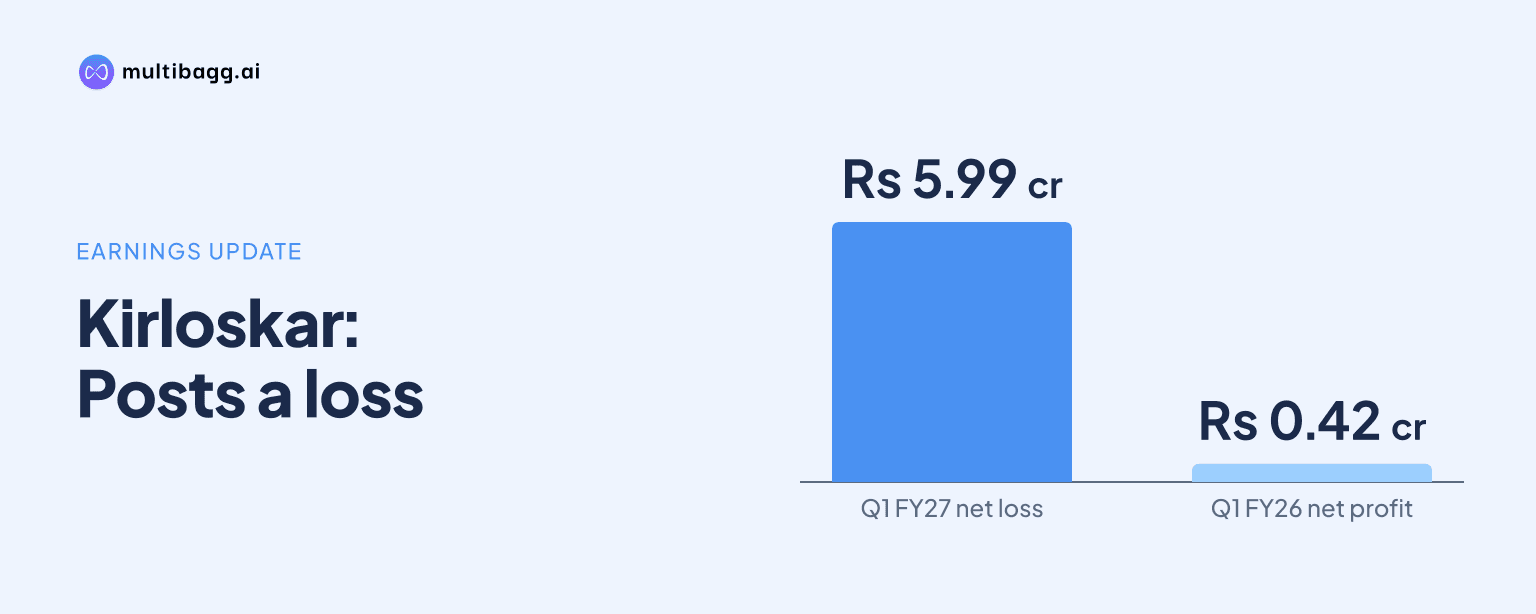
Kirloskar Electric Company Limited reported a standalone net loss of ₹5.99 crore in Q1 FY27, compared with a ₹0.42 crore profit a year earlier, as revenue fell 21.5% year-on-year to ₹103.85 crore amid deferred dispatches. The result marked a sharp reversal from the preceding quarter and brought net margin to negative 5.8% of sales.
Know Kirloskar Electric Company inside out
Results, valuation, peers and who's buying, in one view.
What did Kirloskar Electric report for Q1 FY27?
Kirloskar Electric reported total income of ₹104.53 crore for the June 2026 quarter, down from ₹133.20 crore in Q1 FY26 and ₹164.38 crore in Q4 FY26. Net sales turnover was ₹103.85 crore, against ₹132.24 crore a year earlier. The company recorded a loss before tax of about ₹6 crore and a net loss of ₹5.99 crore.
The reported loss followed a ₹0.42 crore profit in the corresponding quarter of the previous financial year. It also widened from a ₹0.63 crore loss in Q4 FY26. The quarterly financial data describes the Q1 FY27 performance as standalone, which means the figures relate to the company rather than a consolidated group result.
Expenses were ₹110.48 crore in Q1 FY27, compared with ₹132.55 crore in Q1 FY26 and ₹164.92 crore in Q4 FY26. Although expenditure declined from both comparison periods, the reduction did not match the fall in income on a margin basis. Operating profit was negative ₹0.37 crore, while EBITDA was ₹0.31 crore.
Why did revenue and profit decline in the June quarter?
Kirloskar Electric attributed the revenue decline to deferred dispatches, which affected billing in the June quarter. The fall in reported revenue was 21.5% year-on-year and 36.4% sequentially, based on total income of ₹104.53 crore. Revenue was ₹103.85 crore when measured as net sales turnover.
The lower billing level had a direct effect on profitability. Total income of ₹104.53 crore was below expenditure of ₹110.48 crore, producing a pre-tax loss of roughly ₹6 crore. Tax expense was ₹4 lakh, and the company consequently reported a ₹5.99 crore net loss for the quarter.
Management has indicated that billing is expected to normalise through the year. That statement provides the company’s reported operating context, but the available information does not provide a numerical revenue or profit forecast for later FY27 quarters. Investors therefore have no verified company guidance figure against which to assess the expected normalisation.
How does Q1 FY27 compare with recent quarters?
Kirloskar Electric’s Q1 FY27 revenue was the lowest level in the eight-quarter series provided, following a stronger March 2026 quarter. Total income had risen from ₹133.20 crore in Q1 FY26 to ₹164.38 crore in Q4 FY26 before declining to ₹104.53 crore in the latest quarter.
Profitability was also uneven across the period. The company reported net profit of ₹12.19 crore in Q4 FY26 after ₹9.98 crore in Q3 FY26, but moved back into a loss in Q1 FY27. This movement shows that the latest result was not only weaker than the year-earlier quarter but also a substantial sequential deterioration.
Got a follow-up? Ask IRIS
What does the quarterly loss mean for investors and operations?
The Q1 FY27 result shows that lower dispatch-linked billing had a material impact on Kirloskar Electric’s operating leverage. Revenue fell faster than expenditure on a year-on-year basis, with income down 21.5% and expenses down 16.6%. This gap contributed to the move from a small profit in Q1 FY26 to a loss in the latest quarter.
For investors, the immediate financial markers are the negative operating profit, the ₹5.99 crore net loss, and the decline from the ₹12.19 crore profit reported in Q4 FY26. The available data does not establish whether the deferred dispatches were recovered after the quarter, so the next reported results will be important for assessing the timing of billing and margin recovery.
The company’s financial position has also seen a separate banking development. Its board approved closure of the Master Restructuring Agreement dated June 30, 2015 with Bank of India and consortium banks, stating that the exit had no negative impact on the company. The board also approved a ₹50 crore overdraft facility. These decisions are distinct from the Q1 profit and loss account but are relevant to the company’s financing arrangements.
When will Kirloskar Electric report the next quarterly results?
Kirloskar Electric has said that its board will convene on November 6, 2026, to consider and approve Ind-AS compliant unaudited financial results for the quarter and half-year ended September 30, 2026. The September quarter, or Q2 FY27, follows the June-quarter loss and will provide the next reported update on billing and profitability.
The September 2025 comparison base was revenue of ₹142.11 crore and net profit of ₹9.98 crore. No verified analyst estimate for Q2 FY27 revenue or profit was included in the available information. The company had earlier stated that the trading-window closure would remain effective until 48 hours after declaration of the unaudited results.
Conclusion
Kirloskar Electric’s Q1 FY27 result reflects a marked decline in reported billing, with revenue falling to ₹103.85 crore and the company posting a ₹5.99 crore loss. While expenses also declined, they remained above total income, leading to a negative operating outcome and a negative 5.8% net margin.
The next item to watch is the board’s November 6, 2026 consideration of Q2 FY27 and half-year results. Investors will be able to compare that update with the September 2025 base of ₹142.11 crore revenue and ₹9.98 crore profit, and assess the company’s stated expectation that billing will normalise through the year.