










KMEW holds ₹928.72 crore in 15-year green-tug contracts
Key highlights
- KMEW’s three 15-year green-tug contracts have a combined disclosed value of ₹928.72 crore.
- Major ports have identified demand for about 98 green tugs, while 8 green-tug contracts are commissioned.
- Phase IV in 2034-36 has the highest listed demand at 29 tugs.
- KMEW reports 10 electric-ferry orders valued at ₹62 crore.
powered by IRIS
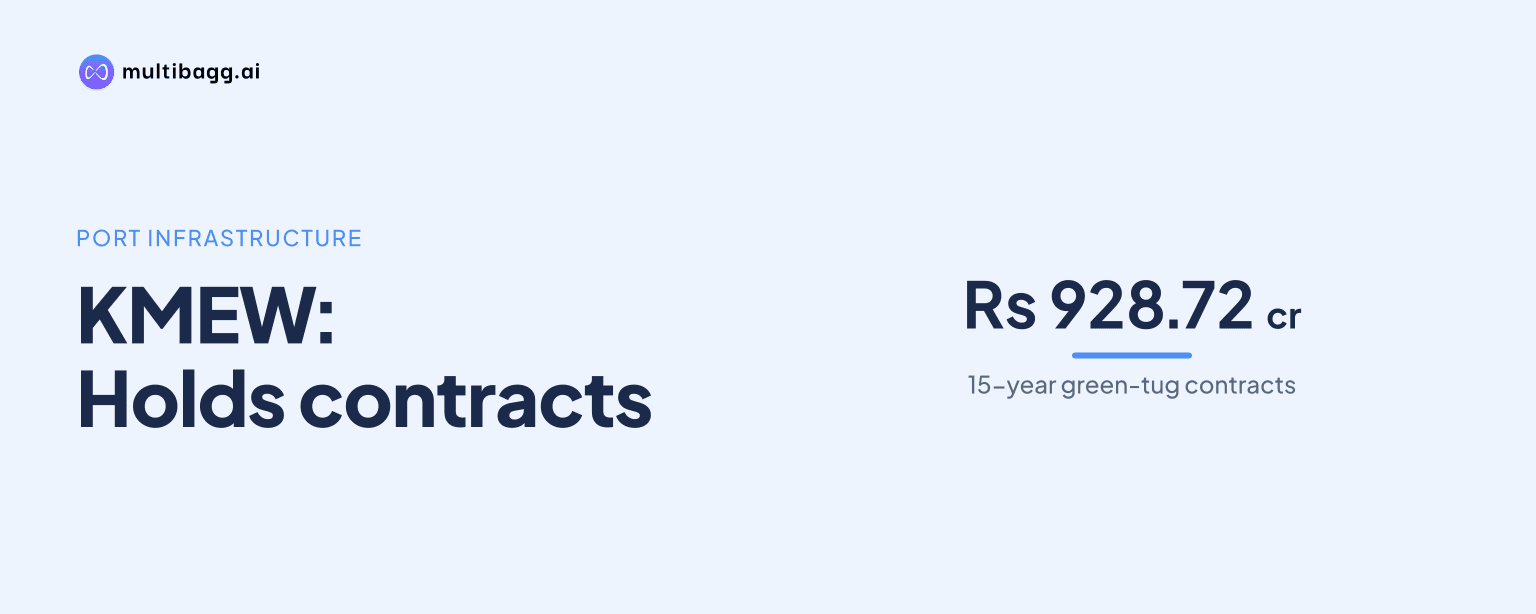
Knowledge Marine & Engineering Works Limited holds three 15-year green-tug contracts valued at a combined ₹928.72 crore, as major Indian ports have identified demand for about 98 green tugs through 2040. The presentation lists eight green-tug contracts as commissioned, placing KMEW’s three disclosed contracts within the early deployment stage of the national transition programme.
Know Knowledge Marine & Engineering Works inside out
Results, valuation, peers and who's buying, in one view.
What green-tug contracts has KMEW secured?
KMEW has secured three 15-year green-tug contracts worth ₹928.72 crore in aggregate. Its maiden contract with V.O. Chidambaranar Port Authority (VOCPA) is valued at ₹367 crore, its second contract with Visakhapatnam Port Authority (VPA) is valued at ₹325 crore, and its third contract with Mumbai Port Authority, listed as MbPT in the presentation, is valued at ₹236.72 crore.
The VOCPA agreement is KMEW’s largest disclosed green-tug contract at ₹367 crore, exceeding the Mumbai contract by ₹130.28 crore. The VOCPA and VPA contracts together total ₹692 crore, while the Mumbai contract accounts for ₹236.72 crore. The presentation does not disclose the number of tugs, delivery timetable, vessel specifications or propulsion system under each individual agreement.
How much green-tug demand have major ports identified?
Major ports have identified demand for about 98 green tugs across 12 port entries, compared with eight green-tug contracts commissioned. This indicates that the commissioned-contract count remains below the identified requirement, although KMEW does not state how many vessels are covered by each of the eight contracts.
Deendayal Port Authority has the largest listed requirement at 19 tugs, followed by Syama Prasad Mookerjee Port Authority and Haldia Dock Complex at 18 tugs and Jawaharlal Nehru Port Authority at 12 tugs. Paradip Port Authority requires eight tugs, Mumbai Port Authority seven and VPA six, showing that the planned requirement is distributed across the major-port network.
KMEW’s three contract locations are included in the demand schedule. VOCPA is listed for four tugs, VPA for six and Mumbai Port Authority for seven, making a combined requirement of 17 tugs at the three locations. The presentation does not link that 17-tug requirement to the number of vessels awarded under KMEW’s contracts.
When is the 98-tug programme scheduled to be deployed?
The highest planned demand is 29 tugs in Phase IV, covering 2034-36, followed by 28 tugs in Phase III, covering 2031-33. Phase I for 2024-27 lists 15 tugs, Phase II for 2028-30 lists 10, and Phase V for 2037-40 lists 16, for a total of 98 tugs.
The demand schedule is weighted towards the programme’s middle years. The 57 tugs listed for Phases III and IV exceed the 25 tugs listed across Phases I and II, while Phase IV alone has 19 more tugs than Phase II. KMEW’s 15-year contract tenures could span multiple phases, but the presentation provides no contract-specific construction or deployment dates.
Got a follow-up? Ask IRIS
What does the Green Tug Transition Programme require from ports?
The Green Tug Transition Programme begins with a 2024-27 pilot and proof-of-concept phase covering four major ports, with two tugs deployed at each port. The programme was launched on 22 May 2023 under the Amrit Kaal Vision to support cleaner maritime operations.
Phase II, scheduled for 2028-30, calls for the programme to scale to all major ports and for 30% of the operational tug fleet to become programme-compliant. The stated target rises to 60% in Phase III during 2031-33 and to 100% of the operational fleet at ports under the Ministry of Ports, Shipping and Waterways in Phase IV during 2034-36.
Phase V, covering 2037-40, calls for action plans for all ports in India and a 100% transition of the operational tug fleet to programme-compliant tugs. The 98-tug demand schedule cited by KMEW is sourced to a Ministry of Ports, Shipping and Waterways review meeting dated 11 May 2026, and covers 12 major-port entries rather than all Indian ports.
How does KMEW’s green-vessel work extend beyond tugs?
KMEW also reports a portfolio of 10 electric ferries with an order value of ₹62 crore. The company says its subsidiary, Knowledge Shipyard Limited (KSL), will build the ferries in-house at the Saphale shipyard alongside its green tugs.
The electric ferries are presented in connection with the Harit Nauka initiative, a centrally sponsored scheme with an estimated outlay of ₹14,920 crore. The initiative targets 15,000 inland vessels operating on green fuels, passenger traffic of 16 crore, annual carbon-dioxide reductions of about 10 lakh tonnes and fuel-cost savings of about ₹2,900 crore a year. These are initiative-level targets, not KMEW forecasts.
The presentation also cites shipbuilding financial-assistance rates of 14% for conventional vessels, 20% for fully electric or hybrid-propulsion vessels and 30% for vessels built with alternative fuels. Assistance is released 30% at keel laying, 40% at launching and 30% at delivery, but KMEW does not state whether its green-tug or electric-ferry contracts qualify for assistance.
Conclusion
KMEW has disclosed ₹928.72 crore of value across three 15-year green-tug contracts while major ports have identified about 98 tugs of demand through 2040 and eight contracts have been commissioned. The company’s contract locations, VOCPA, VPA and Mumbai Port Authority, have a combined listed requirement of 17 tugs, though the source does not disclose KMEW’s vessel allocation at those ports.
The next milestone to watch is the programme’s phased rollout, with demand rising from 15 tugs in Phase I during 2024-27 to 28 in Phase III and 29 in Phase IV. KMEW also plans in-house construction of 10 electric ferries at Saphale through KSL, while delivery dates, tug specifications and financial-assistance eligibility remain undisclosed.