










Kody Technolab Reports ₹13.44 Crore H1 FY27 Net Profit
Key highlights
- Kody Technolab reported H1 FY27 revenue from operations of ₹65.41 crore in its detailed standalone filing.
- Kody Technolab reported unaudited H1 FY27 net profit of ₹13.44 crore and profit before tax of ₹18.05 crore.
- Kody Technolab's total income was ₹68.27 crore, while total expenses were ₹50.22 crore for the six months ended September 30, 2026.
- Kody Technolab's Board approved the results on November 2, 2026, and statutory auditors issued an unmodified limited-review opinion.
powered by IRIS
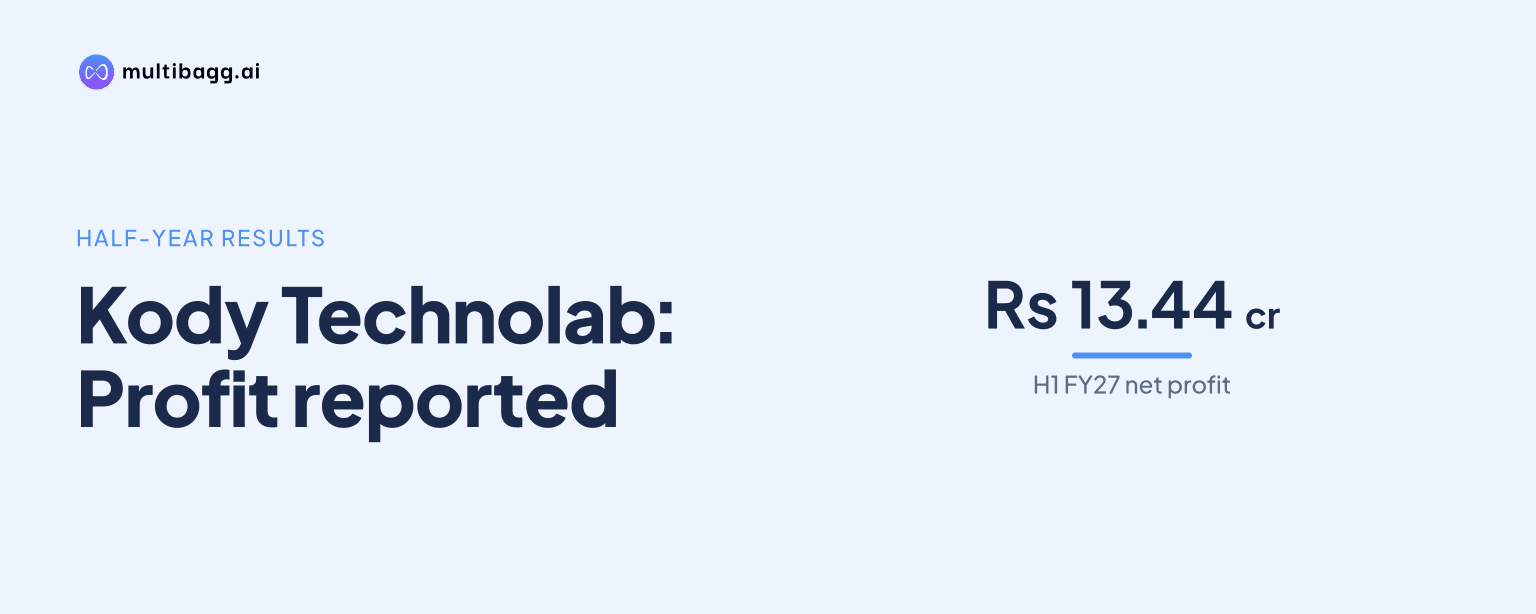
For the six months ended September 30, 2026, Kody Technolab Limited reported unaudited standalone net profit of ₹13.44 crore, with revenue from operations of ₹65.41 crore. The result matters because the detailed exchange filing presents materially different figures from the ₹5.2 crore profit and ₹62.5 crore revenue figures stated in the supplied results summary.
Know Kody Technolab inside out
Results, valuation, peers and who's buying, in one view.
What did Kody Technolab report for H1 FY27?
Kody Technolab reported total income of ₹68.27 crore for the half year ended September 30, 2026, comprising ₹65.41 crore of revenue from operations and ₹2.86 crore of other income. The company reported total expenses of ₹50.22 crore, resulting in profit before tax of ₹18.05 crore.
Net profit for the period stood at ₹13.44 crore. The filing records paid-up equity share capital of ₹14.42 crore. It identifies the financial statements as standalone and unaudited, covering the reporting period from April 1, 2026 to September 30, 2026.
The reported figures were filed with the exchange on November 2, 2026. The half-yearly format means that the numbers cover six months rather than a single July-September quarter, an important distinction for investors comparing the data with quarterly results.
How were Kody Technolab's H1 FY27 results approved and reviewed?
Kody Technolab's H1 FY27 results were reviewed by its Audit Committee and approved by the Board of Directors on November 2, 2026. The company disclosed this in the textual notes accompanying its financial-results submission to the exchange.
The company also said its statutory auditors had carried out a limited review of the unaudited financial results. According to the filing, the auditors expressed an unmodified opinion on the results. An unmodified opinion indicates that the auditors did not report a qualification to the financial information reviewed, based on the scope of that review.
The filing classifies the report as standalone. Therefore, the numbers reflect the reporting entity stated in the filing and should not be treated as consolidated group figures. Investors comparing these results with third-party databases should confirm whether those platforms use the same standalone basis and half-year reporting period.
Got a follow-up? Ask IRIS
What do Kody Technolab's costs and profitability figures show?
Kody Technolab's H1 FY27 filing shows total expenses of ₹50.22 crore against total income of ₹68.27 crore. Cost of materials consumed was ₹30.59 crore, making it the largest disclosed expense item in the supplied filing extract.
The difference between total income and total expenses was ₹18.05 crore, which is also reported as profit before exceptional and extraordinary items and tax. The filing shows the same ₹18.05 crore as profit before extraordinary items and tax, with no exceptional or extraordinary item amount disclosed in the provided data.
Net profit of ₹13.44 crore was lower than pre-tax profit after tax and other items reflected in the statement. Based on the reported figures, net profit represented about 19.7% of total income for the half year. This is a calculation from the filing amounts and not a separately disclosed margin.
The supplied half-yearly results table also lists sales of ₹62 crore, expenses of ₹51 crore, operating profit of ₹12 crore and net profit of ₹5 crore for September 2026. Those rounded table values do not match the detailed exchange-format financial statement, so the latter provides the more specific set of figures available in the supplied material.
Why do Kody Technolab result summaries need checking?
Kody Technolab's detailed financial-results filing needs to be checked because the headline summary supplied with the data states revenue from operations of ₹62.5 crore and net profit of ₹5.2 crore for H1 FY27. It also states year-on-year growth of 97.2% for revenue and 15.6% for net profit.
However, the detailed statement in the same supplied material reports revenue from operations of ₹65.41 crore and net profit of ₹13.44 crore. The supplied data does not explain the reason for the difference, such as whether the summary uses a different reporting basis, period, adjustment, or source.
For investors, the discrepancy makes the exchange filing and the company-issued financial statement the relevant documents for verifying reported performance. It also reinforces the need to compare the reporting period, standalone or consolidated classification, and exact line item before calculating growth rates or valuation metrics.
The data set includes references to annual reports and earlier annual financial tables, but those are not necessary to establish the H1 FY27 result disclosed on November 2. The current filing provides the clearest available information on the six-month period ending September 30, 2026.
Conclusion
Kody Technolab reported unaudited standalone H1 FY27 revenue from operations of ₹65.41 crore, total income of ₹68.27 crore, and net profit of ₹13.44 crore. The results were approved by the Board on November 2, 2026 and received an unmodified limited-review opinion from the statutory auditors. The detailed filing differs from the ₹62.5 crore revenue and ₹5.2 crore profit figures in the supplied summary.
The next point to watch is the company's subsequent exchange filing for the period after September 30, 2026, along with any clarification of the differing figures presented across result summaries. Investors can also monitor whether future disclosures retain the standalone reporting basis and how operating expenses, particularly material costs, move relative to revenue.