










KRM Ayurveda holds ₹24.03 crore IPO proceeds unspent
Key highlights
- KRM Ayurveda had ₹24.03 crore of ₹77.49 crore IPO proceeds unutilised at September 30, 2026.
- KRM Ayurveda had spent nil of the ₹13.67 crore allocated to telemedicine operational facilities.
- KRM Ayurveda deployed ₹6.13 crore of IPO proceeds during the July-September 2026 quarter.
- KRM Ayurveda reallocated ₹0.20 crore from general corporate purposes to issue-related expenses, approved at the September 30, 2026 AGM.
powered by IRIS
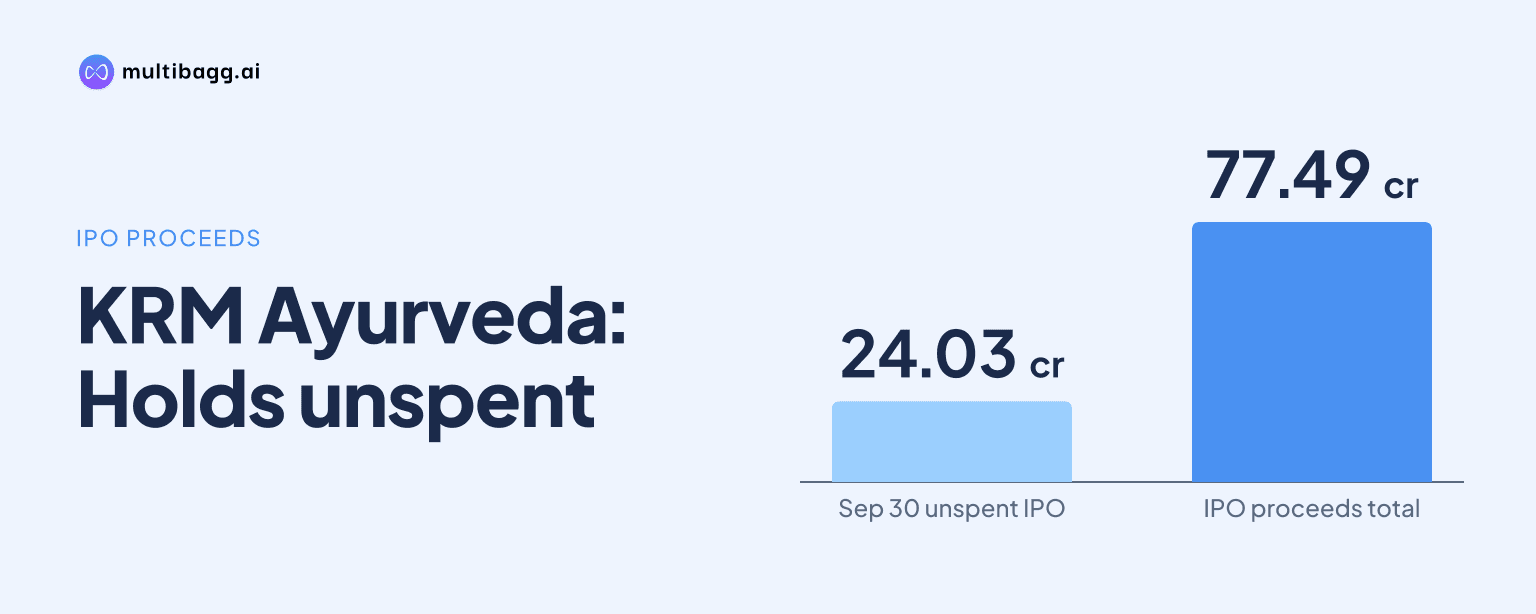
KRM Ayurveda Limited had ₹24.03 crore of its ₹77.49 crore initial public offering (IPO) proceeds unutilised on September 30, 2026, including no spending from the ₹13.67 crore allocated to telemedicine operational facilities. Cumulative utilisation reached ₹53.46 crore after ₹6.13 crore was deployed during the July-September 2026 quarter.
Know KRM Ayurveda inside out
Results, valuation, peers and who's buying, in one view.
How much of KRM Ayurveda's IPO proceeds remained unutilised?
KRM Ayurveda had ₹24.03 crore of IPO proceeds unutilised at September 30, 2026. The utilisation statement records ₹53.46 crore deployed from the ₹77.49 crore total issue allocation, up from ₹47.33 crore at the beginning of the July 1 to September 30, 2026 period.
The ₹6.13 crore deployed during the quarter was the difference between cumulative utilisation of ₹47.33 crore at its start and ₹53.46 crore at its end. The certificate from Shiv & Associates was issued under Regulation 32 of the Securities and Exchange Board of India (SEBI) Issue of Capital and Disclosure Requirements Regulations, 2018, and covered utilisation through September 30, 2026.
KRM Ayurveda's unutilised-and-deployed schedule separately listed ₹24.06 crore invested in bank accounts and fixed deposits, with ₹0.61 crore of earnings and a quarter-end market value of ₹24.67 crore. The schedule included ₹10 crore with Axis Bank, two separate ₹3 crore placements with HDFC Bank, and ₹0.42 crore in the Axis Bank monitoring account.
Management represented that IPO proceeds pending use were held in the monitoring account and fixed deposits with scheduled commercial banks, as required under the SEBI regulations. Shiv & Associates said its examination covered the Axis Bank monitoring account, other bank statements, fixed-deposit receipts, vouchers, payment records and management representations for April 1 through September 30, 2026; it did not provide an audit opinion on KRM Ayurveda's financial results as a whole.
Why had KRM Ayurveda not begun telemedicine-facility spending?
KRM Ayurveda had spent nil of the ₹13.67 crore set aside for construction and development of telemedicine operational facilities by September 30, 2026. The allocation remained ₹13.67 crore under both the offer document and revised-cost schedules, while the utilisation statement recorded nil spending both at the quarter's beginning and during July-September 2026.
The filing does not disclose a construction timetable, implementation milestone or date for the start of telemedicine-facility expenditure. At ₹13.67 crore, telemedicine was the largest remaining IPO object, accounting for more than half of the ₹24.03 crore unutilised balance reported at September 30, 2026.
The other unspent heads were ₹5.06 crore for general corporate purposes, ₹3.99 crore for human resources and ₹1.30 crore for customer relationship management (CRM) software and hardware infrastructure. These four remaining balances, including the telemedicine allocation, total the reported ₹24.03 crore unutilised proceeds.
KRM Ayurveda fully utilised ₹22.90 crore for working-capital requirements, ₹12.50 crore for loan repayment or prepayment, and ₹11.77 crore for issue-related expenses by September 30, 2026. CRM spending rose by ₹0.12 crore during the quarter to ₹0.12 crore cumulatively, while human-resources spending increased by ₹1.40 crore to ₹1.45 crore.
Got a follow-up? Ask IRIS
Which IPO allocations did KRM Ayurveda use during the quarter?
KRM Ayurveda's largest IPO deployment in July-September 2026 was ₹4.49 crore for general corporate purposes, followed by ₹1.40 crore for human resources. The company also used ₹0.13 crore for working capital and ₹0.12 crore for CRM software and hardware, while telemedicine facilities, loan repayment and issue-related expenses recorded nil deployment during the quarter.
The ₹4.49 crore general-corporate-purpose spend was split between ₹1.90 crore of capital expenditure, ₹2.34 crore of operational expenses including rent and commission expenses, and ₹0.25 crore of rent security deposits. Cumulative use under that head rose from ₹0.24 crore at July 1, 2026 to ₹4.73 crore at September 30, leaving ₹5.06 crore unutilised.
Working capital had been substantially deployed before the September quarter, with ₹22.77 crore used at July 1 and the remaining ₹0.13 crore used in the quarter. A separate working-capital certificate stated that the full ₹22.90 crore allocation had been utilised by September 30, compared with expected utilisation of ₹8 crore in financial year 2025-26 and ₹14.90 crore in financial year 2026-27.
The same working-capital certificate stated that ₹10.6421 crore of IPO proceeds earmarked for purposes other than working capital was parked in fixed deposits and included in other current assets. Its reported working-capital use aligns with the IPO utilisation schedule, which showed no unutilised balance against the ₹22.90 crore working-capital object at September 30, 2026.
What changed in KRM Ayurveda's IPO spending plan?
KRM Ayurveda moved ₹0.20 crore from general corporate purposes to issue-related expenses after issue expenses exceeded the original estimate. The revised general-corporate-purpose allocation fell to ₹9.79 crore from ₹9.99 crore, while the issue-expense allocation increased to ₹11.77 crore from ₹11.57 crore; the total IPO allocation remained ₹77.49 crore.
The company said members approved the change at the annual general meeting (AGM) held on September 30, 2026. The certificate also states that the board approved the revised general-corporate-purpose cost on May 1, 2026, and describes the ₹0.20 crore excess issue-expense utilisation as having been used for legitimate business purposes.
The utilisation certificate answered “No material deviation” when asked whether shareholder approval had been obtained for material deviations from offer-document expenditure, but separately disclosed the ₹0.20 crore reallocation. It also reported no change in the means of finance for the IPO objects, no major deviation from earlier monitoring-agency reports, and no event identified as materially affecting investor decision-making.
KRM Ayurveda's September 2026 half-year financial results provide operating context for the deployment of the working-capital allocation. Net revenue from operations was ₹66.9792 crore for the half year ended September 30, 2026, compared with ₹48.3571 crore in the corresponding 2025 period, while profit after tax rose to ₹17.2309 crore from ₹8.2227 crore.
Cash flow from operating activities nevertheless moved to an outflow of ₹4.4888 crore in the half year ended September 30, 2026, from an inflow of ₹2.2842 crore a year earlier. The cash-flow statement recorded increases of ₹16.2206 crore in trade receivables and ₹7.6231 crore in inventories, compared with respective increases of ₹11.8874 crore and ₹0.0342 crore in the prior-year period.
Conclusion
KRM Ayurveda had deployed ₹53.46 crore of its ₹77.49 crore IPO proceeds by September 30, 2026, completing the working-capital, loan-repayment and issue-expense objects. The principal outstanding use was the ₹13.67 crore telemedicine-facilities allocation, where the utilisation statement recorded nil expenditure, alongside ₹10.35 crore remaining across general corporate purposes, human resources and CRM infrastructure.
The next disclosed matter to watch is whether KRM Ayurveda starts spending the ₹13.67 crore telemedicine allocation and reduces the ₹24.03 crore unutilised balance held pending deployment. The September 30, 2026 certificate provides no timetable or completion target for telemedicine facilities, while the ₹0.20 crore allocation change had already received board approval on May 1, 2026 and shareholder approval on September 30, 2026.