










KSCL creditors approve KPL merger with 99.94% by value
Key highlights
- KSCL unsecured creditors approved the KPL amalgamation with 99.9442% of valid vote value in favour on 13 November 2026.
- A total of 751 creditors voted in favour, while 2 creditors voted against the merger resolution.
- Remote e-voting contributed 4,24,64,075 favourable vote-value units, or 99.7072% of valid vote value.
- KSCL reported 995 unsecured creditors on the 31 July 2026 record date and 347 attendees at the virtual meeting.
powered by IRIS
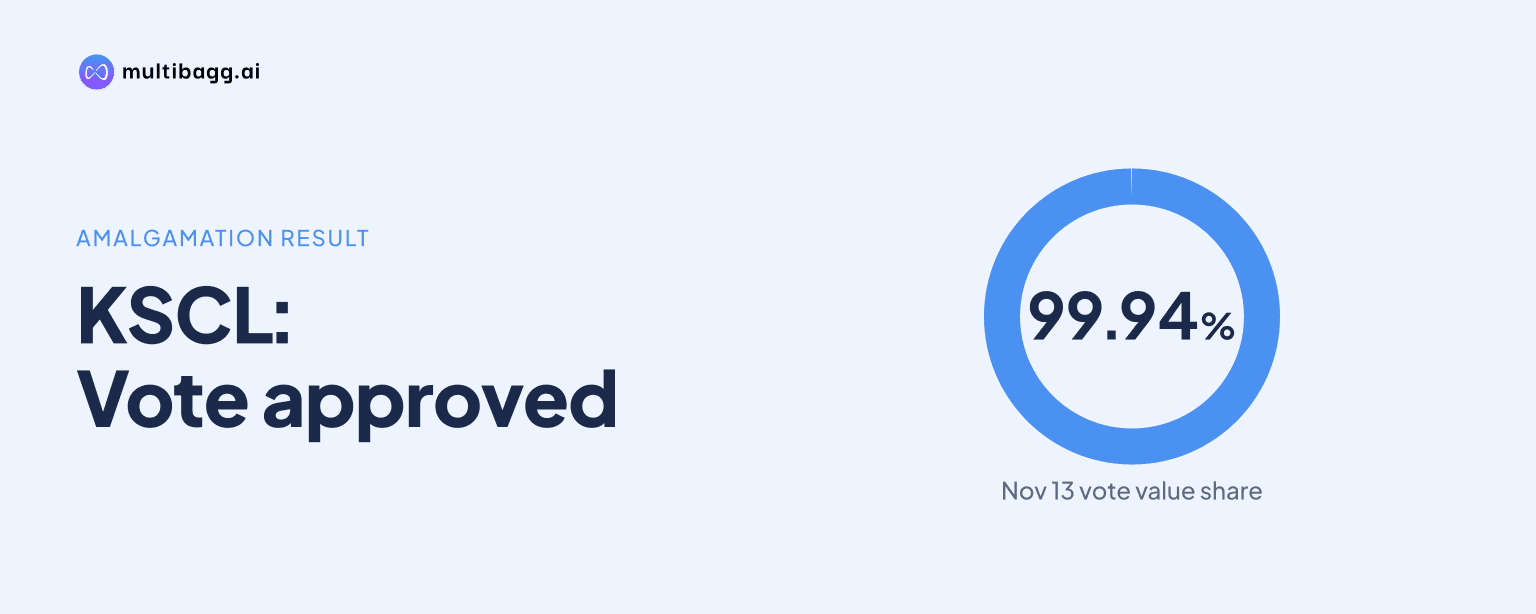
Kothari Sugars and Chemicals Limited (KSCL) unsecured creditors approved its proposed amalgamation into Kothari Petrochemicals Limited (KPL) on 13 November 2026, with 99.9442% of valid vote value, representing 4,25,64,998 vote-value units, cast in favour. The National Company Law Tribunal (NCLT)-convened meeting recorded two votes against and no invalid votes.
Know Kothari Sugars & Chemicals inside out
Results, valuation, peers and who's buying, in one view.
How did KSCL unsecured creditors vote on the merger?
KSCL unsecured creditors approved the amalgamation resolution with 751 creditors, representing 99.7344% of participating creditors, voting in favour on 13 November 2026. Their favourable votes represented 4,25,64,998 valid vote-value units, while two creditors cast 23,785 vote-value units against the scheme, equal to 0.0558% of valid vote value.
The resolution sought approval for the scheme of amalgamation between KSCL, identified as the transferor company, and KPL, identified as the transferee company, along with their respective shareholders and creditors. The scrutiniser certified that the resolution was passed at the NCLT-convened unsecured creditors meeting under the requisite-majority process prescribed by Section 230(6) of the Companies Act, 2013.
The difference between support measured by creditor count and vote value was visible: 99.7344% of creditors who voted supported the resolution, compared with 99.9442% of value. This means the two opposing creditors held a slightly larger proportion of vote value than their 0.2656% share of participating creditor numbers, but their combined value remained 23,785 units.
How did remote voting compare with voting at the KSCL meeting?
KSCL received almost all favourable vote value through remote e-voting, which supplied 4,24,64,075 favourable units, or 99.7072% of valid vote value. E-voting at the meeting added 1,00,923 favourable units, or 0.2370%, and produced no vote against the resolution.
The remote voting window ran from 9:00 a.m. Indian Standard Time on 10 November 2026 to 5:00 p.m. on 12 November 2026 through Central Depository Services (India) Limited (CDSL). CDSL disabled the remote module after that deadline, while eligible creditors who had not voted remotely could vote electronically during the 13 November meeting.
The virtual meeting began at 11:30 a.m. on 13 November 2026 through Webex after the chairperson confirmed a quorum. It was attended virtually by 347 unsecured creditors, and the e-voting module stayed open for 30 minutes after the meeting ended before being blocked at 12:05 p.m.; there were no proxies because the meeting was held through video conferencing or other audio-visual means.
Got a follow-up? Ask IRIS
What did KSCL say about unsecured creditor protections?
KSCL management told the 13 November 2026 meeting that the proposed scheme would keep unsecured creditors’ interests and rights intact, and that KPL would honour all payment terms. That representation was made after the chairperson asked management to explain the rationale, salient features and objective of the amalgamation scheme.
The resolution also authorises the KSCL board to take actions required to implement the scheme, including accounting entries, asset and liability transfer or vesting, and execution of relevant documents. It permits the board to address conditions or modifications imposed by the NCLT, the Securities and Exchange Board of India (SEBI), or other authorities, subject to the terms described in the resolution.
The filing separately reports that no unsecured creditor raised an objection to the proposed scheme, even though two creditors voted against it. These are distinct results in the disclosure: the voting table records 23,785 units against, while the scrutiniser’s certification says no creditor raised an objection during the NCLT-convened process.
What approvals are still required for the KSCL-KPL amalgamation?
The creditor vote is an approved meeting resolution, but the scheme remains subject to sanction by the NCLT and any other approvals or conditions that may be necessary. The resolution expressly refers to the NCLT, SEBI and other regulatory or government authorities as bodies that may impose conditions, modifications, permissions or sanctions before implementation.
The NCLT Chennai Division Bench-I ordered the unsecured creditors meeting on 30 September 2026 in CA(CAA)/72(CHE)/2026. The National Stock Exchange of India Limited had already issued an observation letter dated 19 August 2026, while the creditors’ notice dated 9 October 2026 was circulated through registered email or physical communication and published in newspapers on 12 October 2026.
Only unsecured creditors recorded as of the 31 July 2026 cut-off date were entitled to vote. KSCL reported 995 unsecured creditors on the record date, of whom 753 cast valid votes across remote and meeting e-voting, based on the 751 creditors in favour and two against; the disclosure reported zero invalid votes for lack of authorisation documents.
Conclusion
The 13 November 2026 result gives KSCL’s proposed transfer into KPL the required approval from its unsecured creditor class, with 99.9442% of valid vote value and 99.7344% of participating creditors supporting it. Remote e-voting accounted for 4,24,64,075 of the 4,25,64,998 favourable vote-value units, making it the principal channel for approval.
The next disclosed milestone is NCLT sanction and any conditions or approvals required from SEBI, the NCLT or other authorities. KSCL’s resolution gives its board authority to consider such modifications and, if terms are not acceptable or implementation cannot otherwise proceed, to withdraw and where applicable re-file the scheme.