










Kshitij Polyline commits Rs 65 crore to UAE recycling plant
Key highlights
- Kshitij Polyline announced an AED 25 million, or about Rs 65 crore, UAE recycling investment on November 23, 2026.
- The proposed UAE facility will process waste plastics and plastic e-waste into recycled materials and plastic sheets.
- Plastic sheets are intended mainly for stationery manufacturing, while recycled materials are also aimed at manufacturing, construction and packaging.
- Kshitij Polyline said the project will use bank financing and equity funding without disclosing the split.
powered by IRIS
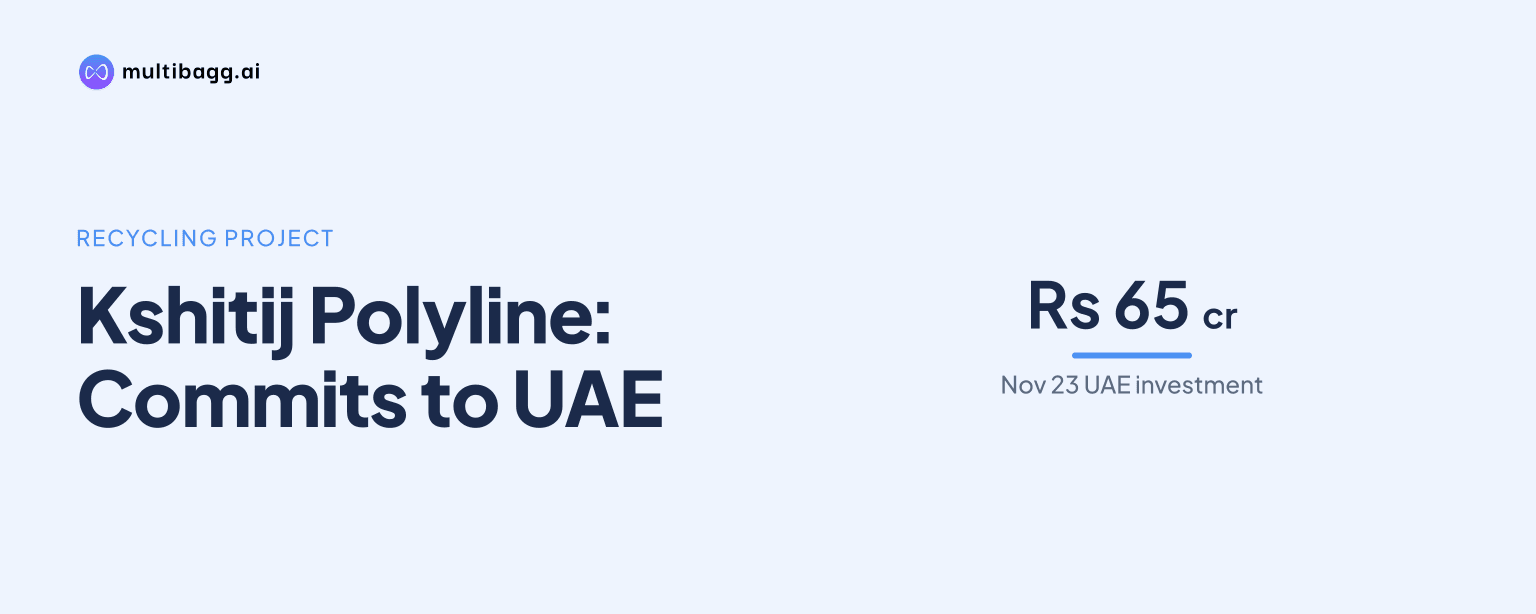
Kshitij Polyline Limited announced on November 23, 2026 an AED 25 million investment, equivalent to about Rs 65 crore, for a UAE recycling plant that will process waste plastics and plastic e-waste into plastic sheets mainly used in stationery manufacturing. The project is to be financed through bank funding and equity funding.
Know Kshitij Polyline inside out
Results, valuation, peers and who's buying, in one view.
What has Kshitij Polyline announced for the UAE?
Kshitij Polyline has announced an AED 25 million, or about Rs 65 crore, investment to establish a recycling plant in the UAE. Its November 23, 2026 release identifies the company as a stationery manufacturer and states that the facility will manufacture plastic sheets mainly for stationery manufacturing.
The disclosed project links waste treatment to a defined manufacturing output. Kshitij Polyline said waste plastics and plastic e-waste will be converted into high-quality recycled raw materials for manufacturing, construction and packaging industries, while the release’s key highlights specify plastic sheets as the final product for stationery use.
This creates a stated change from discarded plastic inputs to recycled material and finished sheets. Plastic sheets are specifically tied to the stationery segment, whereas the recovered raw materials are described for three additional end-use segments: manufacturing, construction and packaging.
What materials will Kshitij Polyline process and produce?
Kshitij Polyline said the UAE plant will process two material streams: waste plastics and plastic e-waste. The November 23, 2026 announcement does not disclose annual intake, the type of plastic polymers involved, a recovery-rate target or the volume of e-waste expected to be handled.
The stated final product is plastic sheets mainly intended for stationery manufacturing. In addition, Kshitij Polyline said the recycling process will produce recycled raw materials for manufacturing, construction and packaging industries, broadening the listed end-use categories beyond its stationery-related sheet output.
The source distinguishes between the plant’s material inputs and its intended outputs. Waste plastics and plastic e-waste are the inputs; recycled raw materials and plastic sheets are the outputs. However, Kshitij Polyline did not state whether the plastic sheets will be consumed by its own operations, supplied to third parties, or sold under customer or offtake arrangements.
No production capacity, sheet specification or revenue forecast is included in the release dated November 23, 2026. The company also did not disclose the expected share of output allocated between stationery manufacturing and the manufacturing, construction and packaging markets named in the announcement.
What technology and environmental outcomes has Kshitij Polyline outlined?
Kshitij Polyline said the proposed UAE facility will use modern sorting, shredding and processing technology to maximise recovery rates while minimising energy use and emissions. Sorting, shredding and processing are the only operating mechanisms identified in the November 23, 2026 disclosure, which names no equipment supplier or technology provider.
The company expects the plant to divert waste from landfill and reduce carbon dioxide, or CO₂, emissions. These are expected outcomes rather than disclosed performance measures because Kshitij Polyline has not provided a waste-diversion volume, an annual CO₂-reduction estimate, an energy-use figure or a recovery percentage.
Mrs. Vineeta Jain, whole-time director of Kshitij Polyline, said the facility will work with local businesses, municipalities and communities to encourage responsible waste segregation and collection. The release does not name any UAE municipality, local business, waste collector or community organisation participating in that process.
The environmental mechanism described is therefore a sequence of sorting, shredding and processing waste plastics and plastic e-waste into recycled materials and plastic sheets. The announcement does not set a date for construction, commissioning or commercial production, so the timing of the stated landfill and emissions outcomes is not disclosed.
Got a follow-up? Ask IRIS
How will Kshitij Polyline fund and develop the UAE plant?
Kshitij Polyline said the plastic recycling plant will be funded through a mix of bank financing and equity funding. The November 23, 2026 release does not divide the AED 25 million, or about Rs 65 crore, commitment between debt and equity.
The funding disclosure does not identify a lender, bank facility, interest rate, repayment terms, equity investor or equity issuance mechanism. It also does not state whether financing has been sanctioned or equity capital has been raised, distinguishing the announced funding sources from completed financing arrangements.
Kshitij Polyline has not given a construction schedule, phased investment plan or commercial-start date for the UAE plant. The release also provides no processing-capacity figure, projected operating cost, expected revenue, profitability estimate or forecast contribution from plastic-sheet production to its stationery business.
The AED 25 million commitment is the project investment amount, while bank financing and equity funding are the proposed capital sources. That distinction leaves the timing of cash deployment, the debt-equity mix and the project’s financial contribution unresolved as of November 23, 2026.
How does Kshitij Polyline link the project to UAE sustainability plans?
Kshitij Polyline said its UAE recycling project aligns with the UAE Net Zero 2050 strategic initiative and the Dubai Integrated Waste Management Strategy 2041. According to the November 23, 2026 announcement, these frameworks aim to reduce dependence on landfill and raise waste-diversion rates across the emirate.
Mahendra Kumar Jain, chairman and chief financial officer of Kshitij Polyline, said the AED 25 million investment reflects confidence in the UAE’s sustainability direction and the company’s commitment to converting waste into resources. He said Kshitij Polyline aims to reduce landfill waste and carbon emissions while providing local industries with recycled materials.
Those statements are management aims, not reported outcomes from an operating plant. The source supports the connection through the proposed processing of waste plastics and plastic e-waste, but it does not quantify the project’s future landfill reduction, CO₂ reduction, local-material supply or contribution to the 2050 and 2041 policy frameworks.
The commercial and environmental elements in the release use the same material chain: waste plastic inputs, sorting and processing mechanisms, and recycled-material or plastic-sheet outputs. Kshitij Polyline has not disclosed whether any UAE authority has granted approvals, incentives, land allocation or a formal partnership for the project.
Conclusion
Kshitij Polyline has disclosed a proposed AED 25 million, or about Rs 65 crore, UAE investment that would turn waste plastics and plastic e-waste into recycled raw materials and plastic sheets. The announcement connects the plastic-sheet output mainly to stationery manufacturing, while also naming manufacturing, construction and packaging as potential markets for recycled materials.
The next disclosures to watch are a construction and commissioning timetable, annual processing capacity and the split between bank financing and equity funding, none of which were specified on November 23, 2026. Further details on UAE project approvals, waste-collection partners, customers and quantified landfill or CO₂ outcomes would clarify the plan’s execution path.