










Lalithaa Jewellery plans merger with no new share issuance
Key highlights
- Lalithaa Jewellery’s board approved the proposed amalgamation of two wholly owned subsidiaries on November 11, 2026.
- The proposed scheme states an effective date of April 1, 2026.
- Lalithaa Jewellery will pay no cash consideration and issue no fresh equity shares under the scheme.
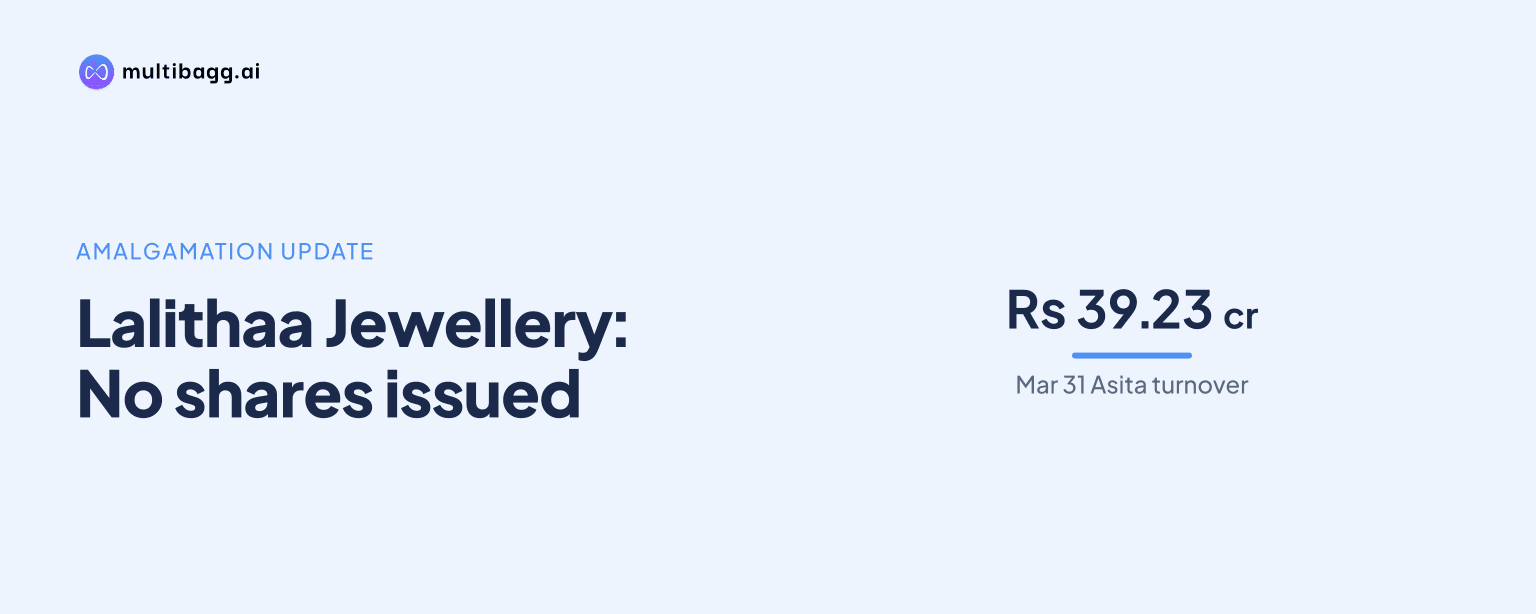
- Asita reported audited standalone turnover of Rs 39.234076 crore as of March 31, 2026.
powered by IRIS
Lalithaa Jewellery Mart Limited has proposed merging two wholly owned subsidiaries into the parent from April 1, 2026, with no cash consideration, no fresh equity issue and no change in shareholder ownership. The board approved the proposed Scheme of Amalgamation on November 11, 2026, covering Centigrade Apparels Private Limited and Asita Jewellery Manufacturing Private Limited.
Know Lalithaa Jewellery Mart inside out
Results, valuation, peers and who's buying, in one view.
Which subsidiaries will Lalithaa Jewellery merge?
Lalithaa Jewellery will merge Centigrade Apparels Private Limited and Asita Jewellery Manufacturing Private Limited under the proposed scheme approved on November 11, 2026. The filing identifies Lalithaa Jewellery as the transferee company and the two wholly owned subsidiaries as transferor companies, with effect stated from April 1, 2026 under Sections 230 to 232 of the Companies Act, 2013.
Centigrade manufactures and exports woven and knitted garments, and Lalithaa Jewellery said its operations are presently at a limited scale. Asita manufactures, exports, imports and trades gold, bullion, jewellery, precious and semi-precious stones; it may also operate as a commission agent, goldsmith and silversmith. Lalithaa Jewellery itself manufactures, exports, imports and trades gold, bullion, jewellery, precious and semi-precious stones and metals in wholesale and retail channels.
The two companies were already included in Lalithaa Jewellery’s unaudited consolidated financial results for the quarter and half year ended September 30, 2026. The proposal therefore changes the legal holding structure of businesses already consolidated in group accounts, rather than bringing newly acquired subsidiaries into the reported group perimeter.
Why is Lalithaa Jewellery pursuing the merger?
Lalithaa Jewellery says the merger is intended to consolidate three entities into one company and support focused growth, operational efficiency, integration synergies and better group supervision. Management also said that pooling the resources of the two transferor companies with those of the transferee could lead to more productive use of resources, cost efficiency and operational efficiency.
The stated rationale includes reducing shareholding layers so Lalithaa Jewellery directly controls the assets and businesses of Centigrade and Asita. Management also cited the potential to scale operations, reduce administrative costs, improve market visibility and enable smoother implementation of policy changes from a higher management level. These are management objectives in the disclosure, not quantified financial benefits or forecasts.
Lalithaa Jewellery said it sees no likelihood that the interests of shareholders or creditors of the three entities would be prejudiced by the scheme. It also said the amalgamation would not impose an additional burden on their members and described the proposal as commercially and economically viable, feasible, fair and reasonable for the companies and their stakeholders.
Will Lalithaa Jewellery pay cash or issue shares?
Lalithaa Jewellery will pay no cash consideration and issue no fresh equity shares under the proposed scheme. The company and its nominees already hold all issued, subscribed and paid-up equity capital of Centigrade and Asita, according to the November 11, 2026 disclosure.
Once the scheme becomes effective, the equity share capital of both transferor companies will automatically be cancelled. The filing specifically says there will be no issue or allotment of Lalithaa Jewellery shares, notwithstanding anything contrary in the scheme. As a result, the transaction does not provide consideration to outside shareholders of either subsidiary because none are identified.
Lalithaa Jewellery also said its shareholding pattern will not change pursuant to the scheme. The stated mechanism is the absence of a fresh equity issue, rather than a share swap that would add new holders to the parent’s register. The filing further says transactions between a holding company and wholly owned subsidiary are exempt from certain related-party transaction requirements under Regulation 23(5)(b) of the Securities and Exchange Board of India Listing Obligations and Disclosure Requirements Regulations.
Got a follow-up? Ask IRIS
How large are the entities in Lalithaa Jewellery’s scheme?
Asita is the larger of the two transferor companies on the disclosed March 31, 2026 audited standalone figures, reporting turnover of Rs 39.234076 crore and net worth of Rs 15.692095 crore. Centigrade reported net worth of Rs 1.261304 crore, while its turnover was shown as a dash in the filing’s table. That disclosure is consistent with Lalithaa Jewellery’s description of Centigrade as operating at a limited scale.
Lalithaa Jewellery’s standalone turnover of Rs 25,039.036 crore was Rs 15.109 crore higher than its consolidated turnover of Rs 25,023.927 crore as of March 31, 2026. Its standalone net worth of Rs 3,016.264 crore was Rs 86.539 crore above consolidated net worth of Rs 2,929.725 crore. The filing presents both bases but does not explain the reasons for those differences.
The table uses audited figures for the transferor companies and discloses both standalone and consolidated figures for Lalithaa Jewellery. Asita’s disclosed turnover was more than its Rs 15.692095 crore net worth, while Centigrade’s turnover was not reported in the same table; the source does not provide a separate profitability comparison for either subsidiary.
What does the April 1, 2026 effective date mean?
The scheme states April 1, 2026 as its effective date, although Lalithaa Jewellery’s board approved the proposal later, on November 11, 2026. The disclosure does not state that the legal amalgamation has been completed, and it provides no completion date, tribunal timetable or schedule of additional approvals.
The board approval was disclosed alongside the group’s unaudited consolidated financial results for the quarter and half year ended September 30, 2026. Those results already included Centigrade and Asita, so the scheme’s immediate disclosed effect is corporate simplification rather than a change in which operating entities contribute to consolidated reporting.
The filing does not quantify anticipated savings, integration costs, tax effects or any impact on revenue from the direct absorption of the subsidiaries. It instead identifies administrative-cost reduction, operational efficiency, resource pooling and direct control as the intended mechanisms. Whether and when those outcomes occur will depend on the scheme becoming effective and the subsequent integration of the two businesses.
Conclusion
Lalithaa Jewellery’s proposed amalgamation would bring Centigrade’s garment operations and Asita’s jewellery-related operations directly into the listed parent, while cancelling subsidiary equity already owned by Lalithaa Jewellery and its nominees. The structure avoids both cash consideration and new parent shares, leaving the parent’s disclosed shareholding pattern unchanged.
The next development to watch is progress after the November 11, 2026 board approval, because the disclosure gives no completion date or approval timetable despite stating an April 1, 2026 effective date. Investors can also monitor whether Lalithaa Jewellery later quantifies the administrative-cost, operational-efficiency and direct-control outcomes management identified for the scheme.