










Leo Dryfruits revenue rises 82%, profit gains 29% in H1
Key highlights
- Leo Dryfruits reported Rs 97.13 crore of revenue from operations for the half year ended September 30, 2026, up 82% year on year.
- Net profit rose 29% year on year to Rs 6.14 crore, while basic earnings per share increased to Rs 3.43 from Rs 2.66.
- Operating activities used Rs 8.96 crore of cash in the September 2026 half year, after operating profit before working-capital changes of Rs 11.98 crore.
- Long-term borrowings stood at Rs 17.61 crore at September 30, 2026, and financing cash flow included Rs 14.31 crore of long-term borrowing proceeds.
powered by IRIS
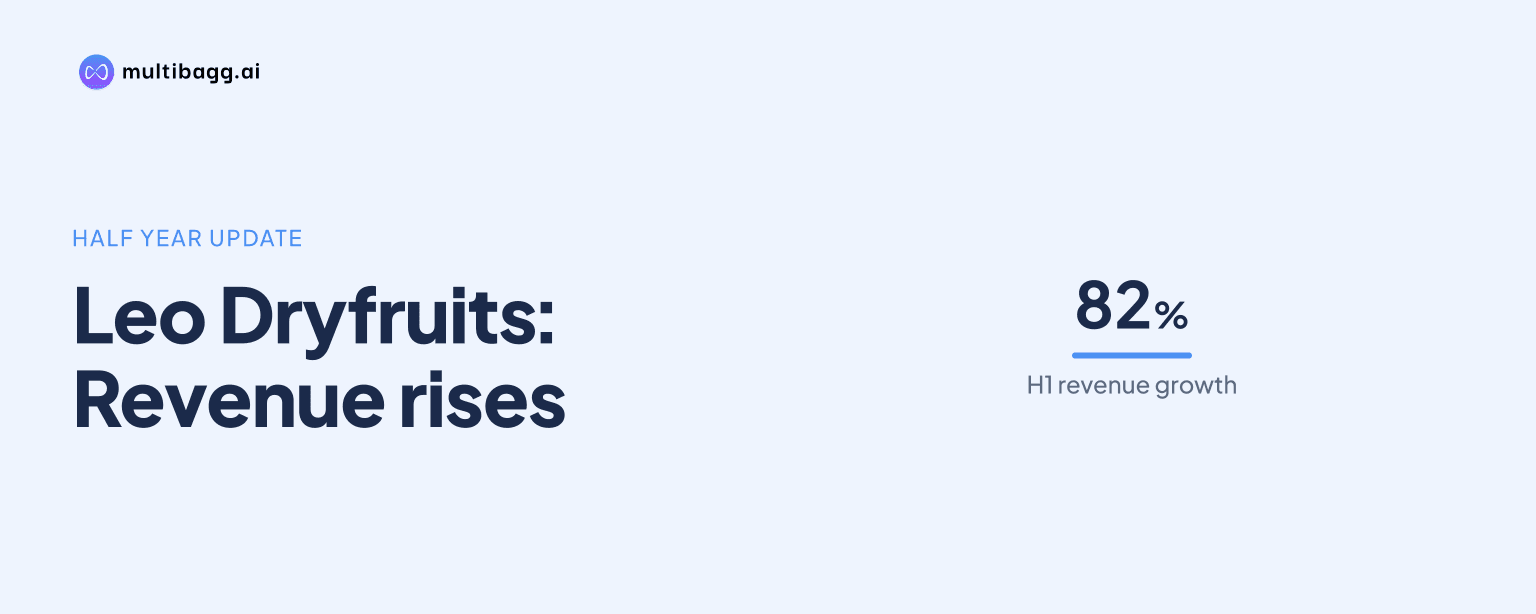
Leo Dryfruits & Spices Trading Limited reported standalone revenue from operations of Rs 97.13 crore for the half year ended September 30, 2026, up 82% from Rs 53.46 crore a year earlier, while net profit increased 29% to Rs 6.14 crore and operating activities used Rs 8.96 crore of cash.
Know Leo Dryfruits & Spices Trading inside out
Results, valuation, peers and who's buying, in one view.
How much did Leo Dryfruits grow in the first half?
Leo Dryfruits increased revenue from operations to Rs 97.13 crore in the half year ended September 30, 2026, from Rs 53.46 crore in the half year ended September 30, 2025. The increase was Rs 43.67 crore, or about 82% year on year. Total income rose to Rs 97.16 crore from Rs 53.59 crore, although other income declined to Rs 2.83 lakh from Rs 13.32 lakh.
Revenue was lower than the Rs 120.79 crore recorded in the preceding half year ended March 31, 2026. Total income also declined from Rs 121.07 crore in that six-month period to Rs 97.16 crore in the September 2026 half year. Leo Dryfruits reported one operating segment under Accounting Standard 17, so the filing does not provide a segment-level explanation for the movement.
What changed in Leo Dryfruits' costs and profit?
Leo Dryfruits reported total expenses of Rs 88.52 crore for the September 2026 half year, compared with Rs 46.99 crore a year earlier. Purchases of stock-in-trade increased by Rs 34.47 crore to Rs 86.66 crore from Rs 52.19 crore, accounting for most of the increase in the expense base as revenue expanded.
Profit before tax rose to Rs 8.64 crore from Rs 6.59 crore in the year-earlier half year, but was below Rs 9.40 crore in the half year ended March 31, 2026. Current tax increased to Rs 2.53 crore from Rs 1.85 crore, while deferred tax was Rs 3.58 lakh. Net profit was Rs 6.14 crore, compared with Rs 4.76 crore a year earlier and Rs 5.78 crore in the preceding six months.
Finance costs increased to Rs 2.55 crore from Rs 1.35 crore in the September 2025 half year. Employee-benefit expense rose to Rs 1.95 crore from Rs 1.83 crore, while other expenses declined to Rs 1.16 crore from Rs 2.33 crore. Basic earnings per share, which Leo Dryfruits stated is not annualised for half-year periods, rose to Rs 3.43 from Rs 2.66.
Why did Leo Dryfruits report negative operating cash flow?
Leo Dryfruits reported net cash used in operating activities of Rs 8.96 crore in the half year ended September 30, 2026, despite reporting profit before tax of Rs 8.64 crore. The cash-flow statement recorded operating profit before working-capital changes of Rs 11.98 crore before movements in current liabilities, provisions, loans, advances and other current assets.
Those working-capital movements resulted in cash generated from operations of negative Rs 8.94 crore. After direct taxes paid of Rs 1.88 lakh, the operating cash outflow was Rs 8.96 crore. For comparison, the filing reports operating cash outflow of Rs 6.42 crore for the year ended March 31, 2026, making the latest six-month outflow Rs 2.53 crore greater than that full-year figure.
The income statement and cash-flow statement therefore show different outcomes for the September 2026 half year: net profit was Rs 6.14 crore, while operating cash flow was negative Rs 8.96 crore. The filing identifies working-capital movements as the mechanism between operating profit before such changes and cash generated from operations, but does not provide a separate narrative explanation for each movement.
Got a follow-up? Ask IRIS
How was Leo Dryfruits' cash outflow financed?
Leo Dryfruits generated Rs 5.08 crore of net cash from financing activities in the half year ended September 30, 2026. The financing cash-flow section records Rs 14.31 crore of proceeds from long-term borrowings, partly offset by a Rs 2.98 crore movement in short-term borrowings and Rs 2.28 crore of interest and financial charges.
Long-term borrowings stood at Rs 17.61 crore at September 30, 2026. Total assets were Rs 195.60 crore at that date, compared with Rs 147.51 crore at March 31, 2026. The balance-sheet comparison shows that the asset base increased by Rs 48.08 crore over the six months.
Investing activities used Rs 8.24 lakh in the September 2026 half year, including Rs 5.82 lakh spent on property, plant and equipment. The filing recorded net cash used in investing activities of Rs 6.51 crore for the year ended March 31, 2026, including Rs 6.27 crore of property, plant and equipment purchases. The latest half-year cash-flow statement reported a Rs 1.13 lakh net increase in cash and cash equivalents.
What disclosures should Leo Dryfruits shareholders monitor next?
Leo Dryfruits' unaudited standalone results were reviewed by Ratan Chandak & Co LLP and approved by the board on November 13, 2026. The reviewer stated that nothing had come to its attention to suggest the standalone statement did not disclose required information or contained a material misstatement, while also stating that a review provides less assurance than an audit.
The reviewer noted that a dividend declared on September 29, 2026 had not been paid to eligible shareholders within the prescribed timeline, resulting in stated non-compliance with Section 127 of the Companies Act, 2013, subject to applicable exceptions. The filing also states that corporate social responsibility expenditure for the financial year ended March 31, 2026 remained unspent as of the results date.
Leo Dryfruits had proposed an issue of 70 lakh fully convertible warrants aggregating to Rs 42 crore, but the proposed issue was discontinued after it did not obtain prior in-principle approval from BSE before convening the extraordinary general meeting. Separately, Leo Dryfruits proposes to incorporate two subsidiaries in the United Arab Emirates, with completion indicated by February 28, 2027, subject to approvals and regulatory compliance.
Conclusion
Leo Dryfruits recorded substantially higher year-on-year first-half revenue and profit for the six months ended September 30, 2026, with revenue reaching Rs 97.13 crore and net profit reaching Rs 6.14 crore. However, the Rs 8.96 crore operating cash outflow shows that the period's reported profit was accompanied by cash consumption through the working-capital movements shown in the cash-flow statement.
The next reporting periods will show whether operating cash flow changes after the September 2026 working-capital movements and how long-term borrowings, which stood at Rs 17.61 crore, develop. The disclosed milestones to monitor are the proposed incorporation of two UAE subsidiaries by February 28, 2027, the unpaid September 29, 2026 dividend and the status of unspent financial-year 2025-26 corporate social responsibility expenditure.