










Linc Limited operating cash flow falls to Rs 41.71 lakh
Key highlights
- Linc generated Rs 41.71 lakh of operating cash in the half year ended September 30, 2026, versus Rs 26.2454 crore a year earlier.
- Linc’s inventory increased by Rs 36.4072 crore to Rs 141.339 crore at September 30, 2026.
- Linc spent Rs 31.6815 crore on capital assets and related advances, up from Rs 20.4391 crore in the prior-year half.
- Linc’s current borrowings rose to Rs 23.6701 crore from Rs 6.4294 crore at March 31, 2026.
powered by IRIS
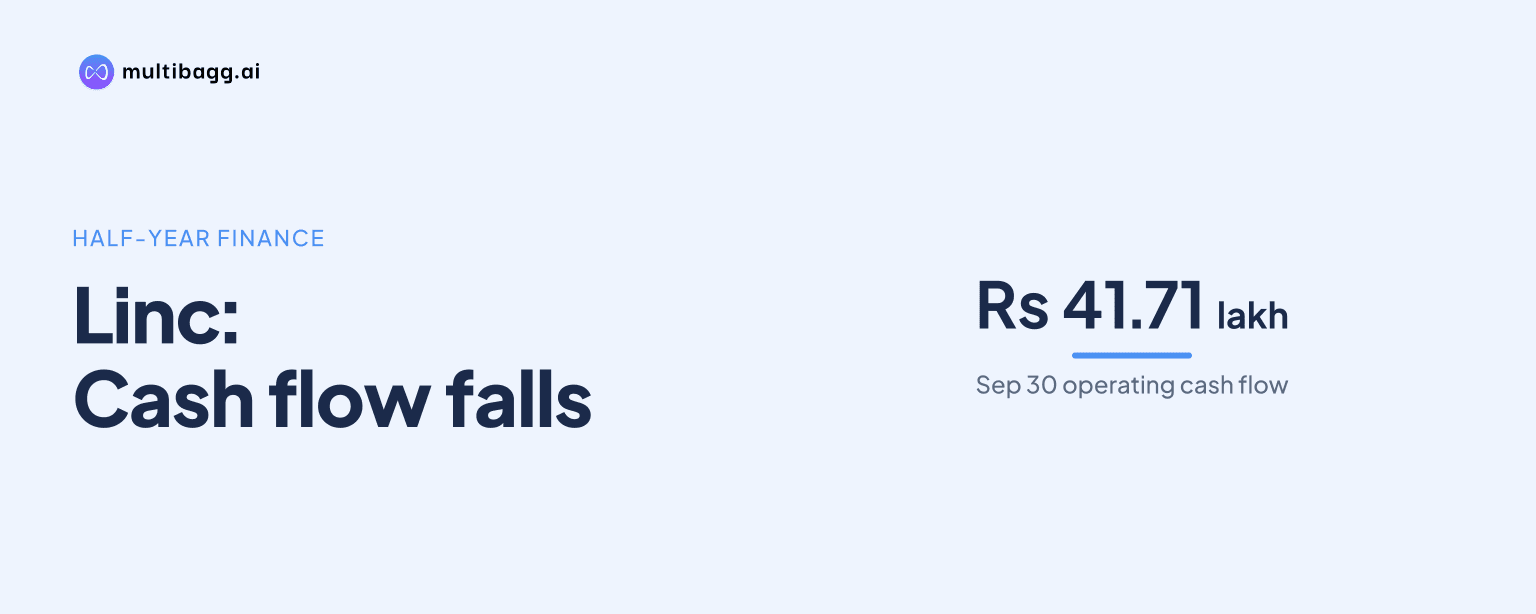
Linc Limited generated Rs 41.71 lakh of net cash from operating activities in the half year ended September 30, 2026, down from Rs 26.2454 crore a year earlier, as inventories increased by Rs 36.4072 crore and absorbed most of the cash generated from operations.
Know Linc inside out
Results, valuation, peers and who's buying, in one view.
How did Linc’s operating cash flow change in the half year?
Linc’s net operating cash flow fell by Rs 25.8283 crore year on year to Rs 41.71 lakh in the half year ended September 30, 2026. Cash generated from operations before direct taxes was Rs 4.2053 crore, compared with Rs 32.7359 crore in the half year ended September 30, 2025, while direct taxes paid were Rs 3.7882 crore against Rs 6.4905 crore.
The reduction came despite continued profitability. Operating profit before working-capital changes decreased to Rs 23.9089 crore from Rs 29.4599 crore, while consolidated profit before tax fell to Rs 15.4158 crore from Rs 23.3315 crore. Profit after tax was Rs 11.2499 crore, below Rs 15.5067 crore a year earlier, although revenue from operations increased to Rs 293.0727 crore from Rs 276.0485 crore.
Why did inventory absorb Linc’s operating cash?
Inventory was the largest operating cash-use item, increasing by Rs 36.4072 crore in the September 2026 half year, compared with a Rs 1.2068 crore increase in the corresponding 2025 period. Consolidated inventories stood at Rs 141.339 crore on September 30, 2026, up from Rs 104.9318 crore on March 31, 2026, matching the increase recorded in the cash-flow statement.
Receivables and other asset movements also used cash during the six months. Trade receivables increased by Rs 4.2103 crore, other current assets rose by Rs 6.2047 crore and other financial assets increased by Rs 58.46 lakh. These demands were partly offset by a Rs 19.6186 crore increase in trade payables, a Rs 4.0529 crore rise in other current liabilities and a Rs 3.3458 crore increase in other financial liabilities.
The working-capital pattern was materially different from the September 2025 half year. Trade receivables released Rs 2.6041 crore of cash in that earlier period but consumed Rs 4.2103 crore in 2026, while other current assets changed from a Rs 3.1941 crore cash release to a Rs 6.2047 crore outflow. Trade payables shifted from a Rs 2.3475 crore outflow in 2025 to a Rs 19.6186 crore inflow in 2026.
Got a follow-up? Ask IRIS
How much did Linc spend on investment and capital assets?
Linc used Rs 24.4319 crore in investing activities in the half year ended September 30, 2026, compared with Rs 21.2239 crore in the year-earlier half. Purchases of property, plant and equipment, intangible assets, capital work in progress and capital advances were Rs 31.6815 crore, up from Rs 20.4391 crore in the corresponding 2025 period.
The balance sheet shows the related expansion in non-current assets at September 30, 2026. Property, plant and equipment rose to Rs 96.8445 crore from Rs 89.041 crore at March 31, while capital work in progress increased to Rs 55.2011 crore from Rs 33.9201 crore. Right-of-use assets also increased to Rs 20.7127 crore from Rs 17.392 crore.
Investing inflows included Rs 7.04 crore from net redemption of fixed deposits, Rs 26.80 lakh of interest received and Rs 12.70 lakh from the sale of property, plant and equipment. Linc granted an intercorporate loan of Rs 5 crore and received a Rs 5 crore refund of an intercorporate loan during the same half year, leaving no net cash effect from those two loan movements.
How were Linc’s cash outflows financed and what changed on the balance sheet?
Linc’s financing cash flows totalled Rs 12.0203 crore in the half year ended September 30, 2026, compared with a Rs 10.5117 crore outflow in the prior-year period. The listed financing movements included Rs 17.2407 crore of net proceeds from short-term borrowings and Rs 6.1282 crore from equity shares issued by a subsidiary, offset by Rs 8.9234 crore of dividends, Rs 1.9882 crore of lease-liability payments and Rs 43.70 lakh of interest paid.
Current borrowings rose to Rs 23.6701 crore at September 30, 2026, from Rs 6.4294 crore at March 31, 2026. Cash and cash equivalents declined to Rs 1.2988 crore from Rs 13.2933 crore, and bank balances other than cash equivalents fell to Rs 1.1404 crore from Rs 7.1601 crore. The cash-flow statement reports a net decrease of Rs 11.9945 crore in cash and cash equivalents during the half year.
Total consolidated assets increased to Rs 417.6689 crore at September 30 from Rs 359.317 crore at March 31. Total equity rose to Rs 267.9886 crore from Rs 259.7932 crore, including non-controlling interests of Rs 9.4376 crore, compared with Rs 2.0541 crore. Linc reports one operating segment, writing instruments and stationery, so the filing provides no segment-level split of inventory or capital-expenditure movements.
Conclusion
Linc’s half-year figures show that higher revenue of Rs 293.0727 crore and profit after tax of Rs 11.2499 crore did not translate into comparable operating cash generation. The Rs 36.4072 crore inventory build-up, together with increases in receivables and other current assets, reduced net operating cash to Rs 41.71 lakh, while capital expenditure and related investment outflows further reduced cash balances.
The next results will indicate whether the Rs 141.339 crore inventory balance converts into sales and operating cash, and whether current borrowings of Rs 23.6701 crore change. Linc also disclosed an unresolved Goods and Services Tax demand order dated January 31, 2025, comprising Rs 3.5339 crore of tax, a Rs 3.5339 crore penalty and applicable interest; it appealed on March 23, 2025 and has made no provision based on taxation advice.